


Wydawcy
Katalog tematyczny
- Archeologia (109)
- Ekonomia, finanse, business (13704)
- Filozofia (1445)
- Historia (3040)
- Języki i językoznawstwo (2356)
- Lifestyle, hobby i rozrywka (475)
- Medycyna (9704)
- Nauki humanistyczne (4)
- Nauki o Ziemi i środowisku (2638)
- Nauki ścisłe (20412)
- Nauki społeczne (8486)
- Nauki techniczne (13450)
- Budownictwo lądowe (1045)
- Budownictwo komunikacyjne (9)
- Hydraulika (33)
- Konstrukcje budowlane (95)
- Mechanika konstrukcji (182)
- Przemysł budowlany (7)
- Chemia przemysłowa (2258)
- Elektronika i telekomunikacja (3287)
- Energetyka (1122)
- Inne nauki stosowane (363)
- Inżynieria biochemiczna (507)
- Inżynieria transportu (232)
- Mechanika i materiały (3316)
- Nauka o środowisku (321)
- Rolnictwo (507)
- Technika, ogólnie (475)
- Prawo (1696)
- Publikacje informacyjne i interdyscyplinarne (1288)
- Religia i wierzenia (917)
- Technika komputerowa (4067)
- Zdrowie, relacje międzyludzkie i rozwój osobisty (657)





Informacje szczegółowe o książce
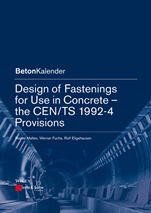
Design of Fastenings for Use in Concrete: The CEN/TS 1992–4 Provisions
ISBN 9783433030448
Autor: Rainer Mallée, Rolf Eligehausen, Werner Fuchs, Konrad Bergmeister, Frank Fingerloos, Johann–Dietr
Wydawca: Wiley
Dostępność: 3-6 tygodni
Cena: 286,65 zł
Przed złożeniem zamówienia prosimy o kontakt mailowy celem potwierdzenia ceny.
ISBN13: |
9783433030448 |
ISBN10: |
3433030448 |
Autor: |
Rainer Mallée, Rolf Eligehausen, Werner Fuchs, Konrad Bergmeister, Frank Fingerloos, Johann–Dietr |
Oprawa: |
Paperback |
Rok Wydania: |
2013-04-03 |
Ilość stron: |
170 |
Wymiary: |
239x171 |
Tematy: |
TN |
The European pre–standard CEN/TS 1992–4 for the design of fastenings by means of headed studs, anchor channels as well as post–installed mechanical and chemical anchors is ready for use. The background and interpretation of the provisions related to the determination of actions and resistances based on limit state design, durability, fire resistance, fatigue and earthquake actions as required by CEN/TS 1992 are described in detail. Selected chapters from the German concrete yearbook are now being published in the new English "Beton–Kalender Series" for the benefit of an international audience. Since it was founded in 1906, the Ernst & Sobin "Beton Kalender" has been supporting developments in reinforced and prestressed concrete. The aim was to publish a yearbook to reflect progress in "ferro–concrete" structures until – as the book′s first editor, Fritz von Emperger (1862–1942), expressed it – the "tempestuous development" in this form of construction came to an end. However, the "Beton Kalender" quickly became the chosen work of reference for civil and structural engineers, and apart from the years 1945–1950 has been published annually ever since.
Editorial XI 1 Introduction 1 2 Fields of application 3 3 Basis of design 13 3.1 General 13 3.2 Verifications 14 3.3 Partial factors 15 3.3.1 General 15 3.3.2 Actions 15 3.3.3 Resistance . 16 4 Derivation of forces acting on fasteners 19 4.1 General 19 4.2 Tension loads 19 4.2.1 Tension loads on fastenings with post–installed fasteners and headed fasteners 19 4.2.2 Tension loads on fastenings with anchor channels 21 4.3 Shear loads 23 4.3.1 Shear loads on fastenings with post–installed and headed fasteners 23 4.3.2 Shear loads on fastenings with anchor channels 35 4.4 Tension forces in a supplementary reinforcement 36 5 Verification of ultimate limit state by elastic analysis for post–installed fasteners (mechanical systems) 41 5.1 General 41 5.2 Tension load 42 5.2.1 Required verifications 42 5.2.2 Steel failure 44 5.2.3 Pull–out/pull–through failure 44 5.2.4 Conical concrete break–out failure 45 5.2.5 Splitting 61 5.3 Shear load 63 5.3.1 Required verifications 63 5.3.2 Steel failure without lever arm 64 5.3.3 Steel failure with lever arm 64 5.3.4 Pry–out failure 65 5.3.5 Concrete edge failure 68 5.4 Combined tension and shear load 80 5.4.1 Steel failure decisive for tension and shear load 80 5.4.2 Other modes of failure decisive 81 6 Verification of post–installed fasteners (chemical systems) for the ultimate limit state based on the theory of elasticity 83 6.1 General 83 6.2 Tension load 83 6.2.1 Required verifications 83 6.2.2 Steel failure 84 6.2.3 Combined pull–out and concrete failure 84 6.2.4 Concrete cone failure 89 6.2.5 Splitting 89 6.3 Shear load 89 6.3.1 Required verifications 89 6.3.2 Steel failure due to shear load without and with lever arm 90 6.3.3 Concrete pry–out 90 6.3.4 Concrete edge failure 90 6.4 Combined tension and shear 90 7 Verification of ultimate limit state by elastic analysis for headed fasteners 91 7.1 General 91 7.2 Tension forces in the supplementary reinforcement 91 7.2.1 Detailing of supplementary reinforcement in case of tension loaded fastenings 91 7.2.2 Detailing of supplementary reinforcement in case of shear loaded fastenings 92 7.3 Tension load 92 7.3.1 Required verifications 92 7.3.2 Steel failure 93 7.3.3 Pull–out failure 93 7.3.4 Concrete cone failure 93 7.3.5 Splitting 94 7.3.6 Local concrete break–out (blow–out) 94 7.3.7 Steel failure of the supplementary reinforcement 98 7.3.8 Anchorage failure of the supplementary reinforcement in the concrete cone 98 7.4 Shear load 99 7.4.1 Required verifications 99 7.4.2 Steel failure of the headed fastener 99 7.4.3 Concrete pry–out failure 99 7.4.4 Concrete edge failure 99 7.4.5 Steel failure of the supplementary reinforcement 99 7.4.6 Anchorage failure of the supplementary reinforcement in the concrete break–out body 100 7.5 Combined tension and shear load 100 8 Verification of ultimate limit state by elastic analysis for anchor channels 101 8.1 General 101 8.2 Tension forces in the supplementary reinforcement 103 8.2.1 Detailing of supplementary reinforcement in case of tension loaded anchor channels 103 8.2.2 Detailing of supplementary reinforcement in case of shear loaded anchor channels 104 8.3 Tension load 104 8.3.1 Required verifications 104 8.3.2 Steel failure of channel bolt and channel 105 8.3.3 Pull–out failure 105 8.3.4 Concrete cone failure 105 8.3.5 Splitting of the concrete 111 8.3.6 Blow–out failure 111 8.3.7 Steel– and anchorage failure of the supplementary reinforcement 112 8.4 Shear loads 112 8.4.1 Required verifications 112 8.4.2 Channel bolt (special screw) and local flexure of channel lip 112 8.4.3 Concrete pry–out failure 112 8.4.4 Concrete edge failure 113 8.5 Combined tension and shear loads 119 9 Plastic design approach, fastenings with headed fasteners and post–installed fasteners 121 9.1 General 121 9.2 Conditions of application 121 9.3 Distribution of external forces to the fasteners of a group 123 9.4 Design of fastenings 125 10 Durability 127 10.1 General 127 10.2 Fasteners in dry, internal conditions 127 10.3 Fasteners in external atmospheric or in permanently damp internal exposure and high corrosion exposure 127 10.3.1 Fastenings in external atmospheric or in permanently damp internal exposure 128 10.3.2 Fasteners in high corrosion exposure by chloride and sulphur dioxide 128 11 Exposure to fire 131 11.1 General 131 11.2 Basis of design 132 11.3 Resistances under tension and shear load 135 11.3.1 Steel failure under tension load and shear load 135 11.3.2 Steel failure under shear load with lever arm 136 11.3.3 Pull–out under tension load 136 11.3.4 Concrete break–out under tension load and concrete pry–out failure under shear load 136 11.3.5 Concrete edge failure under shear load 137 12 Seismic loading 139 12.1 General 139 12.2 Additions and alterations to EN 1998–1:2004 (Eurocode 8) 139 12.3 Verification of seismic loading 141 12.3.1 General 141 12.3.2 Derivation of actions 142 12.3.3 Resistance 142 13 Outlook 145 References 147 Index 153
Rolf Eligehausen, Prof. Dr.–Ing ., studied structural engineering at the Technical University Braunschweig and gained his doctorate from the University Stuttgart. Following two years of research at the University of California Berkeley, he became professor for fastenings technology at the University Stuttgart in 1984. Professor Eligehausen is a member of numerous national and international expert commissions in the fields of steel–reinforced concrete and fastening technology and the author of a large number of articles and books on these topics. Rainer Mallée, Dr.–Ing. , studied structural engineering at the Technical University Braunschweig and gained his doctorate from the University Stuttgart. Between 1980 and 1987 he was head of Professor Rehm′s engineering bureau in Munich, before becoming head of development in fastening elements at fischer in Waldachtal, Germany. Between 1996 and 2010 he was head of research at the fischer group of companies. Prior to his retirement in 2010 he was a member of numerous national and international expert commissions in the fields of fastening technology and the author of a large number of articles on these topics. Werner Fuchs, Dr.–Ing., studied structural engineering at the Technical University Karlsruhe and gained his doctorate from the University Stuttgart. Between 1991 and 1997 he assumed a senior position at Hilti′s R&D center in Kaufering, Germany. In 1997 Dr. Fuchs returned to the University of Stuttgart, where he manages research and coordination of projects in different fields pertaining to fastenings in concrete and masonry. Since 2003 he is also lecturer for fastening technology at the University Karlsruhe. He is a member of numerous national and international expert commissions in the fields of steel–reinforced concrete and fastening technology. He has published a large number of articles related to these topics.
Koszyk
Książek w koszyku: 0 szt.
Wartość zakupów: 0,00 zł
Informacje


Kontakt
Gambit
Centrum Oprogramowania
i Szkoleń Sp. z o.o.
Al. Pokoju 29b/22-24
31-564 Kraków
Siedziba Księgarni
ul. Kordylewskiego 1
31-542 Kraków
+48 12 410 5991
+48 12 410 5987
+48 12 410 5989
Subskrypcje
Administratorem danych osobowych jest firma Gambit COiS Sp. z o.o. Na podany adres będzie wysyłany wyłącznie biuletyn informacyjny.
Autoryzacja płatności

Informacje na temat autoryzacji płatności poprzez PayU.

© Copyright 2012: GAMBIT COiS Sp. z o.o. Wszelkie prawa zastrzeżone.
Projekt i wykonanie: Alchemia Studio Reklamy