


Wydawcy
Katalog tematyczny
- Archeologia (109)
- Ekonomia, finanse, business (13704)
- Filozofia (1445)
- Historia (3040)
- Języki i językoznawstwo (2356)
- Lifestyle, hobby i rozrywka (475)
- Medycyna (9704)
- Nauki humanistyczne (4)
- Nauki o Ziemi i środowisku (2638)
- Nauki ścisłe (20412)
- Nauki społeczne (8486)
- Nauki techniczne (13450)
- Budownictwo lądowe (1045)
- Budownictwo komunikacyjne (9)
- Hydraulika (33)
- Konstrukcje budowlane (95)
- Mechanika konstrukcji (182)
- Przemysł budowlany (7)
- Chemia przemysłowa (2258)
- Elektronika i telekomunikacja (3287)
- Energetyka (1122)
- Inne nauki stosowane (363)
- Inżynieria biochemiczna (507)
- Inżynieria transportu (232)
- Mechanika i materiały (3316)
- Nauka o środowisku (321)
- Rolnictwo (507)
- Technika, ogólnie (475)
- Prawo (1696)
- Publikacje informacyjne i interdyscyplinarne (1288)
- Religia i wierzenia (917)
- Technika komputerowa (4067)
- Zdrowie, relacje międzyludzkie i rozwój osobisty (657)





Informacje szczegółowe o książce
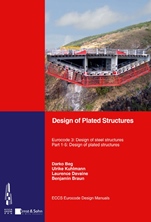
Design of Plated Structures: Eurocode 3: Design of Steel Structures, Part 1–5: Design of Plated Structures
ISBN 9783433029800
Autor: Darko Beg, Ulrike Kuhlmann, Laurence Davaine, Benjamin Braun
Wydawca: Wiley
Dostępność: 3-6 tygodni
Cena: 313,95 zł
Przed złożeniem zamówienia prosimy o kontakt mailowy celem potwierdzenia ceny.
ISBN13: |
9783433029800 |
ISBN10: |
3433029806 |
Autor: |
Darko Beg, Ulrike Kuhlmann, Laurence Davaine, Benjamin Braun |
Oprawa: |
Paperback |
Rok Wydania: |
2011-01-26 |
Ilość stron: |
290 |
Wymiary: |
240x170 |
Tematy: |
TN |
The main aim of this book is to provide practical advice to designers of plated structures for correct and efficient application of EN 1993–1–5 design rules. In Chapter 1 the purpose, the scope and the structure of the book is explained. In Chapter 2 a detailed and commented overview of EN 1993–1–5 design rules is given following the structure of the standard. Shear lag effect as well as plate buckling problems due to direct stresses, shear forces, transverse forces and interaction of these effects are covered. This chapter also includes a reduced stress method and a finite element analysis approach to plate buckling problems. A large number of design examples illustrate the proper application of individual design rules. Chapter 3 and 4 bring two complete design examples on a crane runway beam and a box–girder bridge.
Spis treści:
Foreword.
Preface.
Symbols.
Chapter 1. Introduction.
1.1 Plate buckling in steel structures.
1.2 Purpose of this book.
1.3 Structure of this book.
Chapter 2. Overview of Design Rules.
2.1 Introduction.
2.2 Basis of design and modeling.
2.3 Shear lag in member design.
2.4 Plate buckling effects due to direct stresses (including annexes A and E where applicable).
2.5 Resistance to shear (including annex A where applicable).
2.6 Resistance to transverse loading.
2.7 Interaction.
2.8 Flange induced buckling.
2.9 Stiffeners and detailing.
2.10 Reduced stress method (including Annexes A and B where applicable).
2.11 FEM.
Chapter 3. Crane Runway Beam Example.
3.1 Description of the crane.
3.2 Description of the crane runway beam.
3.3 Actions and load partial factors.
3.4 Internal forces and stresses.
3.5 Verifications in general.
3.6 Buckling verifications according to section 4 to 7, EN 1993–1–5.
3.7 Buckling verifications according to section 10, EN 1993–1–5.
3.8 Flang
e induced buckling verification.
3.9 Stiffener verifications.
Chapter 4. Box–Girder Bridge Example.
4.1 Description of the bridge.
4.2 Internal forces and moments, Stresses.
4.3 Web buckling verification for the launching phase.
4.4 Effective cross section of the stiffened bottom flange at internal support P1 (uniform compression).
4.5 Effective cross section of the stiffened web at internal support (bending).
4.6 Checking of the box–girder section under bending at support P1.
4.7 Shear resistance of the stiffened web panel closest to the internal support P1.
4.8 Interaction between bending and shear at support P1.
4.9 Intermediate transverse stiffener design.
4.10 Buckling verifications at internal support P1 according to section 10, EN 1993–1–5.
References.
Nota biograficzna:
Darko Beg is professor of steel structures and chair of Metal Structures at the University of Ljubljana, Faculty of Civil and Geodetic Engineering . He was a member of the project team that drafted Eurocode 3, Part 1–5: Plated structural elements. He is a member of CEN/TC250/SC3 and a member of three ECCS technical committees: TC8 Stability, TC10 Connections and TC13 Seismic Design. He also chairs the Slovenian National Technical Committee on Structures.
Ulrike Kuhlmann is professor of steel, timber and composites structures at the University of Stuttgart, Germany and head of the Institute of Structural Design. She chairs CEN/TC250/SC3 Steel Structures and Technical Working Group 8.3 Plates of ECCS. She was a member of the project team for the conversion of ENV 1993–1–1 to EN 1993 and has since been deeply involved in code drafting.
Laurence Davaine is a bridge engineer at the Department of Bridge Engineering of the French Railway Administration (SNCF) in Paris, France. Formerly she worked as a research engineer at SETRA (technical centre for bridge engineering)
for the French Ministry of Transportation. She is a member of the Technical Working Group 8.3 Plates of ECCS and involved in CEN/TC250/SC3 Steel Structures for EN 1993–2 (bridges).
Benjamin Braun is a scientific researcher at the Department of Structural Engineering of the Federal Waterways Engineering and Research Institute (BAW) in Karlsruhe, Germany. Formerly he worked at the Institute of Structural Design of the University of Stuttgart where he was in charge of co–writing the German National Annex to Eurocode 3 Part 1–5. He is a member of Technical Working Group 8.3 Plates of ECCS.
Okładka tylna:
The main aim of this book is to provide practical advice to designers of plated structures for correct and efficient application of EN 1993–1–5 design rules. In Chapter 1 the purpose, the scope and the structure of the book is explained. In Chapter 2 a detailed and commented overview of EN 1993–1–5 design rules is given following the structure of the standard. Shear lag effect as well as plate buckling problems due to direct stresses, shear forces, transverse forces and interaction of these effects are covered. This chapter also includes a reduced stress method and a finite element analysis approach to plate buckling problems. A large number of design examples illustrate the proper application of individual design rules. Chapter 3 and 4 bring two complete design examples on a crane runway beam and a box–girder bridge.
Koszyk
Książek w koszyku: 0 szt.
Wartość zakupów: 0,00 zł
Informacje


Kontakt
Gambit
Centrum Oprogramowania
i Szkoleń Sp. z o.o.
Al. Pokoju 29b/22-24
31-564 Kraków
Siedziba Księgarni
ul. Kordylewskiego 1
31-542 Kraków
+48 12 410 5991
+48 12 410 5987
+48 12 410 5989
Subskrypcje
Administratorem danych osobowych jest firma Gambit COiS Sp. z o.o. Na podany adres będzie wysyłany wyłącznie biuletyn informacyjny.
Autoryzacja płatności

Informacje na temat autoryzacji płatności poprzez PayU.

© Copyright 2012: GAMBIT COiS Sp. z o.o. Wszelkie prawa zastrzeżone.
Projekt i wykonanie: Alchemia Studio Reklamy