


Wydawcy
Katalog tematyczny
- Archeologia (109)
- Ekonomia, finanse, business (13704)
- Filozofia (1445)
- Historia (3040)
- Języki i językoznawstwo (2356)
- Lifestyle, hobby i rozrywka (475)
- Medycyna (9704)
- Nauki humanistyczne (4)
- Nauki o Ziemi i środowisku (2638)
- Nauki ścisłe (20412)
- Nauki społeczne (8486)
- Edukacja (229)
- Kryminologia, opieka spełeczna (284)
- Obronność (10)
- Polityka (1389)
- Psychologia (777)
- Socjologia (410)
- Społeczeństwo i kultura (187)
- Nauki techniczne (13450)
- Prawo (1696)
- Publikacje informacyjne i interdyscyplinarne (1288)
- Religia i wierzenia (917)
- Technika komputerowa (4067)
- Zdrowie, relacje międzyludzkie i rozwój osobisty (657)





Informacje szczegółowe o książce
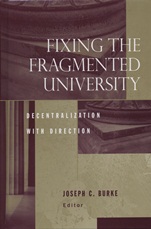
Fixing the Fragmented University: Decentralization With Direction
ISBN 9781933371153
Autor: Joseph C. Burke
Wydawca: Wiley
Dostępność: 3-6 tygodni
Cena: 227,85 zł
Przed złożeniem zamówienia prosimy o kontakt mailowy celem potwierdzenia ceny.
ISBN13: |
9781933371153 |
ISBN10: |
1933371153 |
Autor: |
Joseph C. Burke |
Oprawa: |
Hardback |
Rok Wydania: |
2007-12-28 |
Ilość stron: |
450 |
Wymiary: |
235x159 |
Tematy: |
JD |
A fatal flaw in accountability programs is the fragmented university that leaves academic departments—the units most responsible for institutional results—out of the performance loop. Currently, decentralization fosters a disabling disconnect among societal concerns, institutional goals, and departmental aims, the three links of public accountability. How then can the culture of many research universities be transformed from provider–driven prestige to public–centered engagement?
The answer is not to end decentralization but to add direction. By using strategic planning, priority budgeting, assessment and quality assurance, regional accreditation, and departmental performance reporting, large research universities will be able to set priorities and implement direction while preserving decentralization.
Written for central administrators, trustees, faculty leaders, and students in higher education, this book discusses the participants and the methods for fixing the fragmented university and changing the campus culture. It brings together a group of national experts who each describe how their particular part of the puzzle can help fix the fragmented university and assist it in becoming as devoted to undergraduate education and public engagement as it is to faculty research.
This book is organized into four parts:The participantsMeans and methods of cohesionRedesigning the missionMaking it happen on campus
Spis treści:
About the Authors.
Preface.
Introduction.
1 "The Fragmented University" (Joseph C. Burke).
Part I: The Participants.
2 Governing Boards of Public Research Universities as Conflicted Necessities (Richard T. Ingram).
3 Fixing the Fragmented University: A View From the Bridge (James J. Duderstadt).
4 Recreating the Faculty Role in University Governance (Roger Benjamin).
Part II: Means and Methods of Cohesion.
5 Strategic Direction and Decentralization in Public Research Universities (Daniel James Rowley, Herbert Sherman).
6 Using the Budget to Fight Fragmentation and Improve Quality (William F. Massy).
7 Assessing Institutional Effectiveness and Connecting the Pieces of a Fragmented University (J. Fredericks Volkwein).
8 Accrediting the Public University: Part of the Problem or Part of the Solution? (Ralph A. Wolff).
9 Performance Reporting: Putting Academic Departments in the Performance Loop (Joseph C. Burke).
Part III: Redesigning the Mission.
10 Making Students Matter (George D. Kuh).
11 Making a "Great ′Engaged′ University" Requires Rhetoric (Richard A. Cherwitz, E. Johanna Hartelius).
Part IV: Making It Happen on Campus.
12 Transforming the University of Minnesota Through Strategic Positioning (Robert H. Bruininks).
13 A Targeted Path Toward Academic Excellence at The Ohio State University (Karen A. Holbrook).
14 Florida International University: A Top Urban Public Research University (Mayra E. Beers, Paul D. Gallagher, Modesto A. Maidique).
Conclusion.
15 The Kellogg Commission: Glancing Back, Looking Forward (C. Peter Magrath).
16 Returning to Their Roots: Putting Unity, Students, and Public Back Into State Universities (Joseph C. Burke).
Index.
Nota biograficzna:
Joseph C. Burke is director of the Higher Education Program and a Senior Fellow at the Nelson A. Rockefeller Institute of Government, and professor of higher education policy and management at the State University of New York. After receiving his Ph.D. in history from Indiana University, Dr. Burke taught for 12 years. He served as president of the Sate University of New York at Pittsburgh for 12 years, followed by 9 years as provost and vice chancellor for academic affair and 1 year as interim chancellor of the State Universi
ty of New York System. While Provost, he also held the post of president of the State University of New York Research Foundation, the Fiscal agent for all research grants and contracts in the SUNY System. Dr. Burke was also a consultant with the Center for Public Higher Education Trusteeship and Governance at the Association of Governing Boards of Universities ad Colleges. In 2005, he served as an advisor to the State Higher Education Executive Officers National Commission on Accountability.
Dr. Burke has consulted, written and lectured on a wide array of topics in higher education, including the role of college and university presidents, system governance, accountability and autonomy in higher education, outcomes assessment, and performance reporting, budgeting, and funding. He has published more than 60 books, monographs, and articles on these subjects. His most recent book, which he edited and coauthored, is Achieving Accountability in Higher Education: Balancing Public, Academic, and Market Demands (2005, Jossey–Bass). The Henry Luce Foundation, the Pew Charitable Trusts, and the Ford Foundation have awarded him grants for national studies of the budgeting, reporting, accountability, and performance of public university systems and state colleges and universities. The Ford Foundation supported the preparation of this present book.
Okładka tylna:
A fatal flaw in accountability programs is the fragmented university that leaves academic departments—the units most responsible for institutional results—out of the performance loop. Currently, decentralization fosters a disabling disconnect among societal concerns, institutional goals, and departmental aims, the three links of public accountability. How then can the culture of many research universities be transformed from provider–driven prestige to public–centered engagement?
The answer is not to end decentralization but to add direction. By using stra
tegic planning, priority budgeting, assessment and quality assurance, regional accreditation, and departmental performance reporting, large research universities will be able to set priorities and implement direction while preserving decentralization.
Written for central administrators, trustees, faculty leaders, and students in higher education, this book discusses the participants and the methods for fixing the fragmented university and changing the campus culture. It brings together a group of national experts who each describe how their particular part of the puzzle can help fix the fragmented university and assist it in becoming as devoted to undergraduate education and public engagement as it is to faculty research.
This book is organized into four parts:The participantsMeans and methods of cohesionRedesigning the missionMaking it happen on campus
Koszyk
Książek w koszyku: 0 szt.
Wartość zakupów: 0,00 zł
Informacje


Kontakt
Gambit
Centrum Oprogramowania
i Szkoleń Sp. z o.o.
Al. Pokoju 29b/22-24
31-564 Kraków
Siedziba Księgarni
ul. Kordylewskiego 1
31-542 Kraków
+48 12 410 5991
+48 12 410 5987
+48 12 410 5989
Subskrypcje
Administratorem danych osobowych jest firma Gambit COiS Sp. z o.o. Na podany adres będzie wysyłany wyłącznie biuletyn informacyjny.
Autoryzacja płatności

Informacje na temat autoryzacji płatności poprzez PayU.

© Copyright 2012: GAMBIT COiS Sp. z o.o. Wszelkie prawa zastrzeżone.
Projekt i wykonanie: Alchemia Studio Reklamy