


Wydawcy
Katalog tematyczny
- Archeologia (109)
- Ekonomia, finanse, business (13704)
- Filozofia (1445)
- Historia (3040)
- Języki i językoznawstwo (2356)
- Lifestyle, hobby i rozrywka (475)
- Medycyna (9704)
- Nauki humanistyczne (4)
- Nauki o Ziemi i środowisku (2638)
- Nauki ścisłe (20412)
- Nauki społeczne (8486)
- Edukacja (229)
- Kryminologia, opieka spełeczna (284)
- Obronność (10)
- Polityka (1389)
- Psychologia (777)
- Socjologia (410)
- Społeczeństwo i kultura (187)
- Nauki techniczne (13450)
- Prawo (1696)
- Publikacje informacyjne i interdyscyplinarne (1288)
- Religia i wierzenia (917)
- Technika komputerowa (4067)
- Zdrowie, relacje międzyludzkie i rozwój osobisty (657)





Informacje szczegółowe o książce
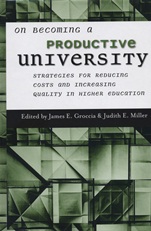
On Becoming a Productive University: Strategies for Reducing Cost and Increasing Quality in Higher Education
ISBN 9781882982790
Autor: James E. Groccia, Judith E. Miller
Wydawca: Wiley
Dostępność: 3-6 tygodni
Cena: 205,80 zł
Przed złożeniem zamówienia prosimy o kontakt mailowy celem potwierdzenia ceny.
ISBN13: |
9781882982790 |
ISBN10: |
1882982797 |
Autor: |
James E. Groccia, Judith E. Miller |
Oprawa: |
Hardback |
Rok Wydania: |
2007-07-24 |
Ilość stron: |
358 |
Wymiary: |
236x163 |
Tematy: |
JD |
While educational spending worldwide has increased significantly over the last four decades, there has been no appreciable change or improvement in student achievement. Faith in higher education′s ability to "do the right thing" without external scrutiny or control has been replaced by calls for accountability. This book describes what universities can do to recapture the public trust and ensure long–term financial viability by reducing costs and increasing quality and productivity.
Organized into six parts, the book explores concrete and specific strategies for increasing productivity and quality in the areas of organization, assessment, faculty development, technology, curriculum, and the classroom. With more than 30 chapters contributed by authors from many disciplines and institutions, this practical resource brings fresh ideas to the discussion of productivity that are easily accessible to educational practitioners and administrators, without requiring a background in economics or finance. The book makes it clear that all segments of the academic community have important roles to play in ensuring the survival of the higher education enterprise.
Spis treści:
About the Authors.
Foreword.
Introduction.
Part I: Organizational Strategies.
1. Institutional Transformation in a Climate of Reduced Resources (Alan E. Guskin, Mary B. Marcy).
2. Random Acts of Progress Versus Planned Productivity Via Strategic Planning (Lori S. Franz, Daniel R. Morrison).
3. The Holon Frame Work: Process Improvement and Control for Higher Education (Gary A. Bell, Maggie A. Cooper, Jon P. Warwick, Michael S. Kennedy).
4. Incentive–Based Budgeting: Lessons From Public Higher Education (Rex Fuller, D. Patrick Morton, Ann Korschgen).
5. The Integration of Faculty responsibilities and Institutional Needs (Gary S. Krahenbuhl).
Chapter 6. Crisis as Opportunity: An Entrepreneurial Approach to Higher Education Productivit
y (Richad A. Cherwitz, Thomas J. Darwin).
Part II: Assessment Strategies.
7. Benchmarking Departmental Activity Via a Consortial Approach: The Delaware Study (Michael F. Middaugh, Heather K. Isaacs).
8. Potluck or Planning? Program Quality Requires Intentional Focus (Cathy L. Livingston, Kathleen C. Rentsch).
9. Measuring Productivity and Quality in Graduate Education (Suzanne T. Ortega).
10. Integrated and Systemic Assessment as Learning: The Alverno College Approach to Productivity (Zohreh Ememi, William H. Richards, Tim Riordan).
Part III: Faculty Development Strategies.
11. Preparing Future Faculty to Improve Productivity (Jerry G. Gaff, Anne S. Pruitt–Logan).
12. Developing Faculty Productivity: Learning to Teach Large Classes Well (Lee F. Seidel, Victor A. Benassi).
13. Using Soft–System Management Methodology to Develop an Online Part–Time Staff Development Resource (Uma Patel, Peter Mangan).
14. The Reflective Practice Project: Faculty Productivity Beyond the Numbers (Laurel J. Black, Mary Ann Cessna, John Woolcock).
15. Meeting Institutional Goals Through Technology (Michael L. Rodgers, David A. Starrett).
Part IV: Technology Strategies.
16. Aligning Technology With Institutional Mission Through Integrated Planning (Ellen L. Nuffer).
17. Mobile Computing at Seton Hall University: Using Technology to Increase Learning Effectiveness (Stephen G. Landry, Heather Stewart).
18. Increasing Instructional Capacity Through Virtual Learning and Cross–Institutional Collaboration (Sally Kuhlenschmidt, Myk Garn, Sandy Cook, Stan Cooke).
19. What Are the Relevant Costs of Online Education? (Michael W. Maher, Barbara Sommer, Curt Acredolo, Harry R. Matthews).
Part V: Curricular Strategies.
20. High Attrition in Doctoral Education: Is It Inevitable? (Orlando L. Taylor, Terroly P. Carter).
21. Building Bridges for Student Engagement: The Key to Enhancing Learning Pro
ductivity (Charles Schroeder).
22. The Cognitive Approach as a Basis for Enhanced Curricula (Georges N. Nahas).
23. Restructuring a Capstone Course to Enhance Learning Productivity (Gloria Edwards).
24. Accreditation of Prior Learning in a Nurse Education Program (Ian Scott).
25. Enhancing Engineering Education Productivity Through Interdisciplinary Team Teaching (Frances S. Johnson).
Part VI: Classroom Strategies.
26. Classroom Productivity: A Six–Step Model for Working With Faculty (Barbara E. Walvoord).
27. Student–Assisted Teaching: Harnessing the Power of Peers for Improved Learning and Increased Productivity (Judith E. Miller, James E. Groccia, Marilyn S. Miller).
28. Improving College Teaching Productivity Via Mastery Learning (J. Ronald Gentile).
29. The Studio Model: Responding to the Challenges of Large Enrollment Quantitative Science Instruction (Karen Cummings).
30. The Group Research Project: Using Student Experience to Enhance Learning and Retention (Janis L. Massa).
31. The Archaeological Research Portfolio: A Solution to the Content Versus Abilities Dilemma (Susan Dobyns, Kathleen Swart).
Conclusion.
Index.
Nota biograficzna:
James E. Groccia is founding director of the Biggio Center for the Enhancement of Teaching and Learning and associate professor of educational leadership at Auburn University. He has spent more than 25 years in higher education as a faculty member and director of faculty and instructional development, student counseling and orientation services, and as a graduate school assistant dean. He has published and presented nationally and internationally on creating engaged/interactive learning, cooperative learning, student–assisted teaching, and creating an academic portfolio. He is the author of The College Success Book: A Whole–Student Approach to Academic Excellence (Glenbridge, 1992).
Judith E. Miller is associate dean f
or special academic initiatives at Clark University. She has published and presented extensively on cooperative learning, group dynamics, active learning, team teaching, outcomes assessment, and student and professional portfolios. In 1998 she received the Outstanding Undergraduate Science teacher award from the Society for College Science Teachers, and in 2002 she was named the Massachusetts CASE Professor of the Year by the Carnegie Foundation for the Advancement of teaching. In he r other life, she keeps in touch with the experience of novice learners by taking a beginning yoga class.
Drs. Groccia and Miller have coedited Enhancing Productivity: Administrative, Instructional, and Technological Strategies (Jossey–Bass, 1998) and (with Marilyn Miller) Student–Assisted Teaching: A Guide to Faculty–Student Teamwork (Anker, 2001).
Okładka tylna:
While educational spending worldwide has increased significantly over the last four decades, there has been no appreciable change or improvement in student achievement. Faith in higher education′s ability to "do the right thing" without external scrutiny or control has been replaced by calls for accountability. This book describes what universities can do to recapture the public trust and ensure long–term financial viability by reducing costs and increasing quality and productivity.
Organized into six parts, the book explores concrete and specific strategies for increasing productivity and quality in the areas of organization, assessment, faculty development, technology, curriculum, and the classroom. With more than 30 chapters contributed by authors from many disciplines and institutions, this practical resource brings fresh ideas to the discussion of productivity that are easily accessible to educational practitioners and administrators, without requiring a background in economics or finance. The book makes it clear that all segments of the academic com
Koszyk
Książek w koszyku: 0 szt.
Wartość zakupów: 0,00 zł
Informacje


Kontakt
Gambit
Centrum Oprogramowania
i Szkoleń Sp. z o.o.
Al. Pokoju 29b/22-24
31-564 Kraków
Siedziba Księgarni
ul. Kordylewskiego 1
31-542 Kraków
+48 12 410 5991
+48 12 410 5987
+48 12 410 5989
Subskrypcje
Administratorem danych osobowych jest firma Gambit COiS Sp. z o.o. Na podany adres będzie wysyłany wyłącznie biuletyn informacyjny.
Autoryzacja płatności

Informacje na temat autoryzacji płatności poprzez PayU.

© Copyright 2012: GAMBIT COiS Sp. z o.o. Wszelkie prawa zastrzeżone.
Projekt i wykonanie: Alchemia Studio Reklamy