


Wydawcy
Katalog tematyczny
- Archeologia (1)
- Ekonomia, finanse, business (698)
- Filozofia (20)
- Historia (57)
- Języki i językoznawstwo (4)
- Lifestyle, hobby i rozrywka (32)
- Medycyna (1025)
- Nauki humanistyczne (2)
- Nauki o Ziemi i środowisku (430)
- Nauki ścisłe (1680)
- Nauki społeczne (6049)
- Nauki techniczne (530)
- Budownictwo lądowe (6)
- Chemia przemysłowa (27)
- Elektronika i telekomunikacja (163)
- Energetyka (25)
- Inne nauki stosowane (16)
- Inżynieria biochemiczna (11)
- Inżynieria transportu (17)
- Mechanika i materiały (176)
- Nauka o środowisku (27)
- Rolnictwo (8)
- Technika, ogólnie (46)
- Prawo (1437)
- Publikacje informacyjne i interdyscyplinarne (32)
- Religia i wierzenia (15)
- Technika komputerowa (237)
- Zdrowie, relacje międzyludzkie i rozwój osobisty (4)





Informacje szczegółowe o książce
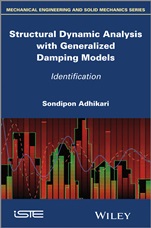
Structural Dynamic Analysis with Generalized Damping Models: Identification
ISBN 9781848216709
Autor: Sondipon Adhikari
Wydawca: Wiley
Dostępność: 3-6 tygodni
Cena: 495,60 zł
Przed złożeniem zamówienia prosimy o kontakt mailowy celem potwierdzenia ceny.
ISBN13: |
9781848216709 |
ISBN10: |
184821670X |
Autor: |
Sondipon Adhikari |
Oprawa: |
Hardback |
Rok Wydania: |
2013-12-03 |
Ilość stron: |
288 |
Since Lord Rayleigh introduced the idea of viscous damping in his classic work "The Theory of Sound" in 1877, it has become standard practice to use this approach in dynamics, covering a wide range of applications from aerospace to civil engineering. However, in the majority of practical cases this approach is adopted more for mathematical convenience than for modeling the physics of vibration damping. Over the past decade, extensive research has been undertaken on more general “non–viscous” damping models and vibration of non–viscously damped systems. This book, along with a related book Structural Dynamic Analysis with Generalized Damping Models: Analysis, is the first comprehensive study to cover vibration problems with general non–viscous damping. The author draws on his considerable research experience to produce a text covering: parametric senistivity of damped systems; identification of viscous damping; identification of non–viscous damping; and some tools for the quanitification of damping. The book is written from a vibration theory standpoint, with numerous worked examples which are relevant across a wide range of mechanical, aerospace and structural engineering applications. Contents 1. Parametric Sensitivity of Damped Systems. 2. Identification of Viscous Damping. 3. Identification of Non–viscous Damping. 4. Quantification of Damping. About the Authors Sondipon Adhikari is Chair Professor of Aerospace Engineering at Swansea University, Wales. His wide–ranging and multi–disciplinary research interests include uncertainty quantification in computational mechanics, bio– and nanomechanics, dynamics of complex systems, inverse problems for linear and nonlinear dynamics, and renewable energy. He is a technical reviewer of 97 international journals, 18 conferences and 13 funding bodies.He has written over 180 refereed journal papers, 120 refereed conference papers and has authored or co–authored 15 book chapters.
Preface ix Nomenclature xiii Chapter 1. Parametric Sensitivity of Damped Systems 1 1.1. Parametric sensitivity of undamped systems 2 1.1.1. Sensitivity of the eigenvalues 2 1.1.2. Sensitivity of the eigenvectors 3 1.2. Parametric sensitivity of viscously damped systems 5 1.2.1. Sensitivity of the eigenvalues 6 1.2.2. Sensitivity of the eigenvectors 9 1.3. Parametric sensitivity of non–viscously damped systems 22 1.3.1. Sensitivity of the eigenvalues 23 1.3.2. Sensitivity of the eigenvectors 25 1.4. Summary 41 Chapter 2. Identification of Viscous Damping 43 2.1. Identification of proportional viscous damping 44 2.1.1. Damping identification using generalized proportional damping 45 2.1.2. Error propagation in the damping identification method 48 2.1.3. Numerical examples 49 2.1.4. Experimental results 51 2.1.5. Synopsis 67 2.2. Identification of non–proportional viscous damping 69 2.2.1. The theory of damping identification 71 2.2.2. Numerical examples 75 2.2.3. Error analysis 88 2.2.4. Synopsis 90 2.3. Symmetry–preserving damping identification 91 2.3.1. The theory of symmetric damping matrix identification 91 2.3.2. Numerical examples 97 2.3.3. Synopsis 104 2.4. Direct identification of the damping matrix 104 2.4.1. The modified Lancaster’s method 105 2.4.2. Numerical examples 111 2.4.3. Synopsis 117 2.5. Summary 118 Chapter 3. Identification of Non–viscous Damping 121 3.1. Identification of exponential non–viscous damping model 123 3.1.1. Background of complex modes 123 3.1.2. Fitting of the relaxation parameter 125 3.1.3. Fitting of the coefficient matrix 140 3.1.4. Synopsis 149 3.2. Symmetry preserving non–viscous damping identification 151 3.2.1. Theory 151 3.2.2. Numerical examples 155 3.2.3. Synopsis 159 3.3. Direct identification of non–viscous damping 160 3.3.1. Lancaster’s method for non–viscously damped systems 161 3.3.2. Numerical examples 165 3.3.3. Synopsis 167 3.4. Summary 168 Chapter 4. Quantification of Damping 169 4.1. Quantification of non–proportional damping 169 4.1.1. Optimal normalization of complex modes 171 4.1.2. An index of non–proportionality 182 4.1.3. Alternative normalization methods 187 4.1.4. Synopsis 193 4.2. Quantification of non–viscous damping 193 4.2.1. Non–viscosity indices 195 4.2.2. Numerical examples 203 4.2.3. Error analysis 208 4.2.4. Synopsis 211 4.3. Summary 211 Bibliography 213 Author Index 243 Index 245
Koszyk
Książek w koszyku: 0 szt.
Wartość zakupów: 0,00 zł
Informacje


Kontakt
Gambit
Centrum Oprogramowania
i Szkoleń Sp. z o.o.
Al. Pokoju 29b/22-24
31-564 Kraków
Siedziba Księgarni
ul. Kordylewskiego 1
31-542 Kraków
+48 12 410 5991
+48 12 410 5987
+48 12 410 5989
Subskrypcje
Administratorem danych osobowych jest firma Gambit COiS Sp. z o.o. Na podany adres będzie wysyłany wyłącznie biuletyn informacyjny.
Autoryzacja płatności

Informacje na temat autoryzacji płatności poprzez PayU.

© Copyright 2012: GAMBIT COiS Sp. z o.o. Wszelkie prawa zastrzeżone.
Projekt i wykonanie: Alchemia Studio Reklamy