


Wydawcy
Katalog tematyczny
- Archeologia (109)
- Ekonomia, finanse, business (13704)
- Filozofia (1445)
- Historia (3040)
- Języki i językoznawstwo (2356)
- Lifestyle, hobby i rozrywka (475)
- Medycyna (9704)
- Nauki humanistyczne (4)
- Nauki o Ziemi i środowisku (2638)
- Nauki ścisłe (20412)
- Nauki społeczne (8486)
- Nauki techniczne (13450)
- Prawo (1696)
- Publikacje informacyjne i interdyscyplinarne (1288)
- Religia i wierzenia (917)
- Technika komputerowa (4067)
- Zdrowie, relacje międzyludzkie i rozwój osobisty (657)





Informacje szczegółowe o książce
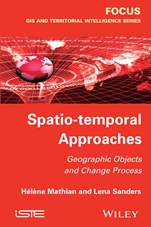
Spatio-temporal Approaches: Geographic Objects and Change Process
ISBN 9781848215528
Autor: Helene Mathian
Wydawca: Wiley
Dostępność: 3-6 tygodni
Cena: 351,75 zł
Przed złożeniem zamówienia prosimy o kontakt mailowy celem potwierdzenia ceny.
ISBN13: |
9781848215528 |
ISBN10: |
1848215525 |
Autor: |
Helene Mathian |
Oprawa: |
Hardback |
Rok Wydania: |
2014-11-21 |
Ilość stron: |
176 |
Spatio–temporal Approaches presents a well–built set of concepts, methods and approaches, in order to represent and understand the evolution of social and environmental phenomena within the space. It is basedon examples in human geography and archeology (which will enable us to explore questions regarding various temporalities) and tackles social and environmental phenomena. Chapter 1 discusses how to apprehend change: objects, attributes, relations, processes.
Chapter 2 introduces multiple points of view about modeling and the authors try to shed a new light on the different, but complementary approaches of geomaticians and thematicians. Chapter 3 is devoted to the construction of spatio–temporal indicators, to various measurements of the change, while highlighting the advantage of an approach crossing several points of view, in order to understand the phenomenon at hand. Chapter 4 presents different categories of simulation model in line with complexity sciences. These models rely notably on the concepts of emergence and self–organization and allow us to highlight the roles of interaction within change. Chapter 5 provides ideas on research concerning the various construction approaches of hybrid objects and model couplings.
INTRODUCTION ix
CHAPTER 1. BUILDING OBJECTS IN TIME 1
1.1. Different points of view on ontology 4
1.1.1. Defining ontology 4
1.1.2. Qualification of the objects from an ontological perspective: bona fide versus fiat objects 8
1.1.3. Specification of ontologies in the field of spatial analysis and geographical sciences: objects versus fields 10
1.1.4. An example of empirical objects construction: the case of cities 13
1.2. Locating spatial objects in time 16
1.2.1. Objects formalization in time: endurant and perdurant entities of philosophers 17
1.2.2. From change to objects life 21
1.3. Conclusion 28
CHAPTER 2. FROM EMPIRICAL QUESTIONING TO SPATIO–TEMPORAL MODELING 29
2.1. From the conception of entities to their analysis of responding to thematic issues 30
2.1.1. Building the spatio–temporal objects from the empirical observations (challenge 1) 32
2.1.2. Representing and exploring change and movement (challenge 2) 35
2.1.3. Analyzing the evolution of statistical and spatial relationships (challenge 3) 38
2.1.4. Identifying the underlying processes of change: simulation and scenario testing (challenge 4) 41
2.2. Challenges and models: the possible misunderstandings 44
2.3. Application examples 46
2.3.1. Cities dynamics: construction and follow–up of composite objects in time 47
2.3.2. Distribution of urban functions in the intra–urban space: construction of spatio–temporal
functional objects 53
2.3.3. Evaluating the impact of mobile objects on a spatial support 56
2.3.4. What factors are behind the emergence and/or the reinforcement of school segregation? Construction of multilevel and multidate information 60
2.4. Conclusion 64
CHAPTER 3. ANALYZING SPATIO–TEMPORAL DATA: EMPIRICAL AND STATISTICAL APPROACHES 65
3.1. Statistical data and spatio–temporal analysis 66
3.1.1. Spatial analysis evolution in a context influenced by statistics and computer science 66
3.1.2. Different ways to take time and space into account to analyze spatio–temporal processes 70
3.1.3. From entities dynamics to that of organizations: what is it that changes and relative to what frame of reference? 73
3.2. Following the evolution of the structure of spatial systems 76
3.2.1. Describing the evolution of space and hierarchical organizations 76
3.2.2. Change, temporalities and statistical explanations 82
3.3. Understanding the evolution of a spatial system s entities 86
3.3.1. Constructing, describing and categorizing trajectories of evolution 87
3.3.2. Identifying a priori defined types of change to classify evolutions 91
3.3.3. Unfolded time and forecast 93
3.4. Conclusion 97
Chapter 4. Exploring the Underlying Processes of Change: Simulation Models 99
4.1. Computer simulation versus statistical approach: different points of view about explanation 99
4.1.1. From covariation to interaction, from differentiation to emergence 102
4.1.2. Different types of explanation: from the percentage of variance explained to the generation of mechanisms 104
4.1.3. Different points of view on multilevel phenomena 105
4.2. Microsimulation models107
4.3. Computing models: simulation and emergence 112
4.3.1. Modeling the diffusion of a migratory wave front 113
4.3.2. Cellular automata approaches: the case of land use changes 115
4.3.3. Agent–based models applied to simple entities 120
4.3.4. Agent modeling on composite entities 124
4.4. Conclusion 129
CONCLUSION 133
BIBLIOGRAPHY 139
INDEX 155
Koszyk
Książek w koszyku: 0 szt.
Wartość zakupów: 0,00 zł
Informacje


Kontakt
Gambit
Centrum Oprogramowania
i Szkoleń Sp. z o.o.
Al. Pokoju 29b/22-24
31-564 Kraków
Siedziba Księgarni
ul. Kordylewskiego 1
31-542 Kraków
+48 12 410 5991
+48 12 410 5987
+48 12 410 5989
Subskrypcje
Administratorem danych osobowych jest firma Gambit COiS Sp. z o.o. Na podany adres będzie wysyłany wyłącznie biuletyn informacyjny.
Autoryzacja płatności

Informacje na temat autoryzacji płatności poprzez PayU.

© Copyright 2012: GAMBIT COiS Sp. z o.o. Wszelkie prawa zastrzeżone.
Projekt i wykonanie: Alchemia Studio Reklamy