


Wydawcy
Katalog tematyczny
- Archeologia (109)
- Ekonomia, finanse, business (13704)
- Filozofia (1445)
- Historia (3040)
- Języki i językoznawstwo (2356)
- Lifestyle, hobby i rozrywka (475)
- Medycyna (9704)
- Chirurgia (272)
- Inne gałęzie medycyny (1871)
- Medycyna kliniczna (4187)
- Choroby wewnętrzne (514)
- Dermatologia (51)
- Diagnostyka medyczna (3)
- Endokrynologia (144)
- Gastroenterologia (27)
- Geriatria (50)
- Ginekologia i położnictwo (134)
- Hematologia (46)
- Hepatologia (10)
- Kardiologia (71)
- Laryngologia (12)
- Nefrologia (10)
- Neurologia (500)
- Oftalmologia (50)
- Pediatria (33)
- Pulmunologia (32)
- Reumatologia (14)
- Terapia genowa (1)
- Układ mięśniowo-szkieletowy (1)
- Urologia (14)
- Medycyna niekonwencjonalna (14)
- Medycyna przedkliniczna (269)
- Medycyna, ogólnie (1740)
- Medyczne służby pomocnicze (745)
- Studia medyczne (16)
- Weterynaria (548)
- Nauki humanistyczne (4)
- Nauki o Ziemi i środowisku (2638)
- Nauki ścisłe (20412)
- Nauki społeczne (8486)
- Nauki techniczne (13450)
- Prawo (1696)
- Publikacje informacyjne i interdyscyplinarne (1288)
- Religia i wierzenia (917)
- Technika komputerowa (4067)
- Zdrowie, relacje międzyludzkie i rozwój osobisty (657)





Informacje szczegółowe o książce
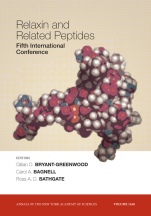
Relaxin and Related Peptides: Fifth International Conference, Volume 1160
ISBN 9781573317214
Autor: Gillian D. Bryant–Greenwood, Carol A. Bagnell, Ross Bathgate, O. David Sherwood
Wydawca: Wiley
Dostępność: 3-6 tygodni
Cena: 662,55 zł
Przed złożeniem zamówienia prosimy o kontakt mailowy celem potwierdzenia ceny.
ISBN13: |
9781573317214 |
ISBN10: |
1573317217 |
Autor: |
Gillian D. Bryant–Greenwood, Carol A. Bagnell, Ross Bathgate, O. David Sherwood |
Oprawa: |
Paperback |
Rok Wydania: |
2009-06-05 |
Ilość stron: |
352 |
Wymiary: |
254x179 |
Tematy: |
MJ |
Relaxin is a protein hormone, produced and secreted during pregnancy in mammalian species, having superficial structural features resembling those of insulin. Since its initial isolation from the ovaries of pregnant pigs in 1976, increasing interest in relaxin has led to increased understanding of the chemistry, synthesis, secretion, biological roles, mechanisms of action, and potential clinical applications of relaxin in humans and domestic animals.
This volume contains a description of recent advances and future research and clinical possibilities in the field of relaxin and related peptides.
NOTE: Annals volumes are available for sale as individual books or as a journal. For information on institutional journal subscriptions, please visit www.blackwellpublishing.com/nyas.
ACADEMY MEMBERS: Please contact the New York Academy of Sciences directly to place your order (www.nyas.org). Members of the New York Academy of Science receive full–text access to the Annals online and discounts on print volumes. Please visit www.nyas.org/membership/main.asp for more information about becoming a member.
Spis treści:
Preface (G. Bryant–Greenwood).
Tribute. Bernard G. Steinetz, Jr.: A Most Tenacious Relaxinologist (O. David Sherwood).
Part I: Relaxin and Related Peptides: Structure and Function.
1. Structure and Activity in the Relaxin Family of Peptides (Geoffrey Tregear et al.).
2. The Chemical Synthesis of Relaxin and Related Peptides: A Historical Perspective (John D. Wade et al.).
3. De Novo Design and Synthesis of Cyclic and Linear Peptides to Mimic the Binding Cassette of Human Relaxin (Mohammed Akhter Hossain et al.).
4. Structural Insights into the Function of Relaxins (K.Johan Rosengren et al.).
5. Structural Properties of Relaxin Chimeras: NMR Characterization of the R3/I5 Relaxin Peptide (Linda Haugaard–Jonsson et al.).
6. Probing the
Functional Domains of Relaxin–3 and the Creation of a Selective Antagonist for RXFP3/GPCR135 over Relaxin Receptor RXFP1/LGR7 (Changlu Liu et al.).
7. Degradation of Relaxin Family Peptides by Insulin–Degrading Enzyme (Robert Bennett et al.).
8. The Relationship between Relaxin Family Genes in Humans and Teleosts Revealed Through Bioinformatic Analyses and the Expression of Three RLN Genes in Teleosts Verified (Sergey Yegorov et al.).
Part II: Relaxin Family Receptors.
9. Structural Basis of Allosteric Ligand–Receptor Interactions in the Insulin/Relaxin Peptide Family: Implications for other receptor Tyrosine Kinases and G Protein–Coupled Receptors (Pierre De Meyts et al.).
10. Dimerization and Negative Cooperativity in the Relaxin Family Peptide (RXFP) Receptors (Angel Svendsen et al.).
11. Mechanism of Relaxin Receptor (LGR7/RXFP1) Expression and Function (Andras Kern et al.).
12. Resolving the Unconventional Mechanisms Underlying RXFP1 and RXFP2 Receptor Function (Brigham J. Hartley et al.).
13. Modeling the Primary Hormone Binding Site of RXFP1 and RXFP2 (Daniel Scott et al.).
14. Activation of Relaxin Related Receptors by Short, Linear Peptides Derived from a Collagen Containing Precursor (Ronen Shemesh et al.).
15. Development of Lanthanide–Labeled Human INSL3 as an Alternative Probe to Radioactively–Labeled INSL3 for use in Bioassays (Richard Hughes et al.).
16. Relaxin Receptor LGR7 (RXFP1) is Regulated by Estrogen (Priya Maseelall et al.).
Part III: Relaxin and Related Peptides (Receptor Signaling).
17. The "Hot Wires" of the Relaxin–Like Factor (INSL3) (Christian Schwabe and Erike E. Bullesbach).
18. Roles of the Receptor, the Ligand and the Cell in the Signal Transduction Pathways Utilised by the Relaxin Family Peptide Receptors 1–3 (RXFP1–3) (Roger J Summers et al.).
19. Addition of a Carboxy–Terminal Green Fluorescent Protein (GFP) Do
es Not Alter the Binding and Signaling Properties of the Relaxin Family peptide Receptor (RXFP3) (Emma Van der Westhuizen et al.).
20. Relaxin Activates Multiple cAMP Signaling Pathway Profiles in Different Target Cells (Michelle Halls et al.).
21. Relaxin Family Peptide Receptor 1 (RXFP1) Activation Stimulates the Peroxisome Proliferator–Activated Receptor Gamma (Sudhir Singh et al.).
22. RXFP1 Couples to the Gai3–Gßγ–P13Cζ Pathway via the Final 10 Amino Acids of the Receptor C–Terminal Tail (Michelle L. Halls et al.).
Part IV: Reproductive Functions of Relaxin and Related Peptides.
23. Relative Roles of the Epithelial and Stromal Tissue Compartment(s) in Mediating the Actions of Relaxin and Estrogen on Cell Proliferation and Apoptosis in the Mouse Lower Reproductive Tract (Lijuan Yao et al.).
24. Relaxin in Human Pregnancy (Laura T Goldsmith and Gerson Weiss).
25. Identification of the Relaxin–Responsive Cells in the Human Choriodecidua at Term (Jaime S. Horton et al.).
26. Relaxin in Endometriosis (Sara S. Morelli et al.).
27. Relaxin Supports Implantation and Early Pregnancy in the Marmoset Monkey (Almuth Einspanier et al.).
28. Expression of LGR7 in the Primate Corpus Luteum Implicates the Corpus Luteum as a Relaxin Target Organ (Priya B. Maselall et al.).
29. Milk–Borne Relaxin and the Lactocrine Hypothesis for Maternal Programming of Neonatal Tissues (Carol A. Bagnell et al.).
30. Relaxin and Maternal Lactocrine Programming of Neonatal Uterine Development (Frank F. Bartol et al.).
31. Biological Activity of Relaxin in Porcine Milk (Amy–Lynn Frankshun et al.).
32. Evaluation of Systemic Relaxin Blood Profiles in Horses as a Means of Assessing Placental Function in High–Risk Pregnancies and Responsiveness to Therapeutic Strategies (Peter L Ryan et al.).
33. Relaxin Concentrations in Serum and Urine of Endangered and Crazy Mixed–up Species: N
ew Methods, Uses and Findings (Bernard Steinetz et al.).
34. Conceptus Numbers Do Not Affect Blood Concentrations of Relaxin in the Rabbit (Phillip Fields and Michael Fields).
35. Perinatal Zearalenone Exposure Affects RXFP1, RXFP2 and Morphoregulatory Gene Expression in the Neonatal Porcine Uterus (Joseph C. Chen et al.).
36. Laser Microdissection of Neonatal Porcine Endometrium for Tissue Specific Evaluation of Relaxin Receptor (RXFP1) Expression in Response to Perinatal Zearalenone Exposure (Anne A. Wiley et al.).
37. RXFP1 Is Expressed on Sperm Acrosome and Relaxin Stimulates the Acrosomal Reaction of Human Spermatozoa (Lisa Gianesello et al.).
38. Identification of Boar Testis as a Source and Target Tissue of Relaxin (Tetsuya Kohsaka et al.).
Part V: Physiology of Insulin–Like Peptide 3.
39. INSL3/RXFP2 Signaling in Testicular Descent: Mice and Men (Shu Feng et al.).
40. Nuclear Receptors, Testosterone and Post–Translational Modifications in Human INSL3 Promoter Activity in Testicular Leydig Cells (Jacques J Tremblay et al.).
41. Mutations in INSL3–RXFP2 Genes in Cryptorchid Boys (Alberto Ferlin et al.).
42. New Roles for INSL3 in Adults: Regulation of Bone Metabolism and Association of RXFP2 Gene Mutations with Osteoporosis (Albero Ferlin et al.).
43. INSL3 Plays a Role in the Balance Between Bone Formation and Resorption (Anastasia Pepe et al.).
44. Role of Relaxin in Human Osteoclastogenesis (Arianna Facciolli et al.).
Part VI: Neurobiology of Relaxin and Relaxin–Related Peptides.
45. Relaxin Family Peptides and Receptors in Mammalian Brain–Anatomical Insights and Diverse Functional Possibilities (Andrew L. Gundlach et al.).
46. Behavioral Phenotyping of Mixed–Background (129S5:B6) Relaxin–3 Knockout Mice (Craig M. Smith et al.).
47. Metabolic and Neuroendocrine Reponses to RXFP3 Modulation in the CNS (Steven W. Sutton et al.).
48. Relaxin–3 and
Koszyk
Książek w koszyku: 0 szt.
Wartość zakupów: 0,00 zł
Informacje


Kontakt
Gambit
Centrum Oprogramowania
i Szkoleń Sp. z o.o.
Al. Pokoju 29b/22-24
31-564 Kraków
Siedziba Księgarni
ul. Kordylewskiego 1
31-542 Kraków
+48 12 410 5991
+48 12 410 5987
+48 12 410 5989
Subskrypcje
Administratorem danych osobowych jest firma Gambit COiS Sp. z o.o. Na podany adres będzie wysyłany wyłącznie biuletyn informacyjny.
Autoryzacja płatności

Informacje na temat autoryzacji płatności poprzez PayU.

© Copyright 2012: GAMBIT COiS Sp. z o.o. Wszelkie prawa zastrzeżone.
Projekt i wykonanie: Alchemia Studio Reklamy