


Wydawcy
Katalog tematyczny
- Archeologia (109)
- Ekonomia, finanse, business (13704)
- Filozofia (1445)
- Historia (3040)
- Języki i językoznawstwo (2356)
- Lifestyle, hobby i rozrywka (475)
- Medycyna (9704)
- Nauki humanistyczne (4)
- Nauki o Ziemi i środowisku (2638)
- Nauki ścisłe (20412)
- Astronomia (294)
- Biologia (5119)
- Chemia (6540)
- Chemia analityczna (361)
- Chemia fizyczna (346)
- Chemia nieorganiczna (137)
- Chemia organiczna (535)
- Krystalografia (27)
- Minerologia (46)
- Fizyka (3309)
- Matematyka (4574)
- Nauki ścisłe, ogólnie (503)
- Nauki społeczne (8486)
- Nauki techniczne (13450)
- Prawo (1696)
- Publikacje informacyjne i interdyscyplinarne (1288)
- Religia i wierzenia (917)
- Technika komputerowa (4067)
- Zdrowie, relacje międzyludzkie i rozwój osobisty (657)





Informacje szczegółowe o książce
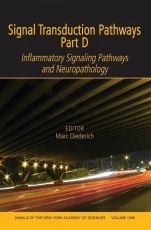
Signal Transduction Pathways, Part D: Inflammatory Signaling Pathways and Neuropathology, Volume 1096
ISBN 9781573316972
Autor: Marc Diederich
Wydawca: Wiley
Dostępność: 3-6 tygodni
Cena: 622,65 zł
Przed złożeniem zamówienia prosimy o kontakt mailowy celem potwierdzenia ceny.
ISBN13: |
9781573316972 |
ISBN10: |
1573316970 |
Autor: |
Marc Diederich |
Oprawa: |
Paperback |
Rok Wydania: |
2007-04-26 |
Ilość stron: |
288 |
Wymiary: |
229x163 |
Tematy: |
PN |
This fouth volume to emerge from the cell signaling meeting in Luxembourg (see Part A, Part B, and Part C) focuses on the therapeutic potential for targeting cell signaling mechanisms with particular attention to cancer therapies and inflammatory signaling pathways as well as immunomodulation.
NOTE: Annals volumes are available for sale as individual books or as a journal. For information on institutional journal subscriptions, please visit www.blackwellpublishing.com/nyas.
ACADEMY MEMBERS: Please contact the New York Academy of Sciences directly to place your order (www.nyas.org). Members of the New York Academy of Science receive full–text access to the Annals online and discounts on print volumes. Please visit www.nyas.org/membership/main.asp for more information about becoming a member.
Spis treści:
Preface.
Part I: Inflammatory Signaling Pathways:.
1. Targeting Bacterial Endotoxin: Two Sides of a Coin: Herbert Bosshart and Michael Heinzelmann.
2. Interaction between the Helicobacter pylori CagA and α–Pix in Gastric Epithelial AGS Cells: Hye Yeon Baek, Joo Weon Lim, and Hyeyoung Kim.
3. Expression of Suppressors of Cytokine Signaling–3 in Helicobacter pylori–Infected Rat Gastric Mucosal RGM–1Cells: Boram Cha, Kyung Hwan Kim, Hirofumi Matsui, and Hyeyoung Kim.
4. Role of Proteinase–Activated Receptor–2 on Cyclooxygenase–2 Expression in H. pylori–Infected Gastric Epithelial Cells: Ji Hye Seo, Kyung Hwan Kim, and Hyeyoung Kim.
5. Control of Human Herpes Virus Type 8–Associated Diseases by NK Cells: Maria C. Sirianni, Massimo Campagna, Donato Scaramuzzi, Maurizio Carbonari, Elena Toschi, Ilaria Bacigalupo, Paolo Monini, and Barbara Ensoli.
6. Analysis of Tissue Distribution of TNF–α, TNF–α–Receptors, and the Activating TNF– α–Converting Enzyme Suggests
Activation of the TNF–α System in the Aging Intervertebral Disc: Beatrice E. Bachmeier, Andreas G. Nerlich, Christoph Weiler, Gunther Paesold, Marianne Jochum, and Norbert Boos.
7. Upregulation of Apolipoprotein B Secretion, but Not Lipid, by Tumor Necrosis Factor–α in Rat Hepatocyte Cultures in the Absence of Extracellular Fatty Acids: Nerea Bartolome, Lorena Rodriguez, Maria J. Martinez, Begona Ochoa, and Yolanda Chico.
8. Gene Expression Profiling of LPS–Stimulated Murine Macrophages and Role of the NF–κB and PI3K/mTOR Signaling Pathways: S. Dos Santos, A.–I. Delattre, F. De Longueville, H. Bult, and M. Raes.
9. Modification of Proteins by Cyclopentenone Prostaglandins is Differentially Modulated by GSH in vitro: Javier Gayarre, M. Isabel Avellano, Francisco J. Sanchez–Gomez, M. Jesus Carrasco, F. Javier Canada, and Dolores Perez–Sala.
10. Signaling Pathways Involved in Proteinase–Activated Receptor1–Induced Proinflammatory and Profibrotic Mediator Release Following Lung Injury: Paul F. Mercer, Xiaoling Deng, and Rachel C. Chambers.
11. Signaling Pathway Used by HSV–1 to Induce NF–κB Activation: Possible Role of Herpes Virus Entry Receptor A: M. Teresa Sciortino, M. Antonietta Medici, Francesca Marino–Merlo, Daniela Zaccaria, Maria Giuffr`E, Assunta Venuti, Sandro Grelli, and Antonio Mastino.
12. Melphalan Reduces the Severity of Experimental Colitis in Mice by Blocking Tumor Necrosis Factor–α Signaling Pathway: Galina Shmarina, Alexander Pukhalsky, Vladimir Alioshkin, and Alex Sabelnikov.
Part II: Neuropathology:.
13. Cellular Prion Protein Signaling in Serotonergic Neuronal Cells: Sophie Mouillet–Richard, Benoit Schneider, Elodie Pradines, Mathea Pietri, Myriam Ermonval, Jacques Grassi, J. Grayson Richards, Vincent Mutel, Jean–Marie Launay, and Odile Kellermann.
14. Strongly Reduced Number of Parvalbumin–Im
munoreactive Projection Neurons in the Mammillary Bodies in Schizophrenia: Further Evidence for Limbic Neuropathology: Hans–Gert Bernstein, Stephanie Krause, Dieter Krell, Henrik Dobrowolny, Marion Wolter, Renate Stauch, Karin Ranft, Peter Danos, Gustav F. Jirikowski, and Bernhard Bogerts.
15. Alterations of Synaptic Turnover Rate in Aging May Trigger Senile Plaque Formation and Neurodegeneration: Carlo Bertoni–Freddari, Patrizia Fattoretti, Belinda Giorgetti, Yessica Grossi, Marta Balietti, Tiziana Casoli, Giuseppina Di Stefano, and Gemma Perretta.
16. Preservation of Mitochondrial Volume Homeostasis at the Early Stages of Age–Related Synaptic Deterioration: Carlo Bertoni–Freddari, Patrizia Fattoretti, Belinda Giorgetti, Yessica Grossi, Marta Balietti, Tiziana Casoli, Giuseppina Di Stefano, and Gemma Perretta.
17. Immunohistochemical Evidence for Impaired Neuregulin–1 Signaling in the Prefrontal Cortex in Schizophrenia and in Unipolar Depression: Iris Bertram, Hans–Gert Bernstein, Uwe Lendeckel, Alicja Bukowska, Henrik Dobrowolny, Gerburg Keilhoff, Dimitrios Kanakis, Christian Mawrin, Hendrik Bielau, Peter Falkai, and Bernhard Bogerts.
18. Dysregulation of GABAergic Neurotransmission in Mood Disorders: A Postmortem Study: Hendrik Bielau, Johann Steiner, Christian Mawrin, Kurt Tr¨Ubner, Ralf Brisch, Gabriela Meyer–Lotz, Michael Brodhun, Henrik Dobrowolny, Bruno Baumann, Tomasz Gos, Hans–Gert Bernstein, and Bernhard Bogerts.
19. Release of β–Amyloid from High–Density Platelets: Implications for Alzheimer′s Disease Pathology: Tiziana Casoli, Giuseppina Di Stefano, Belinda Giorgetti, Yessica Grossi, Marta Balietti, Patrizia Fattoretti, and Carlo Bertoni–Freddari.
20. The Role of Selenite on Microglial Migration: Lisa Dalla Puppa, Nicolai E. Savaskan, Anja U. Brauer, Dietrich Behne, and Antonios Kyriakopoulos.
21. Altered Subcellular Distribution of the Alzheimer̸
2;s Amyloid Precursor Protein Under Stress Conditions: Sara C.T.S. Domingues, Ana Gabriela Henriques, Wenjuan Wu, Edgar F. Da Cruz E. Silva, and Odete A.B. Da Cruz E. Silva.
22. Differential Distribution of Alzheimer′s Amyloid Precursor Protein Family Variants in Human Sperm: Margarida Fardilha, Sandra I. Vieira, Alberto Barros, Mario Sousa, Odete A.B. Da Cruz E. Silva, and Edgar F. Da Cruz E. Silva.
23. The Effect of Repeated Physical Exercise on Hippocampus and Brain Cortex in Stressed Rats: Dragana Filipovic, Ljubica Gavrilovic, Sladjana Dronjak, and Marija B. Radojcic.
24. Prion Protein Aggregation and Neurotoxicity in Cortical Neurons: Joana Barbosa Melo, Paula Agostinho, and Catarina Resende Oliveira.
25. Intensive Remodeling of Purkinje Cell Spines after Climbing Fibers Deafferentation Does Not Involve MAPK and Akt Activation: Jelena M. Milasin, Annalisa Buffo, Daniela Carulli, and Piergiorgio Strata.
26. Immunomorphological Analysis of RAGE Receptor Expression and NF–κB Activation in Tissue Samples from Normal and Degenerated Intervertebral Discs of Various Ages: Andreas G. Nerlich, Beatrice E. Bachmeier, Erwin Schleicher, Helmut Rohrbach, Guenther Paesold, and Norbert Boos.
27. Amyloid Precursor Protein and Presenilin 1 Interaction Studied by FRET in Human H4 Cells: Mario Nizzari, Valentina Venezia, Paolo Bianchini, Valentina Caorsi, Alberto Diaspro, Emanuela Repetto, Stefano Thellung, Alessandro Corsaro, Pia Carlo, Gennaro Schettini, Tullio Florio, and Claudio Russo.
28. Amino–Terminally Truncated Prion Protein PrP90–231 Induces Microglial Activation in vitro: Stefano Thellung, Alessandro Corsaro, Valentina Villa, Valentina Venezia, Mario Nizzari, Michela Bisaglia, Claudio Russo, Gennaro Schettini, Antonio Aceto, and Tullio Florio.
29. Activation and Endocytic Internalization of Melanocortin 3 Receptor in Neuronal Cells: S.J.M. Wachira, B. Guruswamy, L. Uradu, C.A. Hughes–Darden, and F.J. Denaro.<
Koszyk
Książek w koszyku: 0 szt.
Wartość zakupów: 0,00 zł
Informacje


Kontakt
Gambit
Centrum Oprogramowania
i Szkoleń Sp. z o.o.
Al. Pokoju 29b/22-24
31-564 Kraków
Siedziba Księgarni
ul. Kordylewskiego 1
31-542 Kraków
+48 12 410 5991
+48 12 410 5987
+48 12 410 5989
Subskrypcje
Administratorem danych osobowych jest firma Gambit COiS Sp. z o.o. Na podany adres będzie wysyłany wyłącznie biuletyn informacyjny.
Autoryzacja płatności

Informacje na temat autoryzacji płatności poprzez PayU.

© Copyright 2012: GAMBIT COiS Sp. z o.o. Wszelkie prawa zastrzeżone.
Projekt i wykonanie: Alchemia Studio Reklamy