


Wydawcy
Katalog tematyczny
- Archeologia (109)
- Ekonomia, finanse, business (13704)
- Filozofia (1445)
- Historia (3040)
- Języki i językoznawstwo (2356)
- Lifestyle, hobby i rozrywka (475)
- Medycyna (9704)
- Nauki humanistyczne (4)
- Nauki o Ziemi i środowisku (2638)
- Nauki ścisłe (20412)
- Astronomia (294)
- Biologia (5119)
- Biochemia (575)
- Biologia człowieka (14)
- Biologia komórkowa (377)
- Biologia molekularna (398)
- Biologia rozwoju (130)
- Biologia, ogólnie (1277)
- Botanika (280)
- Hydrobiologia (92)
- Mikrobiologia (363)
- Mykologia (22)
- Zoologia (303)
- Chemia (6540)
- Fizyka (3309)
- Matematyka (4574)
- Nauki ścisłe, ogólnie (503)
- Nauki społeczne (8486)
- Nauki techniczne (13450)
- Prawo (1696)
- Publikacje informacyjne i interdyscyplinarne (1288)
- Religia i wierzenia (917)
- Technika komputerowa (4067)
- Zdrowie, relacje międzyludzkie i rozwój osobisty (657)





Informacje szczegółowe o książce
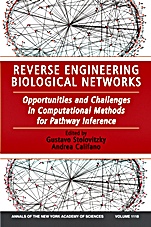
Reverse Engineering Biological Networks: Opportunities and Challenges in Computational Methods for Pathway Inference, Volume 1118
ISBN 9781573316897
Autor: Gustavo Stolovitzky, Andrea Califano
Wydawca: Wiley
Dostępność: 3-6 tygodni
Cena: 589,05 zł
Przed złożeniem zamówienia prosimy o kontakt mailowy celem potwierdzenia ceny.
ISBN13: |
9781573316897 |
ISBN10: |
157331689X |
Autor: |
Gustavo Stolovitzky, Andrea Califano |
Oprawa: |
Paperback |
Rok Wydania: |
2007-12-18 |
Ilość stron: |
452 |
Wymiary: |
228x153 |
Tematy: |
PS |
Computational biologists are striving to "reverse engineer" the underlying networks of interactions between the molecules in the cell. This volume and the conference it reports on attempt a systematic evaluation of reverse engineering methods. The DREAM project brings together a diverse group of researchers to clarify potentials and limitations of the enterprise of reverse engineering cellular networks. An important aspiration of the project is to compare the effectiveness of different methods in reverse engineering biological networks. Evaluating this requires a "gold standard" network for which at least the true topology of connections is known. Many participants, especially the computational biologists, believe that synthetic networks are good candidates for this purpose because, at least for now, only they can be described with certainty. Experimental biologists, however, worry that unless the project addresses real biological networks, it could evolve into a mathematical exercise with little impact on biology. These and other ideas are discussed.
NOTE: Annals volumes are available for sale as individual books or as a journal. For information on institutional journal subscriptions, please visit www.blackwellpublishing.com/nyas.
ACADEMY MEMBERS: Please contact the New York Academy of Sciences directly to place your order (www.nyas.org). Members of the New York Academy of Science receive full–text access to the Annals online and discounts on print volumes. Please visit www.nyas.org/membership/main.asp for more information about becoming a member.
Spis treści:
Preface: Gustavo Stolovitzky.
Part I: Community Efforts for Pathway Inference:.
1. Dialogue on Reverse Engineering Assessment and Methods: the DREAM of High Throughput Pathway Inference: Gustavo Stolovitzky, Don Monroe, Andrea Califano.
2. ENFIN – A Network to Enhance Integrative Systems Biology:
Pascal Kahlem and Ewan Birney.
Part II: Overview of Reverse Engineering Methods: Experiment and Theory:.
3. Reconstructing Signal Transduction Pathways: Challenges and Opportunities: Arnold J. Levine, Wenwei Hu, Zhaohui Feng and German Gil.
4. Theory and Limitations of Genetic Network Inference from Microarray Data: Adam A. Margolin and Andrea Califano.
Part III: Establishing In–Silico and Experimental Gold Standards and Performance Metrics for Reverse Engineering:.
5. Comparison of Reverse Engineering Methods Using an In–Silico Network: Diogo Camacho, Paola Vera Licona, Pedro Mendes and Reinhard Laubenbacher.
6. Benchmarking of Dynamic Bayesian Networks From Stochastic Time–Series Data: Lawrence A. David and Chris H. Wiggins.
7. Reconstruction of Metabolic Networks from High–throughput Metabolite Profiling Data: In–Silico Analysis of Red Blood Cell Metabolism: Ilya Nemenman, G. Sean Escola, William S. Hlavacek, Pat J. Unkefer,Clifford J. Unkefer and Michael E. Wall.
8. The Gap Gene System of Drosophila Melanogaster: Model–fitting and Validation: Theodore J. Perkins.
Part IV: Theoretical Analyses of Reverse Engineering Algorithms:.
9. Algorithmic Issues in Reverse Engineering of Protein and Gene Networks via the Modular Response Analysis Method: Piotr Berman, Bhaskar DasGupta, and Eduardo Sontag.
10. Data Requirements of Reverse–engineering Algorithms: Winfried Just.
Part V: Some Reverse Engineering Algorithms:.
11. Improving Protein–Protein Interaction Prediction based on Phylogenetic Information using Least–Squares SVM: Roger A. Craig and Li Liao.
12. Reverse–Engineering of Dynamic Networks: Brandy Stigler, Abdul Jarrah, Mike Stillman and Reinhard Laubenbacher.
13. Learning Regulatory Programs that Accurately Predict Differential Expression with MEDUSA: Anshul Kundaje, Steve Lianoglou, Xuejing Li, David Quigle, Marta Arias, Chris H. Wiggin
s, Li Zhang and Christina Leslie.
Part VI: Reverse Engineering of Parameters in Quantitative Models:.
14. Extracting Falsifiable Predictions from Sloppy Models: Ryan N. Gutenkunst, Fergal P. Casey, Joshua J. Waterfall, Christopher R. Myers and James P. Sethna.
15. Dynamic Pathway Modeling: Feasibility Analysis and Optimal Experimental Design: Thomas Maiwald, Clemens Kreutz, Andrea C. Pfeifer, Sebastian Bohl, Ursula Klingmüller and Jens Timmer.
16. Sensitivity Analysis of Computational Model of the IKK–NF–ĸB–IĸBά–A20 Signal Transduction Network: Jaewook Joo, Steve Plimpton, Shawn Martin, Laura Swiler and Jean–Loup Faulon.
Part VII: Integration of Prior Information in Reverse Engineering Algorithms:.
17. A Framework for Elucidating Regulatory Networks Based on Prior Information and Expression Data: Olivier Gevaert, Steven Van Vooren and Bart De Moor.
18. CellFrame: A Data Structure for Abstraction of Cell Biology Experiments and Construction of Perturbation Networks: Yunchen Gong and Zhaolei Zhang.
19. Alternative Pathway Approach for Automating Analysis and Validation of Cell Perturbation Networks and Design of Perturbation Experiments: Yunchen Gong and Zhaolei Zhang
Okładka tylna:
Computational biologists are striving to "reverse engineer" the underlying networks of interactions between the molecules in the cell. This volume and the conference it reports on attempt a systematic evaluation of reverse engineering methods. The DREAM project brings together a diverse group of researchers to clarify potentials and limitations of the enterprise of reverse engineering cellular networks. An important aspiration of the project is to compare the effectiveness of different methods in reverse engineering biological networks. Evaluating this requires a "gold standard" network for which at least the true topology of connections is known. Many participants, especially the
computational biologists, believe that synthetic networks are good candidates for this purpose because, at least for now, only they can be described with certainty. Experimental biologists, however, worry that unless the project addresses real biological networks, it could evolve into a mathematical exercise with little impact on biology. These and other ideas are discussed.
NOTE: Annals volumes are available for sale as individual books or as a journal. For information on institutional journal subscriptions, please visit www.blackwellpublishing.com/nyas.
ACADEMY MEMBERS: Please contact the New York Academy of Sciences directly to place your order (www.nyas.org). Members of the New York Academy of Science receive full–text access to the Annals online and discounts on print volumes. Please visit www.nyas.org/membership/main.asp for more information about becoming a member.
Koszyk
Książek w koszyku: 0 szt.
Wartość zakupów: 0,00 zł
Informacje


Kontakt
Gambit
Centrum Oprogramowania
i Szkoleń Sp. z o.o.
Al. Pokoju 29b/22-24
31-564 Kraków
Siedziba Księgarni
ul. Kordylewskiego 1
31-542 Kraków
+48 12 410 5991
+48 12 410 5987
+48 12 410 5989
Subskrypcje
Administratorem danych osobowych jest firma Gambit COiS Sp. z o.o. Na podany adres będzie wysyłany wyłącznie biuletyn informacyjny.
Autoryzacja płatności

Informacje na temat autoryzacji płatności poprzez PayU.

© Copyright 2012: GAMBIT COiS Sp. z o.o. Wszelkie prawa zastrzeżone.
Projekt i wykonanie: Alchemia Studio Reklamy