


Wydawcy
Katalog tematyczny
- Archeologia (109)
- Ekonomia, finanse, business (13704)
- Filozofia (1445)
- Historia (3040)
- Języki i językoznawstwo (2356)
- Lifestyle, hobby i rozrywka (475)
- Medycyna (9704)
- Chirurgia (272)
- Inne gałęzie medycyny (1871)
- Medycyna kliniczna (4187)
- Choroby wewnętrzne (514)
- Dermatologia (51)
- Diagnostyka medyczna (3)
- Endokrynologia (144)
- Gastroenterologia (27)
- Geriatria (50)
- Ginekologia i położnictwo (134)
- Hematologia (46)
- Hepatologia (10)
- Kardiologia (71)
- Laryngologia (12)
- Nefrologia (10)
- Neurologia (500)
- Oftalmologia (50)
- Pediatria (33)
- Pulmunologia (32)
- Reumatologia (14)
- Terapia genowa (1)
- Układ mięśniowo-szkieletowy (1)
- Urologia (14)
- Medycyna niekonwencjonalna (14)
- Medycyna przedkliniczna (269)
- Medycyna, ogólnie (1740)
- Medyczne służby pomocnicze (745)
- Studia medyczne (16)
- Weterynaria (548)
- Nauki humanistyczne (4)
- Nauki o Ziemi i środowisku (2638)
- Nauki ścisłe (20412)
- Nauki społeczne (8486)
- Nauki techniczne (13450)
- Prawo (1696)
- Publikacje informacyjne i interdyscyplinarne (1288)
- Religia i wierzenia (917)
- Technika komputerowa (4067)
- Zdrowie, relacje międzyludzkie i rozwój osobisty (657)





Informacje szczegółowe o książce
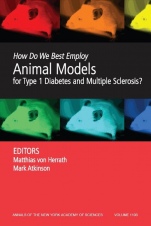
How Do We Best Employ Animal Models for Type 1 Diabetes and Multiple Sclerosis?, Volume 1103
ISBN 9781573316781
Autor: Matthias Von Herrath, Mark A. Atkinson, David A. Hafler, Bart O. Roep
Wydawca: Wiley
Dostępność: 3-6 tygodni
Cena: 631,05 zł
Przed złożeniem zamówienia prosimy o kontakt mailowy celem potwierdzenia ceny.
ISBN13: |
9781573316781 |
ISBN10: |
1573316784 |
Autor: |
Matthias Von Herrath, Mark A. Atkinson, David A. Hafler, Bart O. Roep |
Oprawa: |
Paperback |
Rok Wydania: |
2007-06-01 |
Ilość stron: |
300 |
Wymiary: |
231x155 |
Tematy: |
MJ |
Our understanding of the genetics and pathophysiology of animal models for autoimmune diseases such as type 1 diabetes and multiple sclerosis has increased significantly in the past few years. The central themes of this volume are the necessity for novel and improved models, the optimal use of information from animal models to understand pathogenesis of the human disease, and the rational development of novel immunotherapeutics.
This volume is intended to foster discussion on the utility of currently available animal models, to suggest methods for improving upon present models, and to advance translational research in these fields.
NOTE: Annals volumes are available for sale as individual books or as a journal. For information on institutional journal subscriptions, please visit www.blackwellpublishing.com/nyas.
ACADEMY MEMBERS: Please contact the New York Academy of Sciences directly to place your order (www.nyas.org). Members of the New York Academy of Science receive full–text access to the Annals online and discounts on print volumes. Please visit www.nyas.org/membership/main.asp for more information about becoming a member.
Spis treści:
Introduction.
Part I: Controversies Surrounding the Use of Animal Models in Type 1 Diabetes and Multiple Sclerosis:.
1. Are Insights Gained from NOD Mice Sufficient to Guide Clinical Translation? Another Inconvenient Truth: Bart O. Roep.
2. Building Different Mouse Models for Human MS: Estelle Bettelli.
3. Autoimmunity and β Cell Regeneration in Mouse and Human Type 1 Diabetes. The Peace Is Not Enough: Vitaly Ablamunits, Nicole A. Sherry, Jake A. Kushner, and Kevan C. Herold.
4. Diabetes Research in Jeopardy: The Extinction of Clinical Diabetes Researchers: Aldo A. Rossini and Dale L. Greiner.
Part II. New Methods of Discovery for Questions of Pathogenesis and Therapy:.
In Silico.
5. The Virtual NOD Mouse: Applying Predictive Biosimulation to Research in Type 1 Diabetes: Yanan Zheng, Huub T. C. Kreuwel, Daniel L. Young, Lisl K. M. Shoda, Saroja Ramanujan, Kapil G. Gadkar, Mark A. Atkinson, and Chan C. Whiting.
6. Dosing and Timing Effects of Anti–CD40L Therapy: Predictions from a Mathematical Model of Type 1 Diabetes: Kapil G. Gadkar, Lisl K. M. Shoda, Huub T. C. Kreuwel, Saroja Ramanujan, Yanan Zheng, Chan C. Whiting, and Daniel L. Young.
Humanized, Transgenic, or Congenic Models.
7. Autoreactive T Cells in a Partially Humanized Murine Model of T1D: John A. Gebe, Ben Falk, Kellee Unrath, and Gerald T. Nepom.
8. Humanized NOD/LtSz–scid IL2 Receptor Common Gamma Chain Knockout Mice in Diabetes Research: Leonard D. Shultz, Todd Pearson, Marie King, Lisa Giassi, Lisa Carney, Bruce Gott, Bonnie Lyons, Aldo A. Rossini, and Dale L. Greiner.
9. Development of New–Generation HU–PBMC–NOD/SCID Mice to Study Human Islet Alloreactivity: Marie King, Todd Pearson, Leonard D. Shultz, Jean Leif, Rita Bottino, Massimo Trucco, Mark Atkinson, Clive Wasserfall, Kevan Herold, John P. Mordes, Aldo A. Rossini, and Dale L. Greiner.
10. Resistance to the Induction of Mixed Chimerism in Spontaneously Diabetic NOD Mice Depends on the CD40/CD154 Pathway and Donor MHC Disparity: Bin Luo, Tao Wu, Yisheng Pan, Hakan Sozen, Jianqiang Hao, Yu Zhang, David E. R. Sutherland, Bernhard J. Hering, and Zhiguang Guo.
11. "Humanized" HLA Transgenic NOD Mice to Identify Pancreatic β Cell Autoantigens of Potential Clinical Relevance to Type 1 Diabetes: David V. Serreze, Michele P. Marron, and Teresa P. Dilorenzo.
12. A New Humanized HLA Transgenic Mouse Model of Multiple Sclerosis Expressing Class II on Mouse CD4 T Cells: Ashutosh Mangalam, Moses Rodriguez, and Chella David.
13. The Use of Idd Congenic Mice to Identify Checkpoints of Peripheral Tolerance to Islet Antigen: Emma E. Hamilto
n–Williams, Xavier Martinez, Michael Lyman, Kara Hunter, Linda S. Wicker, and Linda A. Sherman.
14. Refinement of the Iddm4 Diabetes Susceptibility Locus Reveals TCRVβ4 as a Candidate Gene: Elizabeth P. Blankenhorn, Cheryl Descipio, Lucy Rodemich, Laura Cort, Jean H. Leif, Dale L. Greiner, and John P. Mordes.
Viral, Antigen, or Cell–Induced Models.
15. Cytotoxic T Cell–Mediated Diabetes in RIP–CD80 Transgenic Mice: Autoantigen Peptide Sensitivity and Fine Specificity: Klaus Pechhold, Sagarika Chakrabarty, and David M. Harlan.
16. Coxsackievirus Infections and NOD Mice: Relevant Models of Protection from, and Induction of, Type 1 Diabetes: Steven Tracy and Kristen M. Drescher.
17. Establishment of a Model to Examine the Early Events Involved in the Development of Virus–Induced Demyelinating Lesions: Kristen M. Drescher and Steven Tracy.
18. Experimental Autoimmune Encephalomyelitis Mediated by CD8+ T Cells: Qingyong Ji and Joan Goverman.
19. Impaired T Cell Receptor Signaling in Foxp3+ CD4 T Cells: Bryan D. Carson and Steven F. Ziegler.
20. Antigen Presentation in the CNS by Myeloid Dendritic Cells Drives Progression of Relapsing Experimental Autoimmune Encephalomyelitis: Stephen D. Miller, Eileen J. Mcmahon, Bettina Schreiner, and Samantha L. Bailey.
21. Human Clonal CD8 Autoreactivity to an IGRP Islet Epitope Shared between Mice and Men: W.W.J. Unger, G.G.M. Pinkse, S. Mulder–Van Der Kracht, A.R. Van Der Slik, M.G.D. Kester, F. Ossendorp, J.W. Drijfhout, D.V. Serreze, and B.O. Roep.
Complications.
22. Matrix Metalloproteinase–2 Expression and Apoptogenic Activity in Retinal Pericytes: Implications in Diabetic Retinopathy: Ru Yang, Haibo Liu, Iyesha Williams, and Brahim Chaqour.
23. Mouse Models for Studies of Cardiovascular Complications of Type 1 Diabetes: Xia Shen and Karin E. Bornfeldt.
Index of Contributors.
Okładka tylna:
Our
understanding of the genetics and pathophysiology of animal models for autoimmune diseases such as type 1 diabetes and multiple sclerosis has increased significantly in the past few years. The central themes of this volume are the necessity for novel and improved models, the optimal use of information from animal models to understand pathogenesis of the human disease, and the rational development of novel immunotherapeutics.
This volume is intended to foster discussion on the utility of currently available animal models, to suggest methods for improving upon present models, and to advance translational research in these fields.
NOTE: Annals volumes are available for sale as individual books or as a journal. For information on institutional journal subscriptions, please visit www.blackwellpublishing.com/nyas.
ACADEMY MEMBERS: Please contact the New York Academy of Sciences directly to place your order (www.nyas.org). Members of the New York Academy of Science receive full–text access to the Annals online and discounts on print volumes. Please visit www.nyas.org/membership/main.asp for more information about becoming a member.
Koszyk
Książek w koszyku: 0 szt.
Wartość zakupów: 0,00 zł
Informacje


Kontakt
Gambit
Centrum Oprogramowania
i Szkoleń Sp. z o.o.
Al. Pokoju 29b/22-24
31-564 Kraków
Siedziba Księgarni
ul. Kordylewskiego 1
31-542 Kraków
+48 12 410 5991
+48 12 410 5987
+48 12 410 5989
Subskrypcje
Administratorem danych osobowych jest firma Gambit COiS Sp. z o.o. Na podany adres będzie wysyłany wyłącznie biuletyn informacyjny.
Autoryzacja płatności

Informacje na temat autoryzacji płatności poprzez PayU.

© Copyright 2012: GAMBIT COiS Sp. z o.o. Wszelkie prawa zastrzeżone.
Projekt i wykonanie: Alchemia Studio Reklamy