


Wydawcy
Katalog tematyczny
- Archeologia (109)
- Ekonomia, finanse, business (13704)
- Filozofia (1445)
- Historia (3040)
- Języki i językoznawstwo (2356)
- Lifestyle, hobby i rozrywka (475)
- Medycyna (9704)
- Chirurgia (272)
- Inne gałęzie medycyny (1871)
- Medycyna kliniczna (4187)
- Medycyna niekonwencjonalna (14)
- Medycyna przedkliniczna (269)
- Medycyna, ogólnie (1740)
- Historia medycyny (3)
- Lekarze, sprawy zawodowe (8)
- Medycyna, aspekty prawne (10)
- Służba zdrowia (36)
- Wyposażenie medyczne (157)
- Zdrowie publiczne (460)
- Medyczne służby pomocnicze (745)
- Studia medyczne (16)
- Weterynaria (548)
- Nauki humanistyczne (4)
- Nauki o Ziemi i środowisku (2638)
- Nauki ścisłe (20412)
- Nauki społeczne (8486)
- Nauki techniczne (13450)
- Prawo (1696)
- Publikacje informacyjne i interdyscyplinarne (1288)
- Religia i wierzenia (917)
- Technika komputerowa (4067)
- Zdrowie, relacje międzyludzkie i rozwój osobisty (657)





Informacje szczegółowe o książce
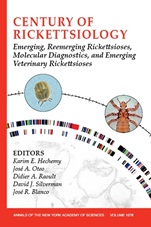
Century of Rickettsiology: Emerging, Reemerging Rickettsioses, Molecular Diagnostics, and Emerging Veterinary Rickettsioses, Volume 1078
ISBN 9781573316392
Autor: Karim E. Hechemy, Jose A. Oteo, Didier A. Raoult, David J. Silverman, Jose R. Blanco
Wydawca: Wiley
Dostępność: 3-6 tygodni
Cena: 672,00 zł
Przed złożeniem zamówienia prosimy o kontakt mailowy celem potwierdzenia ceny.
ISBN13: |
9781573316392 |
ISBN10: |
1573316393 |
Autor: |
Karim E. Hechemy, Jose A. Oteo, Didier A. Raoult, David J. Silverman, Jose R. Blanco |
Oprawa: |
Paperback |
Rok Wydania: |
2006-12-11 |
Ilość stron: |
400 |
Wymiary: |
229x152 |
Tematy: |
MBN |
The worldwide epidemiology of rickettsial diseases, including veterinary rickettsiology, is the focus of this volume, which is the second volume resulting from the 4th International Conference on Rickettsiae and Rickettsial Diseases.
The heterogeneity of clinical presentations of rickettsial diseases is greater than had previously been appreciated, and atypical and previously unseen presentations are discussed here along with chapters on known vectors and vectors previously not known to transmit a given rickettsial species.
This volume and volume 1063, New Insights into Rickettsioses, complete the picture presented at the conference of the wide range of work that is being carried out in rickettsiology worldwide.
NOTE: Annals volumes are available for sale as individual books or as a journal. For information on institutional journal subscriptions, please visit www.blackwellpublishing.com/nyas.
ACADEMY MEMBERS: Please contact the New York Academy of Sciences directly to place your order (www.nyas.org). Members of the New York Academy of Science receive full–text access to the Annals online and discounts on print volumes. Please visit www.nyas.org/membership/main.asp for more information about becoming a member.
Spis treści:
Overview: A Century of Rickettsiology. (Karim E. Hechemy).
Insights into Mechanisms of Bacterial Antigenic Variation Derived from the Complete Genome Sequence of Anaplasma Marginale. (Guy H. Palmer & Kelly A. Brayton.).
Part I: Epidemiology of Rickettsial Disease.
1. Rickettsiosis in Europe. (J.R. Blanco & J.A.Oteo).
2. Epidemiology of Rickettsioses in North Africa. (Amel Letaief).
3. Rickettsioses in Sub–Saharan Africa. (P. Parola).
4. Rickettsial Diseases in Russia. Irina V. Tarasevich & Oleg Y. Mediannikov.
5. Rickettsioses in Japan and Far East. (Fumihiko Mahara).
6. Rickettioses in Austra
lia. (Stephen Graves & John Stenos).
7. Ecology and Molecular Epidemiology of Tick–Borne Rickettsioses and Anaplasmoses with Natural Foci in Russia and Kazakhstan. (Nikolay Rudakov & Didier Raoult).
8. Far Eastern Tick–borne Rickettsiosis: Identification of Two New Cases and Tick Vector. (Oleg Mediannikov & Didier Raoult).
9. Seroprevalence of Anaplasma phagocytophilum among Forestry Rangers in Northern and North–eastern Poland. (Joanna Stańczak & Anna Grzeszczuk).
10. Seroprevalence of Human Anaplasmosis in Slovene Forestry Workers. (Tereza Rojko & Stanka Lotric–Furlan).
11. Molecular Epidemiology of Human and Bovine Anaplasmosis in Southern Europe. (Victoria Naranjo & José de la Fuente).
12. Human exposure to Anaplasma phagocytophilum in Portugal. (A.S. Santos & J.S. Dumler).
13. Human Granulocytic Anaplasmosis (HGA) in North–Eastern Italy. (Anna Beltrame & Pierluigi Viale).
14. Human Infection with Ehrlichia Canis Accompanied by Clinical Ssigns in Venezuela. (Miriam Perez & Yasuko Rikihisa).
15. Human Monocytic Ehrlichiosis and Human Granulocytic Anaplasmosis in the United States, 2001– 2002. (Linda J. Demma & D.L. Swerdlow).
16. Anthropogenic Effects on Changing of Q Fever Epidemiology in Russia. (N.K.Tokarevicha & E.V.Vorobeichikov).
17. Gipuzkoa, Basque Country, Spain (1984–2004), a Hyperendemic Area of Q Fever. (M. Montes & E. Perez–Trallero).
18. Serotesting of Human Q Fever Distribution on Wider Area of Bosnia and Herzegovina. (S. Hamzić & Š. Zvizdić).
19. Ticks and Tick–borne Rickettsiae Surveillance in Montesinho Natural Park – Portugal. (M. Santos–Silva & F. Bacellar).
20. Current Knowledge of Rickettsial Diseases in Italy. (Lorenzo Ciceroni & Alessandra Ciervo).
21. No Serological Evidence for Rickett
sial Diseases among Danish Elite Orienteers. (Peter Schiellerup & Karen A. Krogfelt).
22. Rocky Mountain Spotted Fever in the United States, 1997 – 2002. (A.S. Chapman & D.L. Swerdlow).
23. Rickettsia Felis in the Americas: M.A.M. (Galvão & D.H. Walker).
24. Evidence of Infection in Humans with Rickettsia typhi and Rickettsia felis in Catalonia, Northeast of Spain. (María Mercedes Nogueras & Ferran Segura).
25. Boutonneuse Fever and Climate Variability. (Rita de Sousa & Fatima Bacella).
26. Brazilian Spotted Fever. A Case–series from an Endemic Area in Southeastern Brazil: Epidemiological Aspects. (R.N. Angerami & L.J. Silva).
27. Prospective Evaluation of Rickettsioses in the Trakya (European) Region of Turkey and Atypic Presentations of Rickettsia Conorii. (F. Kuloglu & D. Raoult).
28. Reemergence of Rickettsiosis in Oran, Algeria. (N. Mouffok & D. Raoult).
29. Geoinformation Mapping of Siberian Tick–borne Rickettsiosis Foci in Altai Krai. (Nadezhda Yu.Kurepina & Nikolai V. Rudakov).
30. Methods of Isolation and Cultivation of New Rickettsiaer from Nozoarea of the North Asian Tick Typhus in Siberia. (I.E. Samoylenko & N.V. Rudakov).
31. Validation of a Rickettsia Prowazekii–specific Quantitative Real–time PCR Cassette and DNA Extraction Protocols Using Experimentally Infected Lice. (Patrick J. Rozmajzl & Allen L. Richards).
32. Detection and Identification of a Novel Spotted Fever Group Rickettsia in Western Australia. (Helen Owen & Stan Fenwick).
33. Low Incidence of Tick–Borne Rickettsiosis in a Spanish Mediterranean Area. (A. Guerrero, F. Gimeno, M. Cuenca).
Part II: Clinical Aspects and Diagnosis.
34. Rickettsia slovaca infection. Debonel/Tibola. (V. Ibarra & M. Sanz).
35. Arthropod–borne Diseases in Homeless. (Philippe Brouqui & Didier Raoult).
36. C
linical Diagnosis and Treatment of Human Granulocytotropic Anaplasmosis. (Johan S. Bakken & J. Stephen Dumler).
37. Brazilian Spotted Fever. A Case–series from an Endemic Area in Southeastern Brazil: Clinical Aspects. (R.N. Angerami & L.J. Silva).
38. Revisiting Brazilian Spotted Fever Focus of Caratinga, Minas Gerais State, BRAZIL. (Mam Galvão & D.H. Walker).
39. Fatal Brazilian Spotted Fever Confirmed by Immunohistochemical Staining and Sequencing Methods on Fixed Tissues. (Tatiana Rozental & Elba R. S. Lemos).
40. Detection of Rickettsia rickettsii and Rickettsia spp. in 24 Patient Blood Clots from Different Municipalities of the State of São Paulo, Brazil. (Flávia Sousa Gehrke & Teresinha Tizu Sato Schumake).
41. Rickettsia Side Effects on a Sexual Partner and Eradication Process of Rickettsia in the Infected Person: An Example of the Clare Effect. (Maurita C. McKay & Frank Parsons).
42. Mediterranean Spotted Fever in Crete Greece: Clinical and Therapeutic Data of 15 Consecutive Patients (A. Germanakis & Y. Tselentis).
Part III: Vectors.
43. Prevalence of Rickettsia felis–like and Bartonella spp. in Ctenocephalides felis and Ctenocephalides canis from La Rioja (Northern Spain). (J.R. Blanco & J.A. Oteo).
44. The Prediction of Habitat Suitability for Ticks. (Agustín Estrada–Peña).
45. Natural Infection, Transovarial Transmission, and Transstadial Survival of Rickettsia bellii in the Tick Ixodes Loricatus (Acari: Ixodidae) from Brazil. (Mauricio C. Horta & Marcelo B. Labruna).
46. Prevalence of Bacterial Agents in Ixodes Persulcatus Ticks from Vologda Province of Russia. (Marina E. Eremeeva & Gregory A. Dasch).
47. Prevalence of Rickettsia felis in Ctenocephalides felis and Ctenocephalides canis from Uruguay. (J. M. Venzal & J. A. Oteo).
48. Highly Variable Year to Year Prevalence of Anaplasma ph
Koszyk
Książek w koszyku: 0 szt.
Wartość zakupów: 0,00 zł
Informacje


Kontakt
Gambit
Centrum Oprogramowania
i Szkoleń Sp. z o.o.
Al. Pokoju 29b/22-24
31-564 Kraków
Siedziba Księgarni
ul. Kordylewskiego 1
31-542 Kraków
+48 12 410 5991
+48 12 410 5987
+48 12 410 5989
Subskrypcje
Administratorem danych osobowych jest firma Gambit COiS Sp. z o.o. Na podany adres będzie wysyłany wyłącznie biuletyn informacyjny.
Autoryzacja płatności

Informacje na temat autoryzacji płatności poprzez PayU.

© Copyright 2012: GAMBIT COiS Sp. z o.o. Wszelkie prawa zastrzeżone.
Projekt i wykonanie: Alchemia Studio Reklamy