


Wydawcy
Katalog tematyczny
- Archeologia (109)
- Ekonomia, finanse, business (13704)
- Filozofia (1445)
- Historia (3040)
- Języki i językoznawstwo (2356)
- Lifestyle, hobby i rozrywka (475)
- Medycyna (9704)
- Nauki humanistyczne (4)
- Nauki o Ziemi i środowisku (2638)
- Nauki ścisłe (20412)
- Astronomia (294)
- Biologia (5119)
- Biochemia (575)
- Biologia człowieka (14)
- Biologia komórkowa (377)
- Biologia molekularna (398)
- Biologia rozwoju (130)
- Biologia, ogólnie (1277)
- Botanika (280)
- Hydrobiologia (92)
- Mikrobiologia (363)
- Mykologia (22)
- Zoologia (303)
- Chemia (6540)
- Fizyka (3309)
- Matematyka (4574)
- Nauki ścisłe, ogólnie (503)
- Nauki społeczne (8486)
- Nauki techniczne (13450)
- Prawo (1696)
- Publikacje informacyjne i interdyscyplinarne (1288)
- Religia i wierzenia (917)
- Technika komputerowa (4067)
- Zdrowie, relacje międzyludzkie i rozwój osobisty (657)





Informacje szczegółowe o książce
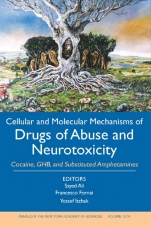
Cellular and Molecular Mechanisms of Drugs of Abuse and Neurotoxicity: Cocaine, GHB, and Substituted Amphetamines Annual of The NY Academy of Science
ISBN 9781573316293
Autor: Sayed Ali, Francesce Fornai, Yossef Itzhak
Wydawca: Wiley
Dostępność: 3-6 tygodni
Cena: 662,55 zł
Przed złożeniem zamówienia prosimy o kontakt mailowy celem potwierdzenia ceny.
ISBN13: |
9781573316293 |
ISBN10: |
1573316296 |
Autor: |
Sayed Ali, Francesce Fornai, Yossef Itzhak |
Oprawa: |
Paperback |
Rok Wydania: |
2006-09-25 |
Ilość stron: |
552 |
Wymiary: |
227x155 |
Tematy: |
PS |
Methamphetamine, MDMA, cocaine, PMA , GHB, and various solvents are the most widely abused drugs in Europe, the United States, Central America, South America, and Asia; and their use has dramatically increased over the last two decades. These drugs of abuse are known to cause neurotoxicity in several species, including not only rodents, dogs, and nonhuman primates, but also humans.
The precise neurochemical mechanisms underlying this drug–induced neurotoxicity remain unclear. This volume explores this question, specifically addressing the following aspects: (1) the role of genomics and proteomics in drug–induced neurotoxicity, (2) drugs of abuse and medication development, (3) molecular biology and free radicals in drug–induced neurotoxicity, (4) substituted amphetamine–induced neurochemical changes and relationship to neurotoxicity, (5) drugs of abuse and imaging brain structure and function.
NOTE: Annals volumes are available for sale as individual books or as a journal. For information on institutional journal subscriptions, please visit www.blackwellpublishing.com/nyas.
ACADEMY MEMBERS: Please contact the New York Academy of Sciences directly to place your order (www.nyas.org). Members of the New York Academy of Science receive full–text access to the Annals online and discounts on print volumes. Please visit www.nyas.org/membership/main.asp for more information about becoming a member.
Spis treści:
Part I: Genes and Drug of Abuse.
1. Opposite Regulation of Cocaine–Induced Intracellular Signaling and Gene Expression by Dopamine D1 and D3 Receptors: J. Zhang and M. Xu.
2. Serial Analysis of Gene Expression (SAGE) in the Rat Striatum following Methamphetamine Administration: N. S. Cai, M. McCoy, B. Ladenheim, J. Lyles, S. Ali and J. Cadet.
3. Dopamine Quinones Activate Microglia and Induce a Neurotoxic Gene Expression Profile: Relationship to Me
thamphetamine–Induced Nerve Ending Damage: D. Kuhn, D. Francescutti–Verbeem and D. Thomas.
4. Gene expression in the brain from Fluoxetine–injected mouse by using DNA microarray: Y. Takahashi, K. Washiyama, T. Kobayashi and S. Hayashi.
5. Short–term effects of adolescent methylphenidate exposure on brain striatal gene.
expression and sexual/endocrine parameters in male rats: W. Adriani , D. Leo, M. Guarino, A. Natoli, E. di Consiglio, G. de Angelis, E. Traina, E. Testai , C. Perrone–Capano, G. Laviola.
6. Effects of L–carnitine Pre–treatment in Methamphetamine and 3–nitropropionic acid–induced neurotoxicity: Z. Binienda, B. Przybyla, B. Robinson, , N. Salem, A. Virmani, A. Amato and S. Ali.
7. Convergent Roles of Alpha–Synuclein, DA Metabolism and the Ubiquitin–Proteasome System in Nigrostriatal Toxicity: F. Fornai, G. Lazzeri, A. Bandettini Di Poggio, P. Soldani, A. de Blasi, F. Nicoletti, S. Ruggieri and A. Paparelli.
8. Association Study of the Dihydropyrimidinase–related Protein 2 Gene and Methamphetamine Psychosis: H. Ujike, A. Sakai, K. Nakata, Y. Tanaka, T. Kodaka, Y. Okahisa, M. Harano, T. Inada, M. Yamada, T. Komiyama, T. Hori, Y. Sekine, N. Iwata, I. Sora, M. Iyo, N. Ozaki and S. Kuroda.
9. Repeated methamphetamine administration alters expression of the NMDA receptor channel ε2 subunit and kinesins in the mouse brain: H. Yamamoto, K. Imai, E. Kamegaya, Y. Takamatsu, M. Irago, Y. Hagino, S. Kasai, K. Shimada, T. Yamamoto, I. Sora, H. Koga and K. Ikeda.
10. Genes and Gene Expression in the Brain of Human Alcoholics: Peter R. Dodd, S. Tracey Buckley, Allison. Eckert, Philomena F. Foley and David J. Innes.
11. Association Study of the Tumor Necrosis Factor–α Gene and Its 1A Receptor Gene with Methampetamine Dependence: A. Nomura, h. Ujike, Y. Tanaka, M. Kishimoto, K. Otani, Y. Morita, A. Morio, M. Harano, T, Inada, M. Yamada, T. Komiyama, T. Hor
i, Y. Sekine, N. Iwata, I. Sora, M. Iyo, N. Ozaki, S. Kuroda.
Part II: Methamphetamine Neurotoxicity.
12. Longitudinal Clinical course following Pharmacological Treatment of Methamphetamine Psychosis which persists after long–term Abstinence: K. Akiyama.
13. Distinct Mechanisms Mediating Methamphetamine–Induced Neuronal Apoptosis and Dopamine Terminal Damage Share the Neuropeptide Substance P in the Striatum of Mice: J. P. Q. Zhu, W. Xu and J.A. Angulo.
14. Effects of Methamphetamine on the Cerebellar Cortex: a Preliminary Study: M. Ferrucci, C. Busceti, A. Falleni, F. Giorgi, S. Ruggieri and Francesco Fornai.
15. Age–Dependent Effects of Methamphetamine on VMAT–2: K. S. Rau, J. G. Truong, D. G. Wilkins, A. E. Fleckenstein, and G. R. Hanson.
16. Methamphetamine, Morphine and their Combination: Acute Changes in Striatal Dopaminergic Transmission evaluated by Microdialysis in Awake Rats: F. Pereira, E. Lourenco, N. Milhazes, T. Morgadinho, C. Ribeiro, S. Ali and T. Macedo.
17. In PC12 Cells Neurotoxicity Induced by Methamphetamine is Related to Proteasome Inhibition: G. Lazzeri, P. Lenzi, M. Gesi, M. Ferrucci, F. Fulcieri, S. Ruggieri, V. Bruno and F. Fornai.
18. Human Immunodeficiency Virus–1 Protein Tat and Methamphetamine Interactions: S. Theodore, S. Stolberg, W. Cass and W. Maragos.
19. Over Expression of α–Synuclein Following Methamphetamine: Is it Good or Bad?: G. Mauceli, C. Busceti, A. Pellegrini, P. Soldani, P. Lenzi, A. Paparelli and F. Fornai.
20. Alterations in Blood–Brain Barrier Function by Morphine and Methamphetamine: H. S. Sharma, and S. F. Ali.
21. Methamphetamine–Induced Selective Dopaminergic Neurotoxicity is Accompanied by an Increase in Striatal Nitrate in the Mouse: Karen L. Anderson and Yossef Itzhak.
22. Methamphetamine Induces Autophagy and Apoptosis in a Mesencephalic Dopaminergic Neuronal Culture Model: Role of Cathepsin–D in Methamphetam
ine–induced Apoptotic Cell Death: Kanthasamy, A, Anantharam, V, Syed F. Ali, Kanthasamy, A.G.
23. Balance Between Dopamine and Serotonin Release Modulates Behavioral Effects of Amphetamine–type Drugs: Richard B. Rothman, and Michael H. Bauman.
Part III: METH: Oxidative Stress, Neurodegeneration and Neuroprotection.
24. Calcitriol Protects against the Dopamine and Serotonin Depleting Effects of Neurotoxic Doses of Methamphetamine: W. Cass, M. Smith and L. Peters.
25. Protection by GDNF and Other Trophic Factors against the Dopamine Depleting Effects of Neurotoxic Doses of Methamphetamine. By W. Cass, L. Peters, M. Harned and K. Seroogy.
26. Estrogen, Testosterone and Methamphetamine Toxicity: D. Dluzen and J. McDermott.
27. Fluoxetine as a Potential Pharmacotherapy for Methamphetamine Dependence: Studies in Mice: Y. Takamatsu, H. Yamamoto, Y. Ogai, Y. Hagino, A. Markou and K. Ikeda.
28. Links Between Nutrition, Drug Abuse and the Metabolic Syndrome: A. Virmani, Z. Binienda, S. Ali and F. Gaetani.
Part IV: METH and MPTP: Similarities and Differences.
29. Inclusion Dynamics in PC12 is Comparable Between Amphetamines and MPTP: M. Gesi, G. Lazzeri, M. Ferrucci, A. Pellegrini, P. Lenzi, F. Fornai and A. Paparelli.
30. Psychoactive drugs affecting the dopaminergic system on the effects of psychostimulants, antidepressants and the antiparkinsonian drug levodopa on dopamine neurons: R. Geracitano , M. Federici , G. Bernardi, and N. Mercuri.
31. Effect of oxidative stress induced by L–dopa on endogenous antioxidants in PC–12 cells: G.T. Vatassery, W.E. Smith, H.T. Quach.
32. Dopamine Stimulation via Infusion in the Lateral Ventricle: F. Biagioni, C. Busceti, G. Molinaro, G. Battaglia, F. Giorgi, S. Ruggieri and F. Fornai.
33. Nigrostriatal Damage with 6–OHDA: Validation of Routinely Applied Procedures: F. Fulceri, F. Biagioni, P. Lenzi, A. Falleni, M. Gesi, S. Ruggieri and Francesco Fornai.
Koszyk
Książek w koszyku: 0 szt.
Wartość zakupów: 0,00 zł
Informacje


Kontakt
Gambit
Centrum Oprogramowania
i Szkoleń Sp. z o.o.
Al. Pokoju 29b/22-24
31-564 Kraków
Siedziba Księgarni
ul. Kordylewskiego 1
31-542 Kraków
+48 12 410 5991
+48 12 410 5987
+48 12 410 5989
Subskrypcje
Administratorem danych osobowych jest firma Gambit COiS Sp. z o.o. Na podany adres będzie wysyłany wyłącznie biuletyn informacyjny.
Autoryzacja płatności

Informacje na temat autoryzacji płatności poprzez PayU.

© Copyright 2012: GAMBIT COiS Sp. z o.o. Wszelkie prawa zastrzeżone.
Projekt i wykonanie: Alchemia Studio Reklamy