


Wydawcy
Katalog tematyczny
- Archeologia (109)
- Ekonomia, finanse, business (13704)
- Filozofia (1445)
- Historia (3040)
- Języki i językoznawstwo (2356)
- Lifestyle, hobby i rozrywka (475)
- Medycyna (9704)
- Nauki humanistyczne (4)
- Nauki o Ziemi i środowisku (2638)
- Nauki ścisłe (20412)
- Astronomia (294)
- Biologia (5119)
- Chemia (6540)
- Chemia analityczna (361)
- Chemia fizyczna (346)
- Chemia nieorganiczna (137)
- Chemia organiczna (535)
- Krystalografia (27)
- Minerologia (46)
- Fizyka (3309)
- Matematyka (4574)
- Nauki ścisłe, ogólnie (503)
- Nauki społeczne (8486)
- Nauki techniczne (13450)
- Prawo (1696)
- Publikacje informacyjne i interdyscyplinarne (1288)
- Religia i wierzenia (917)
- Technika komputerowa (4067)
- Zdrowie, relacje międzyludzkie i rozwój osobisty (657)





Informacje szczegółowe o książce
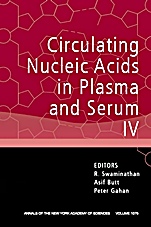
Circulating Nucleic Acids in Plasma and Serum IV, Volume 1075
ISBN 9781573316279
Autor: R. Swaminathan, Asif Butt, Peter Gahan
Wydawca: Wiley
Dostępność: 3-6 tygodni
Cena: 596,40 zł
Przed złożeniem zamówienia prosimy o kontakt mailowy celem potwierdzenia ceny.
ISBN13: |
9781573316279 |
ISBN10: |
157331627X |
Autor: |
R. Swaminathan, Asif Butt, Peter Gahan |
Oprawa: |
Paperback |
Rok Wydania: |
2006-11-04 |
Ilość stron: |
372 |
Wymiary: |
227x165 |
Tematy: |
PN |
An accurate, inexpensive, and noninvasive method for the early diagnosis of cancer has been something of a holy grail among cancer researchers, but until recently a method meeting all three criteria has been elusive. Nucleic acids were first discovered in circulation in 1948, but it was not until the 1960s and 70s that patients with autoimmune disease and cancer were discovered to have higher levels of circulating DNA than were detected in in healthy persons.
The focus in this volume is on three major applications of the circulating nucleic acids detection method: cancer, fetal medicine, and diseases such as diabetes, stroke, and myocardial infarction. In addition, there are reports on the biology and origins of circulating DNA and RNA and on improved methods for the detection of nucleic acids in plasma and serum.
The circulating DNA found in cancer patients has many characteristics in common with their tumors, which made it an attractive candidate for use in the diagnosis and management of patients with malignancies. This method can also be applied to the assessment of the sublinical tumor burden in cancer patients, thus reducing the risk of unnecessary chemotherapy.
Detection of nucleic acids circulating in maternal serum means that fetal diagnosis may be possible without resorting to the more dangerous and invasive methods now used (e.g., amniotic fluid and chorionic villus sampling). Detection of problems in the pregnancy such as preeclampsia and intrauterine growth retardation may also become possible through maternal blood samples.
In diabetic patients, circulating nucleic acids can be used for the early detection of developments such as retinopathy.
The benefits of using circulating nucleic acids in the diagnosis and management of cancer and chronic disease will be realized through earlier detection by means of this less expensive and less invasive testing technique and through its potential for closer monitoring of the disease.
NOTE: Annals volumes are available for sale as individual books or as a journal. For information on institutional journal subscriptions, please visit www.blackwellpublishing.com/nyas.
ACADEMY MEMBERS: Please contact the New York Academy of Sciences directly to place your order (www.nyas.org). Members of the New York Academy of Science receive full–text access to the Annals online and discounts on print volumes. Please visit www.nyas.org/membership/main.asp for more information about becoming a member.
Spis treści:
Welcoming Remarks: P. Whitfield.
Circulating Nicleic Acids in Plasma and Serum Recent Developments: R. Swaminathan and Asif N. Butt.
Part I: Biology of Circulating Nucleic Acids:.
1. Prehistory of CNAPS, the Birth of a Hypothesis: Circulating DNA.: Maurice Stroun and Philippe Anker.
2. Circulating DNA– Intra–Cellular and Intra–Organ Messenger?: P. B. Gahan.
3. Immunological Aspects of Circulating DNA: Philippe Anker And Maurice Stroun.
4. Biology of Circulating Mrna – Still More Questions Than Answers: Michael Fleischhacker.
5. Investigation of the Origin of Extracellular RNA in Human Cell Culture: Katrin Bottcher, Alexander Wenzel And Jens M. Warnecke.
6. Hypoxia–Induced Membrane–Bound Apoptotic DNA Particles: Potential Mechanism of Fetal DNA in Maternal Plasma: Aaron F. Orozco, Farideh Z. Bischoff, Cassandra Horne, Edwina Popek, Joe Leigh Simpson And Dorothy E. Lewis.
Part II: Fetal Nucleic Acids:.
7. Fetal Nucleic Acids in Maternal Body Fluids: an Update: Diana W. Bianchi, Tuangsit Wataganara, Olav Lapaire, May Lee Tjoa, Jill L. Maron, Paige B. Larrabee And Kirby L. Johnson.
8. Fetal DNA in Maternal Plasma: Progress Through Epigenetics: Y. M. Dennis Lo.
9. Cell–Free DNA in Maternal Plasma: Is It a Question of Size?: Ying Li, Wolfgang Holzgreve, Edoardo Di Naro, Angeloantonio Vitucci, And Sinuhe Hahn.
Feta
l Blood Group Genotyping: Present and Future: Geoff Daniels, Kirstin Finning, Pete Martin And Jo Summers.
10. Placental RNA in Maternal Plasma: Towards Non–Invasive Fetal Gene Expression Profiling: Nancy B. Y. Tsui And Y. M. Dennis Lo.
11. Development and Application of a Real Time Quantitative PCR for Prenatal Detection of Fetal ?O–Thalassemia From Maternal Plasma.
Warunee Tungwiwat, Supan Fucharoen, Goonnapa Fucharoen, Thawalwong Ratanasiri And Kanokwan Anchaisuriya.
12. Detection of a Paternally Fetal Mutation in Maternal Plasma by the Use of Automatic Sequencing: Ana Bustamante–Aragones, Maria Garcia–Hoyos, Marta Odriguez De Alba, Cristina Gonzalez–Gonzalaz, Isabel Orda–Sanchez, Dan Diego–Alvarez, M. Jose Trujillo–Tiebas, Armen Ayuso And Carmen Ramos.
13. Occurrence of Neutrophil Extracellular DNA Traps (Nets) in Pre–Eclampsia: a Link with Elevated Levels of Cell–Free DNA?: Anurag Gupta, Paul Hasler, Stephen Gebhardt, Wolfgang And Sinuhe Hahn.
14. Use of Bi–Allelic Insertion/Deletion Polymorphisms As a Positive Control for Fetal Genotyping in Maternal Blood: First Clinical Experience: Godelieve Cml Page–Christiaens, Bernadette Bossers, C. Ellen Van Der Schoot, Masja De Haas.
15. PLAC1 Mrna in Maternal Blood Correlates with Doppler of Uterine Arteries Waveform in Normal Pregnancies At 2nd and 3rd Trimester: Antonio Farina, Manuela Concu, Irina Banzola, Annalisa Tempesta,Sonia Vagnoni, Sandro Gabrielli, Mara Mattioli, Paolo Carinci, Gianluigi Pilu, Danila Morano, Nicola Rizzo.
16. Different Approaches for Non–Invasive Prenatal Diagnosis of Genetic Diseases Based On PNA–Mediated Enriched PCR: Galbiati Silvia, Restagno Gabriella, Foglieni Barbara, Bonalumi Sara, Travi Maurizio, Piga Antonio, Sbaiz Luca, Chiari Marcella, Damin Francesco Smid Maddalena, Valsecchi Luca, Pasi Federica, Ferrari And Laura Cremonesi.
17. Detection of Snps in the Plasma of Pregnan
t Women and in the Urine of Kidney Transplant Recipients by Mass Spectrometry: Ying Li, Deidre Hahn, Friedel Wenzel, Wolfgang Holzgreve And Sinuhe Hahn.
18. Non–Invasive Prenatal Diagnostic Assay for the Detection of ?–Thalassaemia: Thessalia Papasavva, Gabriel Kalakoutis, Ioannis Kalikas, Lectra Noekli, Soteroula Papacharalambous, Andreanni Yrri And Marina Kleanthous.
Part III: Nucleic Acids and Cancer:.
19. Circulating DNA and Lung Cancer: Xiaoyan Xue, Yong M. Zhu And Penella J. Woll.
20. Circulating Nucleic Acids in Plasma/Serum and Tumour Progression: Are Apoptotic Bodies Involved? an Experimental Study in a Rat Cancer Model: Julia Samos, Dolores C. García–Olmo, Maria G. Picazo, Antonio Rubio–Vitaller And Damian Garcia–Olmo.
21. Plasma RNA Integrity Analysis: Methodology and Validation: Blenda C. K. Wong And Y. M. Dennis Lo.
22. Molecular Diagnostic Markers for Lung Cancer in Sputum and Plasma: Yi–Ching Wang, Han–Shui Hsu, Tsz–Pei Chen And Jung–Ta Chen.
23. Quantitative Analysis of Plasma DNA in Colorectal Cancer Patients: a Novel Prognostic Tool: Milo Frattini, Gianfrancesco Gallino, Stefano Signoroni, Debora Balestra. Luigi Battaglia, Gabriella Sozzi, Ermanno Leo, Silvana Pilotti And Marco A. Pierotti.
24. Circulating DNA and DNAse Activity in Human Blood: Svetlana N. Tamkovich, Anna V. Cherepanova, Elena Yu. Rykova, Dmitrii V. Pyshnyi, Valentin V. Vlassov And Pavel P. Laktionov.
Comparative Analysis of Mesenteric and Peripheral Blood Circulating Tumour DNA in Colorectal Cancer Patients: Bret Taback, Sukamal Saha And Dave S. B. Hoon.
25. Real Time Quantification of Human Telomerase Reverse Transcriptase Mrna in the Plasma of Patients with Prostate Cancer: F. Dasí, P. Martinez–Rodes, J. a. March, J Santamaria, J. M. Martinez–Javaloyas, M Gil and S. F. Alino.
26. Epigenetic Analysis of Body Fluids and Tumour Tissues: Application of a Comprehensive
Koszyk
Książek w koszyku: 0 szt.
Wartość zakupów: 0,00 zł
Informacje


Kontakt
Gambit
Centrum Oprogramowania
i Szkoleń Sp. z o.o.
Al. Pokoju 29b/22-24
31-564 Kraków
Siedziba Księgarni
ul. Kordylewskiego 1
31-542 Kraków
+48 12 410 5991
+48 12 410 5987
+48 12 410 5989
Subskrypcje
Administratorem danych osobowych jest firma Gambit COiS Sp. z o.o. Na podany adres będzie wysyłany wyłącznie biuletyn informacyjny.
Autoryzacja płatności

Informacje na temat autoryzacji płatności poprzez PayU.

© Copyright 2012: GAMBIT COiS Sp. z o.o. Wszelkie prawa zastrzeżone.
Projekt i wykonanie: Alchemia Studio Reklamy