


Wydawcy
Katalog tematyczny
- Archeologia (109)
- Ekonomia, finanse, business (13704)
- Filozofia (1445)
- Historia (3040)
- Języki i językoznawstwo (2356)
- Lifestyle, hobby i rozrywka (475)
- Medycyna (9704)
- Chirurgia (272)
- Inne gałęzie medycyny (1871)
- Medycyna kliniczna (4187)
- Medycyna niekonwencjonalna (14)
- Medycyna przedkliniczna (269)
- Medycyna, ogólnie (1740)
- Historia medycyny (3)
- Lekarze, sprawy zawodowe (8)
- Medycyna, aspekty prawne (10)
- Służba zdrowia (36)
- Wyposażenie medyczne (157)
- Zdrowie publiczne (460)
- Medyczne służby pomocnicze (745)
- Studia medyczne (16)
- Weterynaria (548)
- Nauki humanistyczne (4)
- Nauki o Ziemi i środowisku (2638)
- Nauki ścisłe (20412)
- Nauki społeczne (8486)
- Nauki techniczne (13450)
- Prawo (1696)
- Publikacje informacyjne i interdyscyplinarne (1288)
- Religia i wierzenia (917)
- Technika komputerowa (4067)
- Zdrowie, relacje międzyludzkie i rozwój osobisty (657)





Informacje szczegółowe o książce
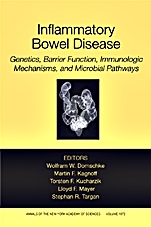
Inflammatory Bowel Disease: Genetics, Barrier Function, and Immunological Mechanisms, and Microbial Pathways, Volume 1072
ISBN 9781573315685
Autor: Wolfram W. Domschke, Martin F Kagnoff, Torsten F. Kucharzik, Lloyd Mayer, Stephan R. Targan
Wydawca: Wiley
Dostępność: 3-6 tygodni
Cena: 589,05 zł
Przed złożeniem zamówienia prosimy o kontakt mailowy celem potwierdzenia ceny.
ISBN13: |
9781573315685 |
ISBN10: |
1573315680 |
Autor: |
Wolfram W. Domschke, Martin F Kagnoff, Torsten F. Kucharzik, Lloyd Mayer, Stephan R. Targan |
Oprawa: |
Paperback |
Rok Wydania: |
2006-11-23 |
Ilość stron: |
428 |
Wymiary: |
234x148 |
Tematy: |
MB |
Inflammatory bowel disease (IBD), which encompasses both Crohn′s disease and ulcerative colitis, is a chronically relapsing intestinal disorder that is characterized by diarrhea and abdominal pain.
The incidence of IBD is increasing worldwide. Although some major advances have been made in recent years, the pathogenesis of the disease still remains obscure. As currently understood, a combination of genetic alterations and immunological disturbances causing an interaction of the enteric microflora with the underlying mucosa and a disrupted barrier function may be crucial for the development of disease.
Despite substantial new data that have been obtained over the last several years, it has become increasingly difficult to accommodate these into a unifying disease model. Identification of pro– and anti–inflammatory cytokines has introduced "biologic therapies," but treatment of IBD is still based mainly on broad–spectrum immunosuppressive drugs such as steroids and azathioprine. In this volume, the most relevant pathogenetic aspects are stressed: genetic alterations, disrupted epithelial barrier function, immunological disturbances, and the role of the enteric microflora.
NOTE: Annals volumes are available for sale as individual books or as a journal. For information on institutional journal subscriptions, please visit www.blackwellpublishing.com/nyas.
ACADEMY MEMBERS: Please contact the New York Academy of Sciences directly to place your order (www.nyas.org). Members of the New York Academy of Science receive full–text access to the Annals online and discounts on print volumes. Please visit www.nyas.org/membership/main.asp for more information about becoming a member.
Spis treści:
Introduction: Current Limitations of IBD Treatment.
Where Do We Go From Here?: S.R. Targan.
Part I: Genetics of Inflammatory Bowel Disease –NOD/CARD Pr
oteins: Diagnostic and Therapeutic Consequences?:.
1. Microbial Signaling Through NOD Proteins: D. Philpott.
2. NOD2/CARD Mutations in Crohn’s Disease: J.P. Hugot.
3. Functional Relevance of NOD2 On Cellular Signalling in Crohn′s Disease: G. Nunez.
4. Do Genetic Mutations Provide New Insights for Therapy?: J. Cho.
Part II: Immunologic Abnormalities in IBD – What Can We Learn From Animal Models?:.
5. Role of TGFβ in Mucosal Inflammation: W. Strober.
6. TNF/TNFR–Pathways in Chronic Inflammation: G. Kollias.
7. Lessons From Enteric Infections: L. Eckmann.
8. New Insights From Studies of Regulatory T Cell Populations: A. O′Garra.
9. the Commensal Microbial Flora: Relevance for Intestinal Inflammation: C.O. Elson.
Part III: Immunologic Disturbances in Human IBD – Defining and Manipulating the Key Pathways:.
10. Chemokines and Cell Trafficking Within the Inflamed Mucosa –– Inhibition of Chemokine Receptors or Ligands as a Potential Approach for Treatment?: I.R. Williams.
11. Life and Death – the Role of Apoptosis: T. Kucharzik.
12. Cytokines – Who Are the Key Plays and the Role for Cytokine Treatment: R.S. Blumberg.
13. Novel Signal Transduction Pathways – Relevance for Future Therapies?: M.F. Neurath.
14. NF–Kappa–B Signaling –the Pros and Cons of Altering NF–κB as a Therapeutic Approach: M. Karin.
15. Intracellular Targets: a Role for Inhibition of MAP–Kinases in Therapy?: S.J. Deventer.
16. Leucocyte Adhesion Molecules – Are They Relevant as Target for IBD Treatment?: D.B. Binion.
Part IV: Intestinal Epithelial Cells in IBD – An Active Barrier?:.
17. Tight Junction Function and the Modulation of Paracellular Permeability During IBD: a. Nusrat.
18. Epithelial Transport Under Inflammatory Conditions – Can It Be Regulated?: M.C. Berin.
19. Imbalance of Epithel
ial Electrolyte Homeostasis – Role in the Pathophysiology of IBD: U. Seidler.
20. Neutrophil Transepithelial Migration and Epithelial Barrier Function in IBD – Potential Targets for Inhibiting Neutrophil Trafficking: C.A. Parkos.
Part V: GALT – Relevant for Regulation of Inflammation?:.
21. Collaboration of Epithelial Cells With Organized Lymphoid Tissue: M.J. Kraehenbuhl.
22. Role of Lymphotoxins in the Development of PP and MLN – Relevance to Intestinal Inflammation and Treatment: T.W. Spahn.
23. Trafficking and Function of Mucosal Dendritic Cells: A. Iwasaki.
24. Intraepithelial T–Cells – Implication for Intestinal Inflammation: M. Kronenberg.
Part VI: Relevance of Microbial Factors – Additive Or Causative for IBD?:.
25. Microbial – Epithelial Cell Crosstalk During Inflammation: The Host Response: M. Kagnoff.
26. Role of Toll–Like Receptors in Orchestrating the Innate Immune Response – Potential Targets for Treatment?: D. Podolsky.
27. Host–Bacterial Interactions in the Gut: Signalling by Commensal Flora: J. Gordon.
28. Immunostimulatory DNA– Potential Therapeutics for Treatment of Enteric Inflammatory Disease?: E. Raz.
29. Probiotics – Their Role in Controlling Intestinal Inflammation?: J.F. Colombel.
30. Inflammatory Bowel Disease – Pandora′s Box, Present and Future: J. Schölmerich.
Index of Contributors
Okładka tylna:
Inflammatory bowel disease (IBD), which encompasses both Crohn′s disease and ulcerative colitis, is a chronically relapsing intestinal disorder that is characterized by diarrhea and abdominal pain.
The incidence of IBD is increasing worldwide. Although some major advances have been made in recent years, the pathogenesis of the disease still remains obscure. As currently understood, a combination of genetic alterations and immunological disturbances causing an intera
ction of the enteric microflora with the underlying mucosa and a disrupted barrier function may be crucial for the development of disease.
Despite substantial new data that have been obtained over the last several years, it has become increasingly difficult to accommodate these into a unifying disease model. Identification of pro– and anti–inflammatory cytokines has introduced "biologic therapies," but treatment of IBD is still based mainly on broad–spectrum immunosuppressive drugs such as steroids and azathioprine. In this volume, the most relevant pathogenetic aspects are stressed: genetic alterations, disrupted epithelial barrier function, immunological disturbances, and the role of the enteric microflora.
NOTE: Annals volumes are available for sale as individual books or as a journal. For information on institutional journal subscriptions, please visit www.blackwellpublishing.com/nyas.
ACADEMY MEMBERS: Please contact the New York Academy of Sciences directly to place your order (www.nyas.org). Members of the New York Academy of Science receive full–text access to the Annals online and discounts on print volumes. Please visit www.nyas.org/membership/main.asp for more information about becoming a member.
Koszyk
Książek w koszyku: 0 szt.
Wartość zakupów: 0,00 zł
Informacje


Kontakt
Gambit
Centrum Oprogramowania
i Szkoleń Sp. z o.o.
Al. Pokoju 29b/22-24
31-564 Kraków
Siedziba Księgarni
ul. Kordylewskiego 1
31-542 Kraków
+48 12 410 5991
+48 12 410 5987
+48 12 410 5989
Subskrypcje
Administratorem danych osobowych jest firma Gambit COiS Sp. z o.o. Na podany adres będzie wysyłany wyłącznie biuletyn informacyjny.
Autoryzacja płatności

Informacje na temat autoryzacji płatności poprzez PayU.

© Copyright 2012: GAMBIT COiS Sp. z o.o. Wszelkie prawa zastrzeżone.
Projekt i wykonanie: Alchemia Studio Reklamy