


Wydawcy
Katalog tematyczny
- Archeologia (109)
- Ekonomia, finanse, business (13704)
- Filozofia (1445)
- Historia (3040)
- Języki i językoznawstwo (2356)
- Lifestyle, hobby i rozrywka (475)
- Medycyna (9704)
- Nauki humanistyczne (4)
- Nauki o Ziemi i środowisku (2638)
- Nauki ścisłe (20412)
- Astronomia (294)
- Biologia (5119)
- Chemia (6540)
- Chemia analityczna (361)
- Chemia fizyczna (346)
- Chemia nieorganiczna (137)
- Chemia organiczna (535)
- Krystalografia (27)
- Minerologia (46)
- Fizyka (3309)
- Matematyka (4574)
- Nauki ścisłe, ogólnie (503)
- Nauki społeczne (8486)
- Nauki techniczne (13450)
- Prawo (1696)
- Publikacje informacyjne i interdyscyplinarne (1288)
- Religia i wierzenia (917)
- Technika komputerowa (4067)
- Zdrowie, relacje międzyludzkie i rozwój osobisty (657)





Informacje szczegółowe o książce
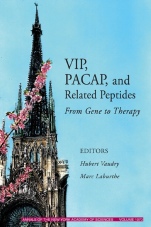
VIP, PACAP, and Related Peptides: From Gene to Therapy, Volume 1070
ISBN 9781573315500
Autor: Hubert Vaudry, Marc Laburthe
Wydawca: Wiley
Dostępność: 3-6 tygodni
Cena: 662,55 zł
Przed złożeniem zamówienia prosimy o kontakt mailowy celem potwierdzenia ceny.
ISBN13: |
9781573315500 |
ISBN10: |
1573315508 |
Autor: |
Hubert Vaudry, Marc Laburthe |
Oprawa: |
Paperback |
Rok Wydania: |
2006-11-23 |
Ilość stron: |
500 |
Wymiary: |
230x156 |
Tematy: |
PN |
This volume provides an overview on the biochemistry, physiology, and pharmacology of vasoactive intestinal polypeptide (VIP), pituitary adenylate cyclase–activating polypeptide (PACAP), and related peptides.
VIP and PACAP are undoubtedly among the most fascinating neuropeptides ever identified. They belong to the largest family of regulatory peptides, which comprises several other prominent neuroendocrine peptides including secretin (the first peptide hormone that has been identified), glucagon, and growth hormone–releasing hormone. The structural and physiological relationships of these peptides as well as their receptors provide a unique model for investigating the processes of molecular evolution leading to the diversification of multigene families.
The primary structures of VIP and PACAP have been remarkably well conserved across vertebrates, suggesting that these peptides must be involved in vital functions throughout the animal kingdom. Indeed, VIP and PACAP appear to be implicated in a large array of physiological processes such as development; growth; endocrine, cardiovascular, respiratory, reproductive and digestive functions; immune responses; and circadian rhythms. There is also clear evidence that VIP and PACAP exert both trophic and antiproliferative effects on normal and tumor cells. The beneficial influence of VIP and PACAP agonists and antagonists in various pathological states including heart failure, ischemia, asthma, impotence, and cancer has motivated the development of novel selective VIP or PACAP ligands that could potentially be used as antihypertensive, neuroprotective, bronchodilatory, vasodilatory, and/or antiproliferative drugs. The occurrence of multiple VIP/PACAP receptor subtypes and splice variants that exhibit tissue–specific expression and possess differential affinity for various ligands generates hopes for the development of new therapeutic agents that could act selectively on the desired target cells.NOTE: Annals volumes are available for sale as individual books or as a journal. For information on institutional journal subscriptions, please visit www.blackwellpublishing.com/nyas.
ACADEMY MEMBERS: Please contact the New York Academy of Sciences directly to place your order (www.nyas.org). Members of the New York Academy of Science receive full–text access to the Annals online and discounts on print volumes. Please visit www.nyas.org/membership/main.asp for more information about becoming a member.
Spis treści:
1. Treatment of Renal Failure Associated with Multiple Myeloma and Other Diseases by PACAP38. (Arimura A., M. Li And V. Batuman).
2. Clues to VIP Function from Knockckout Mice. (Hamidi S.A., A.M. Szema, S. Lyubsky, K.G. Dickman, A. Degene, S.M. Mathew, J.A. Waschek and S.I. Said).
3. The Glucagon–Like Peptides: Pleiotropic Regulators of Nutrient Homeostasis. (Brubaker P.L.).
4. Secretin: a Pleiotrophic Hormone. (Chu J.Y.S., W.H. Yung and B.K.C. Chow ).
5. VIP–PACAP System in Immunity: New Insights for Multitarget Therapy. (Gomariz R.P., Y. Juarranz, C. Abad, A. Arranz, J. Leceta and C. Martinez).
6. New Insights into the Central Pacapergic System from the Phenotypes in PACAP– and PACAP Receptor–Knockout Mice. (Hashimoto H., Shintani N. and Baba A.).
7. The 3–Dimensional Structure of The N–Terminal Domain of Corticotropin Releasing Factor (CRF) Receptors. (Sushi Domains and the B1 Family of G–Protein Coupled Receptors: Perrin M.H., C.R.R. Grace, R. Riek and W.W. Vale).
8. Complexing Receptor Pharmacology: Modulation of Family B G Protein–Coupled Receptor Function by Ramps. (Sexton P.M., M. Morfis, N. Tilakaratne, D.L. Hay, M. Udawela, G. Christopoulos and A. Christopoulos).
9. New Targets for Gpcrs Coupled to Camp and Protein Kinase. (Waschek J.A., E. DiCicco–Bloom, A. Nicot and V. Lelievre).
10. Effec
t of VIP on TLR2 and TLR4 Expression in Lymph Node Immune Cells During TNBS–Induced Colitis. (Arranz A., C. Abad, Y. Juarranz, M. Torroba, F. Rosignoli, J. Leceta, R.P. Gomariz and C. Martinez).
11. Immunocytochemical Distribution of VIP and PACAP in the Rat Brainstem: Implications for REM Sleep Physiology. (Ahnaou A., L. Yon, M. Arluison, H. Vaudry, J. Hannibal, M. Hamon, J. Adrien and P. Bourgin).
12. Microiontophoretically Applied PACAP Blocks Excitatory Effects of Kainic Acid in Vivo. (Atlasz T., Zs. Kőszegi, N. Babai, A.Tamás, D. Reglődi, P. Kovács, I. Hernádi and R.Gábriel).
13. Search for the Optimal Monosodium Glutamate Treatment Schedule to Study the Neuroprotective Effects of PACAP in the Retina. (Babai N., T. Atlasz, A. Tamás, D. Reglődi, G. Tóth, P. Kiss and R. Gábriel).
14. Can PACAP 38 Modulate Immune and Endocrine Responses During Lipopolisaccharide (LPS) – Induced Acute Inflammation ? (Baranowska–Bik A., W. Bik, E. Wolinska–Witort, M. Chmielowska, L. Martynska and B. Baranowska).
15. The Glucagon / Miniglucagon Interplay: a New Level in the Metabolic Regulation. (Bataille D., G. Fontés, S. Costes, C. Longuet and S. Dalle).
16. Effects of VIP and VIP–DAP on Proliferation and Lipid Peroxidation in Human KB Cells. (Caraglia M., A. Dicitore, G. Giuberti, D. Cassese, M. Lepretti, M. Cartenì, A. Abbruzzese and P. Stiuso).
17. The Delayed Rectifier Channel Current IK Plays a Key Role in the Control of Programmed Cell Death by PACAP and Ethanol in Cerebellar Granule Neurons. (Castel H., D. Vaudry, Y–A. Mei, T. Lefebvre, M. Basille, L. Desrues and A. Fournier).
18. Spatial Approximation Between the C–Terminus of VIP and The N–Terminal Ectodomain of the VPAC1 Receptor. (Ceraudo E., Y–V. Tan, A. Couvineau, J–J. Lacapere and M. Laburthe).
19. PACAP and VIP Promote Initiation of Electrophysiological Activity in Differ
entiating Embryonic Stem Cells. (Chafai M., E. Louiset, M. Basille, M. Cazillis, D. Vaudry, W. Rostène, P. Gressens, H. Vaudry and B.J. Gonzalez).
20. Vasoactive Intestinal Peptide Generates cd4+CD25+ Regulatory T Cells In Vivo. Therapeutic Applications in Autoimmunity and Transplantation. (Chorny A., E. Gonzalez–Rey, A. Fernandez–Martin, D. Ganea and M. Delgado).
21. Endogenous Release of Secretin from the Hypothalamus. (Chu J.Y.S., W.H. Yung and B. K. C. Chow).
22. Expression of PACAP Receptors in the Frog Brain During Development. (Ciarlo M., F. Bruzzone, C. Angelini, D. Alexandre, Y. Anouar, M. Vallarino and H. Vaudry).
23. The Human VPAC1 Receptor: Identification of the N–Terminal Ectodomain as a Major VIP Binding Site by Photoaffinity Labeling and 3D Modeling: Couvineau A., Y–V. Tan, E. Ceraudo, J–J. Lacapère, S. Murail, M.J–M. Neumann and M. Laburthe.
24. VPAC2 Receptor Activation Mediates VIP Enhancement of Population Spikes in the CA1 Area of the Hippocampus: Cunha–Reis D., J.A. Ribeiro and A.M. Sebastiao.
25. Expression and GTP–Sensitivity of Peptide Histidine Isoleucine High–Affinity Binding Sites in Rat: Debaigt C., A.C. Meunier, S. Goursaud, A. Montoni, N. Pineau, A. Couvineau, M. Laburthe, J.M. Muller and T. Janet.
26. PACAP, VIP and PHI: Effects on AC–, PLC– and PLD–Driven Signaling Systems in the Primary Glial Cell Cultures: Dejda A., M. Jozwiak–Bebenista and J.Z. Nowak.
27. Vasoactive Intestinal Peptide Induces Regulatory Dendritic Cells That Prevent Acute Graft–Versus–Host Disease and Leukemia Relapse after Bone Marrow Transplantation. (Delgado M., A. Chorny, A. Fernandez–Martin, D. Ganea and E. Gonzalez–Rey.
28. VIP: The Dentritic Cell Regulatory T Cells Axis: Delgado M., E. Gonzalez–Rey and D. Ganea).
29. VIP and PACAP Receptor Pharmacology; a Comparison of Intracellular Signalling Pathways.
Koszyk
Książek w koszyku: 0 szt.
Wartość zakupów: 0,00 zł
Informacje


Kontakt
Gambit
Centrum Oprogramowania
i Szkoleń Sp. z o.o.
Al. Pokoju 29b/22-24
31-564 Kraków
Siedziba Księgarni
ul. Kordylewskiego 1
31-542 Kraków
+48 12 410 5991
+48 12 410 5987
+48 12 410 5989
Subskrypcje
Administratorem danych osobowych jest firma Gambit COiS Sp. z o.o. Na podany adres będzie wysyłany wyłącznie biuletyn informacyjny.
Autoryzacja płatności

Informacje na temat autoryzacji płatności poprzez PayU.

© Copyright 2012: GAMBIT COiS Sp. z o.o. Wszelkie prawa zastrzeżone.
Projekt i wykonanie: Alchemia Studio Reklamy