


Wydawcy
Katalog tematyczny
- Archeologia (109)
- Ekonomia, finanse, business (13704)
- Filozofia (1445)
- Historia (3040)
- Języki i językoznawstwo (2356)
- Lifestyle, hobby i rozrywka (475)
- Medycyna (9704)
- Nauki humanistyczne (4)
- Nauki o Ziemi i środowisku (2638)
- Nauki ścisłe (20412)
- Nauki społeczne (8486)
- Nauki techniczne (13450)
- Prawo (1696)
- Publikacje informacyjne i interdyscyplinarne (1288)
- Religia i wierzenia (917)
- Technika komputerowa (4067)
- Zdrowie, relacje międzyludzkie i rozwój osobisty (657)





Informacje szczegółowe o książce
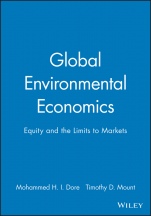
Global Environmental Economics: Equity and the Limits to Markets
ISBN 9781557865113
Autor: Mohammed H. I. Dore, Timothy D. Mount
Wydawca: Wiley
Dostępność: 3-6 tygodni
Cena: 591,15 zł
Przed złożeniem zamówienia prosimy o kontakt mailowy celem potwierdzenia ceny.
ISBN13: |
9781557865113 |
ISBN10: |
1557865116 |
Autor: |
Mohammed H. I. Dore, Timothy D. Mount |
Oprawa: |
Hardback |
Rok Wydania: |
1998-11-16 |
Ilość stron: |
376 |
Wymiary: |
264x186 |
Tematy: |
CT |
Global Environmental Economics: Equity and the Limits to Markets represent a stimulating collaboration by economists, ethicists, political scientists, demographers, and ecologists from around the world.
By focusing on the implications for future generations and the people of developing countries, the editors provide an alternative to standard approaches that have concentrated on the short–term solutions consumers or markets are willing to support.
The book illustrates that issues of equity can be applied to global environmental problems as well as taking a more central role in economic theory. It contends that new developments in social–choice theory offer a better foundation than traditional welfare economics.
Spis treści:
Preface.
Introduction.
Part I: Rights, Preferences and Well–Being.
1. The Economics of Well–Being: A Review of Post Welfarist Economics. (Mohammed Dore).
2. Bequeathing Hazards: Security Rights and Property Rights of Future Humans. (Henry Shue).
3. Non–Use Values and the Limits of Cost Benefit Analysis. (Marc Willinger).
Part II: Equity and Environmental Options.
4. Environmental Uncertainty and Future Generations. (Vercelli).
5. Environmental Option Values: A Critical Assessment. (Marcello Basili and Alexandro Vercelli).
6. Risk and Uncertainty in Environmental Policy Evaluation. (Tony Ward).
Part III: Population and the Environment.
7. The Dynamics of Socio–Environmental Change and the Limits of Neo–Malthusian Environmentalism. (Peter Taylor and Raúl García–Barrios).
8. Population Growth and the State: Reconciling Private Wants and the Public Interest. (Paul Demeny).
Part IV: After RIO: Global Action on Equity and the Environment.
9. Greenhouse Negotiations and the Mirage of Partial Justice. (Erik Schokkaert and Johan Eyckmans).
10. Market–Structuring Reg
ulation and the Ozone Regime: Politics of the Montreal Protocol. (Ronald Herring).
11. Lessons from the Earth Summit: Protecting and Managing Biodiversity in the Tropics (P. S. Ramakrishnan).
Part V: Sectoral Studies of Equity and the Environment.
12. Industrial and Resource Location, Trade and Pollution. (Duane Chapman and Jean Agras and Vivek Suri).
13. Sharing Common Property Resources: The North Atlantic Cod Fishery. (Daniel Gordon and K. K. Klein).
14. Redirecting Energy Policy in the USA to Address Global Warming. (Tim Mount).
Epilogue.
Reference.
Nota biograficzna:
Mohammed Dore, a co–editor of this volume, did his doctoral studies at Oxford University. He is Professor of Economics at Brock University and has published three other books and a number of articles. His current research interests are global environmental change and its distributional consequences on the rich and the poor. He leads an Inter–American team of researchers from South, Central and North America on the role of forests in mitigating global warming. His research has been funded by the Social Sciences and Humanities Research Council of Canada, the National Science Foundation of the USA, the Inter American Institute of Global Change Research (which is now based in Brazil) and also the National Science Foundation of Brazil. He is also a member of NEPAMA, an international consortium of research, based at the University of Brasilia.
Tim Mount received his PhD from the University of California, Berkeley (1970). His research and teaching interests are econometric modeling and policy analysis relating to the demand for fuels and electricity and to environmental policies. Currently, research is being conducted on the implications for long–run planning of incorporating the costs of environmental damage from emissions of sulfur dioxide, nitrogen oxides and carbon dioxide, and the selection of economically efficient stra
tegies for meeting ozone standards and stabilizing emissions of greenhouse gases.
Okładka tylna:
Global Environmental Economics: Equity and the Limits to Markets represent a stimulating collaboration by economists, ethicists, political scientists, demographers, and ecologists from around the world.
By focusing on the implications for future generations and the people of developing countries, the editors provide an alternative to standard approaches that have concentrated on the short–term solutions consumers or markets are willing to support.
The book illustrates that issues of equity can be applied to global environmental problems as well as taking a more central role in economic theory. It contends that new developments in social–choice theory offer a better foundation than traditional welfare economics.
Koszyk
Książek w koszyku: 0 szt.
Wartość zakupów: 0,00 zł
Informacje


Kontakt
Gambit
Centrum Oprogramowania
i Szkoleń Sp. z o.o.
Al. Pokoju 29b/22-24
31-564 Kraków
Siedziba Księgarni
ul. Kordylewskiego 1
31-542 Kraków
+48 12 410 5991
+48 12 410 5987
+48 12 410 5989
Subskrypcje
Administratorem danych osobowych jest firma Gambit COiS Sp. z o.o. Na podany adres będzie wysyłany wyłącznie biuletyn informacyjny.
Autoryzacja płatności

Informacje na temat autoryzacji płatności poprzez PayU.

© Copyright 2012: GAMBIT COiS Sp. z o.o. Wszelkie prawa zastrzeżone.
Projekt i wykonanie: Alchemia Studio Reklamy