


Wydawcy
Katalog tematyczny
- Archeologia (109)
- Ekonomia, finanse, business (13704)
- Filozofia (1445)
- Historia (3040)
- Języki i językoznawstwo (2356)
- Lifestyle, hobby i rozrywka (475)
- Medycyna (9704)
- Nauki humanistyczne (4)
- Nauki o Ziemi i środowisku (2638)
- Geografia (299)
- Nauki o Ziemi (1661)
- Geologia (414)
- Hydrologia (237)
- Meteorologia i klimatologia (114)
- Paleontologia (33)
- Wulkanologia i sejsmologia (44)
- Planowanie przestrzenne (53)
- Środowisko (607)
- Nauki ścisłe (20412)
- Nauki społeczne (8486)
- Nauki techniczne (13450)
- Prawo (1696)
- Publikacje informacyjne i interdyscyplinarne (1288)
- Religia i wierzenia (917)
- Technika komputerowa (4067)
- Zdrowie, relacje międzyludzkie i rozwój osobisty (657)





Informacje szczegółowe o książce
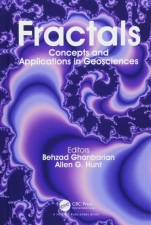
Fractals: Concepts and Applications in Geosciences
ISBN 9781498748711
Autor: Behzad Ghanbarian
Wydawca: CRC Press
Dostępność: 3-6 tygodni
Cena: 660,45 zł
Przed złożeniem zamówienia prosimy o kontakt mailowy celem potwierdzenia ceny.
ISBN13: |
9781498748711 |
ISBN10: |
1498748716 |
Autor: |
Behzad Ghanbarian |
Oprawa: |
Hardback |
Rok Wydania: |
2017-12-21 |
Ilość stron: |
352 |
This book provides theoretical concepts and applications of fractals and multifractals to a broad range of audiences from various scientific communities, such as petroleum, chemical, civil and environmental engineering, atmospheric research, and hydrology. In the first chapter, we introduce fractals and multifractals from physics and math viewpoints. We then discuss theory and practical applications in detail. In what follows, in chapter 2, fragmentation process is modeled using fractals. Fragmentation is the breaking of aggregates into smaller pieces or fragments, a typical phenomenon in nature. In chapter 3, the advantages and disadvantages of two- and three-phase fractal models are discussed in detail. These two kinds of approach have been widely applied in the literature to model different characteristics of natural phenomena. In chapter 4, two- and three-phase fractal techniques are used to develop capillary pressure curve models, which characterize pore-size distribution of porous media. Percolation theory provides a theoretical framework to model flow and transport in disordered networks and systems. Therefore, following chapter 4, in chapter 5 the fractal basis of percolation theory and its applications in surface and subsurface hydrology are discussed. In chapter 6, fracture networks are shown to be modeled using fractal approaches. Chapter 7 provides different applications of fractals and multifractals to petrophysics and relevant area in petroleum engineering. In chapter 8, we introduce the practical advantages of fractals and multifractals in geostatistics at large scales, which have broad applications in stochastic hydrology and hydrogeology. Multifractals have been also widely applied to model atmospheric characteristics, such as precipitation, temperature, and cloud shape. In chapter 9, these kinds of properties are addressed using multifractals. At watershed scales, river networks have been shown to follow fractal behavior. Therefore, the applications of fractals are addressed in chapter 10. Time series analysis has been under investigations for several decades in physics, hydrology, atmospheric research, civil engineering, and water resources. In chapter 11, we therefore, provide fractal, multifractal, multifractal detrended fluctuation analyses, which can be used to study temporal characterization of a phenomenon, such as flow discharge at a specific location of a river. Chapter 12 addresses signals and again time series using a novel fractal Fourier analysis. In chapter 13, we discuss constructal theory, which has a perspective opposite to fractal theories, and is based on optimizationof diffusive exchange. In the case of river drainages, for example, the constructal approach begins at the divide and generates headwater streams first, rather than starting from the fundamental drainage pattern.
Author Biography: Dr. Behzad Ghanbarian received his Ph.D. in Environmental Sciences. Dr. Ghanbarian is employed in the Department of Petroleum and Geosystems Engineering at the University of Texas at Austin. Dr. Allen G. Hunt received his Ph.D. in Physics, Condensed Matter. Dr. Hunt is employed in the Department of Physics and the Department of Earth and Environmental Sciences at Wright State University.
An Introduction to Multifractals and Scale Symmetry Groups Daniel Schertzer, and Ioulia Tchiguirinskaia Fractal Capillary Pressure Curve Models Behzad Ghanbarian and Humberto Millan Two- and three- phase fractal models of porous media: A multiscale approach Edith Perrier The Mathematics of Complexity in the study of soil and granular-porous media Miguel Angel Martin The Fractals of Percolation Theory in the Geosciences A. G. Hunt, and F. Yu Nonlocal Models for Transport in Fractal Media Daniel O'Malley, and John H. Cushman Multifractals and Geostatistics A.M. Tarquis, Juan J. Martin-Sotoca, M.C. Morato, M.T. Castellanos, J. Borondo, N.R. Bird, and A. Saa-Requejo Why the warming can't be natural: the nonlinear geophysics of climate closure S. Lovejoy Fractals and Multifractals in Geophysical Time Series Mikhail I Bogachev, Naiming Yuan, and Armin Bunde Multi-fractal Random Walk and its Application in Petro-physical Quantities Gholamreza Jafari, Soheil Vasheghani Farahani, and Zahra Koohi Lai Combining Fractals and Multifractals to Model Geoscience Records Carlos E. Puente, Mahesh L. Maskey, and Bellie Sivakumar Use of Constructal Theory in Modeling in the Geosciences A. Hunt
Koszyk
Książek w koszyku: 0 szt.
Wartość zakupów: 0,00 zł
Informacje


Kontakt
Gambit
Centrum Oprogramowania
i Szkoleń Sp. z o.o.
Al. Pokoju 29b/22-24
31-564 Kraków
Siedziba Księgarni
ul. Kordylewskiego 1
31-542 Kraków
+48 12 410 5991
+48 12 410 5987
+48 12 410 5989
Subskrypcje
Administratorem danych osobowych jest firma Gambit COiS Sp. z o.o. Na podany adres będzie wysyłany wyłącznie biuletyn informacyjny.
Autoryzacja płatności

Informacje na temat autoryzacji płatności poprzez PayU.

© Copyright 2012: GAMBIT COiS Sp. z o.o. Wszelkie prawa zastrzeżone.
Projekt i wykonanie: Alchemia Studio Reklamy