


Wydawcy
Katalog tematyczny
- Archeologia (109)
- Ekonomia, finanse, business (13704)
- Filozofia (1445)
- Historia (3040)
- Języki i językoznawstwo (2356)
- Lifestyle, hobby i rozrywka (475)
- Medycyna (9704)
- Nauki humanistyczne (4)
- Nauki o Ziemi i środowisku (2638)
- Nauki ścisłe (20412)
- Nauki społeczne (8486)
- Nauki techniczne (13450)
- Budownictwo lądowe (1045)
- Chemia przemysłowa (2258)
- Elektronika i telekomunikacja (3287)
- Energetyka (1122)
- Inne nauki stosowane (363)
- Inżynieria biochemiczna (507)
- Inżynieria transportu (232)
- Mechanika i materiały (3316)
- Nauka o środowisku (321)
- Rolnictwo (507)
- Technika, ogólnie (475)
- Prawo (1696)
- Publikacje informacyjne i interdyscyplinarne (1288)
- Religia i wierzenia (917)
- Technika komputerowa (4067)
- Zdrowie, relacje międzyludzkie i rozwój osobisty (657)





Informacje szczegółowe o książce
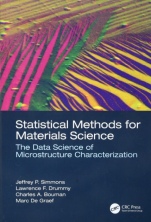
Statistical Methods for Materials Science: The Data Science of Microstructure Characterization
ISBN 9781498738200
Autor: Charles A. Bouman
Wydawca: CRC Press
Dostępność: 3-6 tygodni
Cena: 1 071,00 zł
Przed złożeniem zamówienia prosimy o kontakt mailowy celem potwierdzenia ceny.
ISBN13: |
9781498738200 |
ISBN10: |
1498738206 |
Autor: |
Charles A. Bouman |
Oprawa: |
Hardback |
Rok Wydania: |
2019-02-06 |
Ilość stron: |
514 |
Data analytics has become an integral part of materials science. This book provides the practical tools and fundamentals needed for researchers in materials science to understand how to analyze large datasets using statistical methods, especially inverse methods applied to microstructure characterization. It contains valuable guidance on essential topics such as denoising and data modeling. Additionally, the analysis and applications section addresses compressed sensing methods, stochastic models, extreme estimation, and approaches to pattern detection.
Author Biography: Jeffrey P. Simmons is a Scientist with the Materials and Manufacturing Directorate of the Air Force Research Laboratory (AFRL). He received the B.S. degree in metallurgical engineering from the New Mexico Institute of Mining and Technology, Socorro, NM, USA, and M.E. and Ph.D. degrees in Metallurgical Engineering and Materials Science and Materials Science and Engineering, respectively, from Carnegie Mellon University, Pittsburgh, PA, USA. After receiving the Ph.D. degree, he began work at AFRL as a post-doctoral research contractor. In 1998, he joined AFRL as a Research Scientist. His research interests are in computational imaging for microscopy and has developed advanced algorithms for analysis of large image datasets. Other research interests have included phase field (physics-based) modeling of microstructure formation, atomistic modeling of defect properties, and computational thermodynamics. He has lead teams developing tools for digital data analysis and computer resource integration and security. He has overseen execution of research contracts on computational materials science, particularly in prediction of machining distortion, materials behavior, and thermodynamic modeling. He has published in both the Materials Science and Signal Processing fields. He is a member of ACM and a senior member of IEEE. Charles A. Bouman received a B.S.E.E. degree from the University of Pennsylvania in 1981 and a MS degree from the University of California at Berkeley in 1982. From 1982 to 1985, he was a full staff member at MIT Lincoln Laboratory and in 1989 he received a Ph.D. in electrical engineering from Princeton University. He joined the faculty of Purdue University in 1989 where he is currently the Showalter Professor of Electrical and Computer Engineering and Biomedical Engineering. Professor Boumans research is in statistical signal and image processing in applications ranging from medical to scientific and consumer imaging. His research resulted in the first commercial model-based iterative reconstruction (MBIR) system for medical X-ray computed tom ography (CT), and he is co-inventor on over 50 issued patents that have been licensed and used in millions of consumer imaging products. Marc De Graef received his BS and MS degrees in physics from the University of Antwerp (Belgium) in 1983, and his Ph.D. in physics from the Catholic University of Leuven (Belgium) in 1989, with a thesis on copper-based shape memory alloys. He then spent three and a half years as a post-doctoral researcher in the Materials Department at the University of California at Santa Barbara before joining Carnegie Mellon in 1993 as an assistant professor. He is currently professor and codirector of the J. Earle and Mary Roberts Materials Characterization Laboratory. His research interests lie in the area of microstructural characterization of structural intermetallics and magnetic materials and include the development of numerical techniques to model a variety of materials characterization modalities. Prof. De Graef has published two text books and more than 280 publications. Lawrence F. Drummy Jr. is a senior materials engineer in the Soft Matter Materials Branch, Functional Materials Division, Materials and Manufacturing Directorate, Air Force Research Laboratory in Dayton, OH. Dr. Drummy received his BS in Physics at Rensselaer Polytechnic Institute while researching scanning tunneling microscopy and image processing of silicon growth on surfaces. In 2003 he received his PhD from the Department of Materials Science and Engineering at the University of Michigan while performing research on defect structures in organic molecular semiconductor thin films for flexible electronics. Dr. Drummys research interests include three dimensional morphology characterization of biological, polymeric and nanostructured materials, the structure of materials at interfaces, and data analytics for materials science applications
Chapter 1 Materials Science vs. Data Science Jeff Simmons, Lawrence Drummy, Charles Bouman, Marc De Graef Chapter 2 Emerging Digital Data Capabilities Stephen Mick Chapter 3 Cultural Differences Mary Comer, Charles Bouman, Jeff Simmons Chapter 4 Forward Modeling Marc De Graef Chapter 5 Inverse Problems and Sensing Charles Bouman Chapter 6 Model-Based Iterative Reconstruction for Electron Tomography Singanallur Venkatakrishnan, Lawrence Drummy Chapter 7 Statistical reconstruction and heterogeneity characterization in 3-D biological macromolecular complexes Qiu Wang, Peter C. Doerschuk Chapter 8 Object Tracking through Image Sequences Song Wang, Hongkai Yu, Youjie Zhou, Jeff Simmons, Craig Przybyla Chapter 9 Grain Boundary Characteristics Hossein Beladi, Gregory S. Rohrer Chapter 10 Interface Science and the Formation of Structure Ming Tang, Jian Luo Chapter 11 Hierarchical Assembled Structures from Nanoparticles Dhriti Nepal, Sushil Kanel, Lawrence Drummy Chapter 12 Estimating Orientation Statistics Stephen R. Niezgoda Chapter 13 Representation of Stochastic Microstructures Stephen R. Niezgoda Chapter 14 Computer Vision for Microstructure Representation Brian DeCost, Elizabeth Holm Chapter 15 Topological Analysis of Local Structure Emanuel Lazar, David Srolovitz Chapter 16 Markov Random Fields for Microstructure Simulation Veera Sundararaghavan Chapter 17 Distance Measures for Microstructures Patrick Callahan Chapter 18 Industrial Applications David Furrer, David Brough, Ryan Noraas Chapter 19 Anomaly Testing James Theiler Chapter 20 Anomalies in Microstructures Stephen Bricker, Craig Przybyla, Jeff Simmons, Russel Hardie Chapter 21 Denoising Methods with Applications to Microscopy Rebecca Willett Chapter 22 Compressed Sensing for Imaging Applications Justin Romberg Chapter 23 Dictionary Methods for Compressed Sensing Saiprasad Ravishankar, Raj Rao Nadakuditi Chapter 24 Sparse Sampling in Microscopy Kurt Larson, Hyrum Anderson, Jason Wheeler
Koszyk
Książek w koszyku: 0 szt.
Wartość zakupów: 0,00 zł
Informacje


Kontakt
Gambit
Centrum Oprogramowania
i Szkoleń Sp. z o.o.
Al. Pokoju 29b/22-24
31-564 Kraków
Siedziba Księgarni
ul. Kordylewskiego 1
31-542 Kraków
+48 12 410 5991
+48 12 410 5987
+48 12 410 5989
Subskrypcje
Administratorem danych osobowych jest firma Gambit COiS Sp. z o.o. Na podany adres będzie wysyłany wyłącznie biuletyn informacyjny.
Autoryzacja płatności

Informacje na temat autoryzacji płatności poprzez PayU.

© Copyright 2012: GAMBIT COiS Sp. z o.o. Wszelkie prawa zastrzeżone.
Projekt i wykonanie: Alchemia Studio Reklamy