


Wydawcy
Katalog tematyczny
- Archeologia (109)
- Ekonomia, finanse, business (13704)
- Filozofia (1445)
- Historia (3040)
- Języki i językoznawstwo (2356)
- Lifestyle, hobby i rozrywka (475)
- Medycyna (9704)
- Nauki humanistyczne (4)
- Nauki o Ziemi i środowisku (2638)
- Nauki ścisłe (20412)
- Nauki społeczne (8486)
- Nauki techniczne (13450)
- Budownictwo lądowe (1045)
- Chemia przemysłowa (2258)
- Elektronika i telekomunikacja (3287)
- Energetyka (1122)
- Inne nauki stosowane (363)
- Inżynieria biochemiczna (507)
- Inżynieria transportu (232)
- Mechanika i materiały (3316)
- Nauka o środowisku (321)
- Rolnictwo (507)
- Technika, ogólnie (475)
- Prawo (1696)
- Publikacje informacyjne i interdyscyplinarne (1288)
- Religia i wierzenia (917)
- Technika komputerowa (4067)
- Zdrowie, relacje międzyludzkie i rozwój osobisty (657)





Informacje szczegółowe o książce
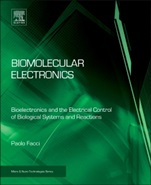
Biomolecular Electronics: Bioelectronics and the Electrical Control of Biological Systems and Reactions
ISBN 9781455731428
Autor: Facci, Paolo
Wydawca: Elsevier
Dostępność: 3-6 tygodni
Cena: 778,05 zł
Przed złożeniem zamówienia prosimy o kontakt mailowy celem potwierdzenia ceny.
ISBN13: |
9781455731428 |
Autor: |
Facci, Paolo |
Oprawa: |
Hardback |
Rok Wydania: |
2014-04-14 |
Tematy: |
TCB |
Biomolecular Electronics – the electrical control of biological phenomena – is a scientific challenge that, once fully realized, will find a wide range of applications from electronics and computing to medicine and therapeutic techniques. This new arena of biomolecular electronics is approached using familiar concepts from many areas such as electrochemistry, device electronics and some mechanisms of gene expression level control. Practical techniques are explored by which electrical and electronic means can be used to control biological reactions and processes. Also, the current and future applications for this new and expanding field are discussed. This book is aimed at scientists and engineers involved in both research and commercial applications across fields including bioelectronics, bionanotechnology, electrochemistry and nanomedicine – providing a state-of-the-art survey of what's going on at the boundary between biology and electronic technology at the micro- and nano- scales, along with a suggestive insight into future possible developments.
Demystifies the science and applications of electrically-driven biological reactions.Explains how the techniques of bioelectronics and electrochemistry can be deployed as biological control technologies.Provides applications information for diverse areas from bio-electrochemistry to electrical control of gene expression levels.
1. Biomolecular Electronics
1. What is Biomolecular Electronics?
1.1 Proteins and biomolecular electronics
1.2 Proteins and planar devices
1.3 The Future of Biomolecular Electronics
1.4 A novel idea: electrical control of biomolecular systems
1.5 References
2. Useful notions in Electrochemistry
2. Charged surfaces in water
2.1 The Poisson-Boltzmann equation
2.2 Charged Surfaces in electrolytic solutions
2.3 Potential and ion concentration away from a charged surface
2.4 Reactions at electrodes
2.4.1 The Marcus Theory of Electron Transfer
2.5 Electrochemical tools
2.5.1 Potentiostats
2.5.2 Bipotentiostats
2.5.3 Galvanostats
2.6 Electrochemical techniques
2.6.1 Potential sweep methods: LSV and CV
2.6.2 The Laviron’s formalism
2.6.3 Electrochemical Impedance Spectroscopy
2.6.4 Equivalent circuit of a cell
2.7 References
3. Life and the water-based environment
3. The peculiar chemical-physical properties of water
3.1 The hydrogen bond and the structure of water
3.2 The hydrophobic effect
3.3. The role of water in biology
3.4 Water and biomolecules
3.4.1 Protein folding
3.4.2 Protein structure
3.4.3 Protein activity and dynamics
3.4.4 Protein–ligand interactions
3.4.5 Water and nucleic-acid structure
3.4.6 Lipids and membranes
3.5 Biological reactions take place in water
3.5.1 Water and proton transfer
3.5.2 Water and electron transfer
3.6 Biological reactions and phenomena involving the action of electric fields
3.6.1 Voltage gated ion channels
3.7 Biological reactions and phenomena involving the transfer of electrons
3.7.1 Biological electron transfer
3.7.2 The Photosynthetic Reaction Centers
3.7.3 Electron transport chain in mitochondria and chloroplasts
3.7.4 Thiol-disulfide exchange reactions
4.Applications of Electrochemistry to Redox Metalloproteins and Cofactors
4. Redox metalloprotein and cofactor electrochemistry
4.1 Redox metalloproteins
4.1.1 The azurin
4.1.2 Cytochrome c
4.2 Redox cofactors
4.3 Driving redox reactions of freely diffusing molecules
4.3.1 Redox metalloprotein electrochemistry in diffusion
4.3.2 Redox cofactor electrochemistry in diffusion
4.4 Driving redox reactions of surface immobilized molecules
4.4.1 Effect of orientation at surface on electrode-protein coupling
4.4.2 Redox cofactor electrochemistry at surfaces
4.5 Single biomolecule electron transfer
4.5.1 Electrochemical scanning tunneling microscope
4.5.2 Theories for ECSTM of redox molecules
4.5.3 Application to redox proteins
4.5.4 ECSTM of benzoquinone/hydroquinone couple
4.6 Electrochemically gated single protein transistor
4.7 References
5. Electrochemistry can drive molecular conformation
5. Direct electrochemical control of protein conformation at an electrode surface
5.1 Direct electrical modulation of the open/closed state of a voltage-gated potassium ion channel
5.1.1 The molecule
5.1.2 Substrate and surface immobilization strategy
5.1.3 Strategy for excising membrane patches and adsorbing them onto electrode surface.
5.1.4 Measuring chamber implementation and approach for imparting a transmembrane potential drop.
5.1.5 Imaging strategy and results
5.2 Direct electrical control of antibody conformation and affinity
5.2.1 The supramolecular construct
5.2.2 Implementing an electric control over IgGs conformation
5.2.3 Implementing an electric control over IgGs functionality
5.3 Towards a direct electrical modulation of enzyme activity
5.4 References
6. Redox Control of Gene Expression Level
6. Regulation of gene expression level
6.1 Gene regulation in bacteriophages
6.2 Redox regulation of gene expression level: the case of Rhodobacter
6.3 Redox regulation of gene expression level: the case of Escherichia coli
6.4 Redox control of gene expression in and subcellular organelles
6.4.1 The mithocondrion in brief
6.4.2 The Chloroplast in brief
6.4.3 The CoRR hypothesis: Colocation for redox regulation
6.5 References
7. Towards Direct Electrochemical Control of Gene Expression Level
7. Direct Electrochemical Control of Gene Expression Level: where to start from?
7.1 The choice of redox mediators
7.2 How to go further?
7.2.1 LUVs and GUVs
7.2.2 Complicating the system
7.3 References
8.What will be next?
8. A pervasive presence of redox controlled biosystems
8.1 Redox-dependent control of blood pressure
8.2 Redox regulation of embryonic stem cell transcription factors by thioredoxin
8.3 Role of p53 redox states on Dna-binding
8.4 Redox regulation in plants
8.4.1 Redox control of plant metabolism
8.4.2 Redox regulation of gene transcription in plastids
8.5 The electrified snail
8.6 References
Koszyk
Książek w koszyku: 0 szt.
Wartość zakupów: 0,00 zł
Informacje


Kontakt
Gambit
Centrum Oprogramowania
i Szkoleń Sp. z o.o.
Al. Pokoju 29b/22-24
31-564 Kraków
Siedziba Księgarni
ul. Kordylewskiego 1
31-542 Kraków
+48 12 410 5991
+48 12 410 5987
+48 12 410 5989
Subskrypcje
Administratorem danych osobowych jest firma Gambit COiS Sp. z o.o. Na podany adres będzie wysyłany wyłącznie biuletyn informacyjny.
Autoryzacja płatności

Informacje na temat autoryzacji płatności poprzez PayU.

© Copyright 2012: GAMBIT COiS Sp. z o.o. Wszelkie prawa zastrzeżone.
Projekt i wykonanie: Alchemia Studio Reklamy