


Wydawcy
Katalog tematyczny
- Archeologia (109)
- Ekonomia, finanse, business (13704)
- Filozofia (1445)
- Historia (3040)
- Języki i językoznawstwo (2356)
- Lifestyle, hobby i rozrywka (475)
- Medycyna (9704)
- Nauki humanistyczne (4)
- Nauki o Ziemi i środowisku (2638)
- Nauki ścisłe (20412)
- Nauki społeczne (8486)
- Nauki techniczne (13450)
- Prawo (1696)
- Publikacje informacyjne i interdyscyplinarne (1288)
- Religia i wierzenia (917)
- Technika komputerowa (4067)
- Zdrowie, relacje międzyludzkie i rozwój osobisty (657)





Informacje szczegółowe o książce
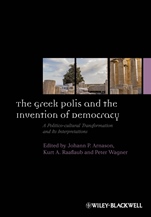
The Greek Polis and the Invention of Democracy: A Politico–cultural Transformation and Its Interpretations
ISBN 9781444351064
Autor: Johann P. Arnason, Kurt A. Raaflaub, Peter Wagner
Wydawca: Wiley
Dostępność: 3-6 tygodni
Cena: 708,75 zł
Przed złożeniem zamówienia prosimy o kontakt mailowy celem potwierdzenia ceny.
ISBN13: |
9781444351064 |
ISBN10: |
1444351060 |
Autor: |
Johann P. Arnason, Kurt A. Raaflaub, Peter Wagner |
Oprawa: |
Hardback |
Rok Wydania: |
2013-04-23 |
Ilość stron: |
410 |
Wymiary: |
256x174 |
Tematy: |
HB |
One of the hallmarks of Greek civilization was the polis —city–states that gave rise to the first democratic system of government. But was the polis of ancient Athens really the birthplace of what we now view as modern democracy? The Greek Polis and the Invention of Democracy presents a comprehensive series of essays that trace the Greeks’ path to democracy and examine the connection between the Greek polis as a citizen state and democracy from a comparative historical perspective, and with reference to recent debates on the Axial Age and its impact on world history. Written collaboratively by an international team of leading scholars in classics, ancient history, sociology, and political science, essays address the interaction between democracy and forms of cultural expression in Athens during the classical period, the place and role of politics in the ancient Greek world, and the place of Greek democracy in political thought and debates about democracy throughout the centuries. Scholarly and thought–provoking, The Greek Polis and the Invention of Democracy offers illuminating insights into our links to the past while revealing ways that the concept of ancient Greek democracy has shaped—or not shaped—modern democracy.
Series Editor’s Preface vii Contributors viii Introduction 1 Johann P. Arnason, Kurt A. Raaflaub, and Peter Wagner Part I The Greek Experience in Long–term Perspective 19 1 Exploring the Greek Needle’s Eye: Civilizational and Political Transformations 21 Johann P. Arnason 2 Transformations of Democracy: Towards a History of Political Thought and Practice in Long–term Perspective 47 Peter Wagner Part II Ways of Polis–making: Grasping the Novelty of the Political 69 3 To Act with Good Advice: Greek Tragedy and the Democratic Political Sphere 71 Egon Flaig 4 Democracy and Dissent: the Case of Comedy 99 Lucio Bertelli 5 Democracy, Oratory, and the Rise of Historiography in Fifth–century Greece 126 Jonas Grethlein 6 Political Uses of Rhetoric in Democratic Athens 144 Harvey Yunis 7 Law and Democracy in Classical Athens 163 Adriaan Lanni 8 Democracy and Political Philosophy: Influences, Tensions, Rapprochement 181 Ryan K. Balot 9 Inscriptions and the City in Democratic Athens 205 Elizabeth A. Meyer Part III Changing a Way of Life: Democracy’s Impact on Polis Society 225 10 The Impact of Democracy on Communal Life 227 Sara L. Forsdyke 11 The Demos’s Participation in Decision–making: Principles and Realities 260 Claude Mossé 12 Democracy and Religion in Classical Greece 274 Robin Osborne 13 Democracy and War 298 Lawrence A. Tritle Part IV Political Concepts and Commitments 321 14 Perfecting the “Political Creature”: Equality and “the Political” in the Evolution of Greek Democracy 323 Kurt A. Raaflaub 15 Tyranny and Tragedy in Nietzsche’s Understanding of the Greek Polis 351 Tracy B. Strong 16 The Liberty of the Moderns Compared to the Liberty of the Ancients 371 Nathalie Karagiannis and Peter Wagner Index 389
Johann P. Arnason is Emeritus Professor of Sociology at La Trobe University, Melbourne and visiting professor at the Charles University in Prague. His previous works include Domains and Divisions of European History (with N. Doyle, 2010), The Roman Empire in Context: Historical and Comparative Perspectives (with K. Raaflaub, Wiley–Blackwell, 2011), and Nordic Paths to Modernity (with B. Wittrock, 2012). Kurt A. Raaflaub is the David Herlihy University Professor and Professor of Classics and History Emeritus at Brown University. His previous works include Geography and Ethnography: Perceptions of the World in Pre–Modern Societies (with R. J. A. Talbert, Wiley–Blackwell, 2010), Epic and History (with D. Konstan, Wiley–Blackwell, 2010), and The Roman Empire in Context: Historical and Comparative Perspectives (with J. Arnason, Wiley–Blackwell, 2011). Peter Wagner is ICREA Research Professor of Sociological Theory, Philosophy of Law, and Methodology of the Social Sciences, at the University of Barcelona. His previous works include Theorizing Modernity: Inescapability and Attainability in Social Theory (2001), Modernity as Experience and Interpretation (2008), and Modernity: Understanding the Present (2012).
Koszyk
Książek w koszyku: 0 szt.
Wartość zakupów: 0,00 zł
Informacje


Kontakt
Gambit
Centrum Oprogramowania
i Szkoleń Sp. z o.o.
Al. Pokoju 29b/22-24
31-564 Kraków
Siedziba Księgarni
ul. Kordylewskiego 1
31-542 Kraków
+48 12 410 5991
+48 12 410 5987
+48 12 410 5989
Subskrypcje
Administratorem danych osobowych jest firma Gambit COiS Sp. z o.o. Na podany adres będzie wysyłany wyłącznie biuletyn informacyjny.
Autoryzacja płatności

Informacje na temat autoryzacji płatności poprzez PayU.

© Copyright 2012: GAMBIT COiS Sp. z o.o. Wszelkie prawa zastrzeżone.
Projekt i wykonanie: Alchemia Studio Reklamy