


Wydawcy
Katalog tematyczny
- Archeologia (109)
- Ekonomia, finanse, business (13704)
- Filozofia (1445)
- Historia (3040)
- Języki i językoznawstwo (2356)
- Lifestyle, hobby i rozrywka (475)
- Medycyna (9704)
- Nauki humanistyczne (4)
- Nauki o Ziemi i środowisku (2638)
- Nauki ścisłe (20412)
- Nauki społeczne (8486)
- Nauki techniczne (13450)
- Prawo (1696)
- Publikacje informacyjne i interdyscyplinarne (1288)
- Religia i wierzenia (917)
- Technika komputerowa (4067)
- Zdrowie, relacje międzyludzkie i rozwój osobisty (657)





Informacje szczegółowe o książce
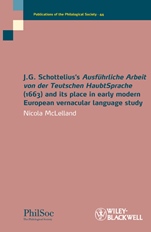
J.G. Schotteliuss Ausführliche Arbeit von der Teutschen HaubtSprache (1663) and its Place in Early Modern European Vernacular Language Study
ISBN 9781444339611
Autor: Nicola McLelland
Wydawca: Wiley
Dostępność: 3-6 tygodni
Cena: 168,00 zł
Przed złożeniem zamówienia prosimy o kontakt mailowy celem potwierdzenia ceny.
ISBN13: |
9781444339611 |
ISBN10: |
1444339613 |
Autor: |
Nicola McLelland |
Oprawa: |
Paperback |
Rok Wydania: |
2011-11-18 |
Ilość stron: |
426 |
Wymiary: |
228x149 |
Tematy: |
CF |
J.G. Schottelius′s landmark two–volume theoretical study of German, The Ausführliche Arbeit von der Teutschen HaubtSprache , was the seminal German language text of the 17th century. At 1,500 quarto pages, his work was more than ten times the length of contemporaneous grammars published in England and France (Wallis′s Grammatica Anglicana , 1653, and the pioneering Port–Royal Grammar of 1660). Germanist and linguist Nicola McLelland presents an accessible yet scholarly exploration that makes sense of Schottelius′s lengthy and often unwieldy study by interpreting its disparate elements from grammar to riddles, from verse to dialogue against European discourse traditions that shaped the German linguist′s views of language.Demonstrating Schottelius′s clear influence on Danish, Dutch, Swedish and Russian grammarians, McLelland reveals how his scholarly significance stretches beyond the borders of Germany to the European continent. McLelland also tackles what many consider the most difficult aspect of Schottelius′s legacy within Germany: could even such an influential grammarian as Schottelius have any discernible impact on actual language use? Finally, McLelland′s comprehensive documentation of Schottelius′s voluminous source materials and citations provides an invaluable snapshot of the range and limits of scholarly knowledge in seventeenth–century Germany. This monograph offers an important reassessment of Schottelius, along with rich insights into the history of linguistic ideas in Europe.
1 An introduction to the Ausführliche Arbeit von der Teutschen HaubtSprache (1663) and its place in European linguistic thought 1.1 Introduction 1.2 Schottelius in the social and intellectual context of seventeenth–century Europe 1.2.1 Schottelius′s life and works 1.2.2 The social, political and intellectual context in Germany 1.2.3 Linguistic thought in Western Europe 1.3 The Ausführliche Arbeit 1.4 Schottelius′s ideology and aspirations revealed in the paratextual features of the Ausführliche Arbeit 1.4.1 Visual features that structure the AA 1.4.2 Accompanying material 1.4.3 Engravings, title pages, and the acclamation of peace 2 Schottelius′s concept of language 2.1 Introduction 2.2 What is ‘the′ German language? 2.2.1 ‘The′ German language as a supraregional written language variety 2.2.2 The ‘object language′ of the Ausführliche Arbeit: Haubtsprache vs Hochteutsch 2.2.3 The ancestry of German 2.2.4 How and why has German changed over time? 2.3 Language, meaning, and the ‘nature′ of the German language 2.3.1 The German SprachNatur ‘linguistic nature′ ( AA 16, 2: 2) 2.3.2 The problem of language and meaning 2.4 Imagining language: banyans and buildings 2.4.1 The language as a banyan tree 2.4.2 The language as a building 2.5 Evaluating language 2.5.1 Traditional criteria 2.5.2. Ratio, naturalness and linguistic analogy 3 Intersecting discourse traditions in the AA 3.1 Introduction 3.2 Legal discourse 3.3 Practical German grammatography 3.4 The Leiden University network – the roots of Schottelius′s linguistic theory in Dutch and Flemish scholarship 3.5 Cultural patriotism 3.5.1 Introduction: cultural and linguistic patriotism 3.5.2 The metaphors of linguistic purism 3.5.3 Cultural–patriotic yardsticks for evaluating the language 3.5.4 Key genres of linguistic patriotism 3.5.5 Language societies, the Fruchtbringende Gesellschaft (‘Fruit–bearing Society′) and society members′ impact on the AA 3.6 International Latinate linguistic reflection 3.6.1 Grammatical theory in the Latin tradition 3.6.2 Analogy 3.6.3 History and origin of language 3.7 Pansemioticism 3.8 Intersecting discourses in the Ausführliche Arbeit 3.8.1. Analogy and anomaly – Regel, Grundrichtigkeit and Gewohnheit 3.8.2 The rootword ( Stammwort ) 4 The genres of the Ausführliche Arbeit and their architexts 4.1 Architextuality in the Ausführliche Arbeit : inheriting and exploring genres 4.2 The orations (Book I, AA 1–170) 4.3 The dialogue on translating ( AA 1216–1268) 4.4 Lists: Vielfaltige Gründe / Exempla und Beweistühmer (‘manifold grounds, examples and proofs′, AA 148: 10: 30) 4.4.1 The list of proper names (AA 1029–1098): die rechten Teutschen wolklingende Nahmen (‘the proper German, good–sounding names′, AA 1031, §1) 4.4.2 The list of proverbs (AA 1099–1147) 4.4.3 The list of writers about Germany, and in or about German (AA 1148–1215) 4.4.4 The list of rootwords (AA 1269–1450) 4.5. The Poetical Treatise (AA 791–997) 4.5.1 Introduction to the poetics 4.5.2 The Verskunst in the context of its predecessors in the genre 4.5.3 Founding poetics on Grundrichtigkeit 4.5.4 Verse types and ars combinatoria 4.6 Verse 4.7 Conclusion 5 The Sprachkunst of the Ausführliche Arbeit and its architexts 5.1 Introduction 5.2 Schottelius′s grammar in competition with Gueintz (1641) 5.3 The grammar of 1663 and its hypotexts of 1641 and 1651 5.4 Rhetorical élan and constructing the authority of the grammarian 5.5 Schottelius′s grammar and its architexts: his predecessors in the discourse of German grammatography 5.5.1 The existing grammatical tradition 5.5.2 The structure of the grammar compared with its predecessors 5.5.3 Spelling 5.5.4. Etymologia ( AA 224–690): inflection and word–formation 5.5.4.1 Inflection 5.5.4.2 Word–formation 5.5.5 Syntax 5.6 Exemplification of copia 5.7 Schottelius′s grammatical terminology 6 Intertextuality, authorities and evidence in the Ausführliche Arbeit 6.1 Hypotextuality and the AA 6.2 Intertexts 6.2.1. The range of sources and authorities in the AA 6.2.2 Legal sources 6.2.3 Evidence of German used in technical domains 6.2.4 Didactic and prescriptive works on German language and style 6.2.5 Chronicles and other historical works 6.2.6 Philological study and speculation 6.2.7 Looking beyond Europe 6.3 Contemporary literary figures referenced in the AA 6.3.1 Christianity and Spracharbeit 6.4 A special relationship: Schottelius and Georg–Philipp Harsdörffer 7 The legacy of the Ausführliche Arbeit in Germany and in Europe 7.1 Introduction 7.2 Cultural patriotism: the popularization of interest in and pride in German 7.3 Language history 7.3.1 The origin of German and the origin of language 7.3.2 Historical linguistic methodology 7.3.3 Understanding linguistic change in German 7.4 Conceptualizing language 7.4.1 Linguistic rationalism 7.4.2 Hypostatization of the language and the ‘spirit′ of the language 7.4.3 Correct language ( Sprachrichtigkeit ) 7.4.4 Discourse strategies for talking about the language: metaphor 7.4.5 Excursus: Schottelius and Leibniz 7.5 Lexicography 7.6 Subsequent Grammars of German 7.7 Pedagogical grammars for foreign learners 7.8 Grammatography in other languages 7.8.1 Danish grammar 7.8.2 Swedish grammar 7.8.3 Dutch grammar 7.8.4 Russian grammar 7.8.5 The rootword in Semitic and Sanskrit languages 7.9 Conclusion 8 Prescription and practice: Schottelius and the development of a standard language 8.1 Introduction: how can we assess Schottelius′s influence on language usage? 8.2 Scenario 1: Prescription of practice that is already widespread 8.3 Scenario 2: The prescription codifies practice that is found, but which is still more or less marginal compared with other forms, spellings and structures 8.4 Scenario 3: A variant is stigmatized 8.5 Scenario 4: Schottelius advocates spellings, forms or structures that are not found at all in earlier practice 8.6 Scenario 5: Schottelius is silent with regard to a form which nevertheless changes in frequency in subsequent usage 8.7 Conclusion 9 Conclusion Appendix 1: Sources and authorities referenced in the AA Bibliography Primary sources Secondary literature Index of words cited Index of subjects and names
Nicola McLelland is Senior Lecturer in German at the University of Nottingham. After gaining her PhD in medieval German literature at Sydney, McLelland completed an MPhil in Linguistics at Cambridge, where she discovered the history of linguistics in Vivien Law’s lectures, and first began work on the history of German grammars.
“Nicola McLelland’s study of J. G. Schottelius’s Ausf ü hrliche Arbeit ( AA ) is a masterly exploration of an important milestone in the history of German.” ( Modern Language Review , 1 July 2014)
Koszyk
Książek w koszyku: 0 szt.
Wartość zakupów: 0,00 zł
Informacje


Kontakt
Gambit
Centrum Oprogramowania
i Szkoleń Sp. z o.o.
Al. Pokoju 29b/22-24
31-564 Kraków
Siedziba Księgarni
ul. Kordylewskiego 1
31-542 Kraków
+48 12 410 5991
+48 12 410 5987
+48 12 410 5989
Subskrypcje
Administratorem danych osobowych jest firma Gambit COiS Sp. z o.o. Na podany adres będzie wysyłany wyłącznie biuletyn informacyjny.
Autoryzacja płatności

Informacje na temat autoryzacji płatności poprzez PayU.

© Copyright 2012: GAMBIT COiS Sp. z o.o. Wszelkie prawa zastrzeżone.
Projekt i wykonanie: Alchemia Studio Reklamy