


Wydawcy
Katalog tematyczny
- Archeologia (109)
- Ekonomia, finanse, business (13704)
- Filozofia (1445)
- Historia (3040)
- Języki i językoznawstwo (2356)
- Lifestyle, hobby i rozrywka (475)
- Medycyna (9704)
- Nauki humanistyczne (4)
- Nauki o Ziemi i środowisku (2638)
- Nauki ścisłe (20412)
- Nauki społeczne (8486)
- Nauki techniczne (13450)
- Prawo (1696)
- Publikacje informacyjne i interdyscyplinarne (1288)
- Religia i wierzenia (917)
- Technika komputerowa (4067)
- Zdrowie, relacje międzyludzkie i rozwój osobisty (657)





Informacje szczegółowe o książce
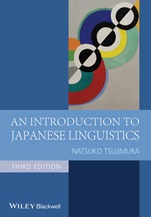
An Introduction to Japanese Linguistics
ISBN 9781444337730
Autor: Natsuko Tsujimura
Wydawca: Wiley
Dostępność: 3-6 tygodni
Cena: 274,05 zł
Przed złożeniem zamówienia prosimy o kontakt mailowy celem potwierdzenia ceny.
ISBN13: |
9781444337730 |
ISBN10: |
1444337734 |
Autor: |
Natsuko Tsujimura |
Oprawa: |
Paperback |
Rok Wydania: |
2013-10-25 |
Numer Wydania: |
3rd Edition |
Ilość stron: |
480 |
Wymiary: |
244x170 |
Tematy: |
CF |
Updated and revised in its third edition, this successful textbook introduces readers to a wide range of cross–linguistic issues, phenomena, and terminology in Japanese linguistics. Its coverage spans phonetics, phonology, morphology, syntax, semantics, language acquisition, and language variation, and now draws on the author’s extensive expertise by incorporating her own data, examples and theoretical analyses throughout. The third edition introduces an approach which is less theoretical and more descriptive, leading to significant modifications to the chapters on phonetics, syntax, and phonology in particular. Updated exercises explore descriptive and theoretical issues, and each chapter now ends with a discussion on language acquisition providing useful context for readers. Ideal as a descriptive source and a theoretical foundation for students and scholars in this field, An Introduction to Japanese Linguistics offers an invaluable pedagogical tool to learn basic notions and terminology in linguistics and to develop skills in linguistic analysis and argumentation.
Preface to the Third Edition xi Acknowledgments xiv 1 Introduction 1 Suggested Readings 4 2 Phonetics 5 1 Phonetic Inventory 7 1.1 Consonants 8 1.1.1 Stops 8 1.1.2 Fricatives 10 1.1.3 Affricates 12 1.1.4 Liquids 12 1.1.5 Glides 13 1.1.6 Nasals 14 1.1.7 Further Notes on Consonants 18 1.2 Vowels 22 2 Suprasegmental Feature – Accent 27 3 Acquisition Issues 33 Notes 35 Suggested Readings 36 Exercises 37 3 Phonology 39 1 Phonological Rules in Japanese 40 1.1 Devoicing of High Vowels 40 1.2 Nasal Assimilation 44 1.3 Alveolar Alternations 47 1.4 [h]/[ɸ]/[ç] Alternations 51 1.5 Digression on the Phoneme Status of [ts, è, š, ǰ, ɸ, ç] 52 1.6 Rule Ordering and the Nature of Rule Statement 54 2 Sequential Voicing – “Rendaku” 56 3 Mora vs. Syllable 65 3.1 Speech Errors 68 3.1.1 English 68 3.1.2 Japanese 70 3.2 Language Games: “Babibu” Language 72 3.3 Syllable–Based Phenomena 74 4 Length Requirements 75 5 Loanwords 81 6 Accentuation in Japanese 85 6.1 Compound Accentuation 86 6.1.1 Accentuation of Long Nominal Compounds 87 6.1.2 Accentuation of Short Nominal Compounds 91 6.1.3 Accentuation of Superlong Nominal Compounds 95 6.2 Accentual Variation among Endings 96 6.3 Accentuation of Loanwords 102 7 Mimetics – Palatalization 104 8 Acquisition Issues 109 Notes 114 Suggested Readings 118 Exercises 119 4 Morphology 125 1 Parts of Speech Categories 126 1.1 Nouns 126 1.2 Verbs 128 1.3 Adjectives 131 1.4 Adverbs 132 1.5 Postpositions 133 1.6 Case Particles 134 1.7 Adjectival Nouns 137 1.8 Verbal Nouns 140 2 Morpheme Types 142 3 Word Formation 150 3.1 Affixation 150 3.2 Compounding 152 3.3 Reduplication 154 3.4 Clipping 154 3.5 Borrowing 155 4 Issues in Japanese Morphology (1): Transitive and Intransitive Verb Pairs 157 5 Issues in Japanese Morphology (2): Nominalization 168 6 Issues in Japanese Morphology (3): Compounding 174 6.1 Background 174 6.2 N–V Compounds 179 6.3 V–V Compounds 184 6.3.1 Lexical vs. Syntactic V–V Compounds 184 6.3.2 Lexical V–V Compounds: Semantic Relations 195 6.3.3 Lexical V–V Compounds: Transitivity and Argument Structure 200 6.3.4 Transitive and Intransitive Compound Verb Pairs 205 6.3.5 Compound Verbs and Nominalization 213 7 Acquisition Issues 214 Notes 221 Suggested Readings 223 Exercises 224 5 Syntax 229 1 Syntactic Structures 229 1.1 Syntactic Constituency 229 1.2 Phrase Structures 231 1.3 Phrase Structure Rules 234 2 Word Order and Scrambling 238 2.1 Basic Word Order 238 2.2 Scrambling Phenomenon 241 2.3 Noun Ellipsis 251 3 Reflexives 254 3.1 Zibun 255 3.2 Zibun–Zisin 263 4 Passives 265 4.1 Direct Passives 266 4.2 Indirect Passives (Adversative Passives) 269 5 Causatives 272 5.1 O–Causatives and Ni–Causatives 272 5.2 The Double–O Constraint 274 5.3 Causative Passives 279 5.4 Adversative Causatives 280 5.5 Lexical Causatives 281 6 Relative Clauses (Sentence Modifiers) 284 6.1 The Ga/No Conversion 288 6.2 Relative Clauses without Gaps 290 6.3 Internally Headed Relative Clauses 291 7 The Light Verb Construction 293 8 Acquisition Issues 295 Notes 300 Suggested Readings 302 Exercises 304 6 Semantics 309 1 Word Meaning and Sentence Meaning 310 1.1 Word/Phrase Meaning and Types of Relationships 310 1.2 Sentence Meaning 313 1.3 Metaphors and Idioms 317 1.4 Deixis 319 1.5 Mimetics 331 2 Tense and Aspect 335 2.1 Tense 335 2.2 Aspect 340 2.2.1 Grammatical Aspect 341 2.2.2 Lexical Aspect 347 2.2.3 Aspectual Verbs 361 3 Verb Semantics 370 3.1 Semantic Classes of Verbs and their Syntactic Patterns 371 3.2 Lexicalization 373 4 Pragmatics 375 4.1 Speaker’s Meaning 375 4.2 The Nature of Information 377 4.2.1 Wa vs. Ga 377 4.2.2 Interaction with Syntax and Morphology 380 4.3 Relevance of Contextual Information 384 5 Acquisition Issues 387 Notes 396 Suggested Readings 397 Exercises 399 7 Language Variation 403 1 Dialectal Variation 403 2 Styles and Levels of Speech 410 3 Gender Differences 415 4 Acquisition Issues 425 Notes 429 Suggested Readings 429 Exercises 430 Bibliography 431 Index 455
Natsuko Tsujimura is Chair and Professor in the Department of East Asian Languages and Cultures and Adjunct Professor in the Department of Linguistics at Indiana University. She is the editor of The Handbook of Japanese Linguistics (Wiley–Blackwell, 1999) and Japanese Linguistics: Critical Concepts (2005), and is Review Editor of the journal Language . She has published extensively on various aspects of Japanese linguistics, including phonology, syntax, semantics, and sociolinguistics.
Koszyk
Książek w koszyku: 0 szt.
Wartość zakupów: 0,00 zł
Informacje


Kontakt
Gambit
Centrum Oprogramowania
i Szkoleń Sp. z o.o.
Al. Pokoju 29b/22-24
31-564 Kraków
Siedziba Księgarni
ul. Kordylewskiego 1
31-542 Kraków
+48 12 410 5991
+48 12 410 5987
+48 12 410 5989
Subskrypcje
Administratorem danych osobowych jest firma Gambit COiS Sp. z o.o. Na podany adres będzie wysyłany wyłącznie biuletyn informacyjny.
Autoryzacja płatności

Informacje na temat autoryzacji płatności poprzez PayU.

© Copyright 2012: GAMBIT COiS Sp. z o.o. Wszelkie prawa zastrzeżone.
Projekt i wykonanie: Alchemia Studio Reklamy