


Wydawcy
Katalog tematyczny
- Archeologia (109)
- Ekonomia, finanse, business (13704)
- Filozofia (1445)
- Historia (3040)
- Języki i językoznawstwo (2356)
- Lifestyle, hobby i rozrywka (475)
- Medycyna (9704)
- Nauki humanistyczne (4)
- Nauki o Ziemi i środowisku (2638)
- Nauki ścisłe (20412)
- Astronomia (294)
- Biologia (5119)
- Biochemia (575)
- Biologia człowieka (14)
- Biologia komórkowa (377)
- Biologia molekularna (398)
- Biologia rozwoju (130)
- Biologia, ogólnie (1277)
- Botanika (280)
- Hydrobiologia (92)
- Mikrobiologia (363)
- Mykologia (22)
- Zoologia (303)
- Chemia (6540)
- Fizyka (3309)
- Matematyka (4574)
- Nauki ścisłe, ogólnie (503)
- Nauki społeczne (8486)
- Nauki techniczne (13450)
- Prawo (1696)
- Publikacje informacyjne i interdyscyplinarne (1288)
- Religia i wierzenia (917)
- Technika komputerowa (4067)
- Zdrowie, relacje międzyludzkie i rozwój osobisty (657)





Informacje szczegółowe o książce
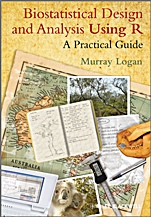
Biostatistical Design and Analysis Using R: A Practical Guide
ISBN 9781444335248
Autor: Dr Murray Logan
Wydawca: Wiley
Dostępność: 3-6 tygodni
Cena: 741,30 zł
Przed złożeniem zamówienia prosimy o kontakt mailowy celem potwierdzenia ceny.
ISBN13: |
9781444335248 |
ISBN10: |
1444335243 |
Autor: |
Dr Murray Logan |
Oprawa: |
Hardback |
Rok Wydania: |
2010-04-13 |
Ilość stron: |
576 |
Wymiary: |
250x178 |
Tematy: |
PS |
R – the statistical and graphical environment is rapidly emerging as an important set of teaching and research tools for biologists. This book draws upon the popularity and free availability of R to couple the theory and practice of biostatistics into a single treatment so as to provide a textbook for biologists learning statistics, R, or both. An abridged description of biostatistical principles and analysis sequence keys are combined together with worked examples of the practical use of R into a
complete practical guide to designing and analyzing real biological research.
Topics covered include
– simple hypothesis testing, graphing,
– exploratory data analysis and graphical summaries
– regression (linear, multi, and non–linear)
– simple and complex ANOVA and ANCOVA designs (including nested, factorial, blocking, spit–plot, and repeated measures)
– frequency analysis and generalized linear models
Linear mixed effects modeling is also incorporated extensively throughout as an alternative to traditional modelling techniques.
The book is accompanied by a companion website (www.wiley.com/go/logan/r) with an extensive set of resources comprising all R scripts and data sets used in the book, additional worked examples, the biology package, and other instructional materials and links.
AUTHOR BIOG
Murray Logan is a lecturer and researcher in the School of Biological Sciences, Monash University, Melbourne, Australia. He teaches a range of zoological and ecological courses in addition to biostatistical and R courses to undergraduate and graduate students. He also provides research design and analysis advice to a range of university, government and private organizations.
Spis treści:
Preface
R quick reference card
General key to statistical methods
1 IntroductiontoR
1.1 Why R?
1.2 Installing R
1.3 The R environment
1.4 Object names
1.5
Expressions, Assignment and Arithmetic
1.6 R Sessions and workspaces
1.7 Getting help
1.8 Functions
1.9 Precedence
1.10 Vectors – variables
1.11 Matrices, lists and data frames
1.12 Object information and conversion
1.13 Indexing vectors, matrices and lists
1.14 Pattern matching and replacement (character search and replace)
1.15 Data manipulation
1.16 Functions that perform other functions repeatedly
1.17 Programming in R
1.18 An introduction to the R graphical environment
1.19 Packages
1.20 Working with scripts
1.21 Citing R in publications
1.22 Further reading
2 Datasets
2.1 Constructing data frames
2.2 Reviewing a data frame – fix ()
2.3 Importing (reading) data
2.4 Exporting (writing) data
2.5 Saving and loading of R objects
2.6 Data frame vectors
2.7 Manipulating data sets
2.8 Dummy data sets – generating random data
3 Introductory statistical principles
3.1 Distributions
3.2 Scale transformations
3.3 Measures of location
3.4 Measures of dispersion and variability
3.5 Measures of the precision of estimates – standard errors and confidence intervals
3.6 Degrees of freedom
3.7 Methods of estimation
3.8 Outliers
3.9 Further reading
4 Sampling and experimental design with R
4.1 Random sampling
4.2 Experimental design
5 Graphical data presentation
5.1 The plot() function
5.2 Graphical Parameters
5.3 Enhancing and customizing plots with low–level plotting functions
5.4 Interactive graphics
5.5 Exporting graphics
5.6 Working with multiple graphical devices
5.7 High–level plotting functions for univariate (single variable) data
5.8 Presenting relationships
5.9 Presenting grouped data
5.10 Presenting categorical data
5.11 Trellis graphics
5.12 Further reading
6 Simple hypothesis testing – one and two population tests
6.1 Hypothesis t
esting
6.2 One– and two–tailed tests
6.3 t–tests
6.4 Assumptions
6.5 Statistical decision and power
6.6 Robust tests
6.7 Further reading
6.8 Key for simple hypothesis testing
6.9 Worked examples of real biological data sets
7 Introduction to Linearmodels
7.1 Linear models
7.2 Linear models in R
7.3 Estimating linear model parameters
7.4 Comments about the importance of understanding the structure and parameterization of linear models
8 Correlation and simple linear regression
8.1 Correlation
8.2 Simple linear regression
8.3 Smoothers and local regression
8.4 Correlation and regression in R
8.5 Further reading
8.6 Key for correlation and regression
8.7 Worked examples of real biological data sets
9 Multiple and curvilinear regression
9.1 Multiple linear regression
9.2 Linear models
9.3 Null hypotheses
9.4 Assumptions
9.5 Curvilinear models
9.6 Robust regression
9.7 Model selection
9.8 Regression trees
9.9 Further reading
9.10 Key and analysis sequence for multiple and complex regression
9.11 Worked examples of real biological data sets
10 Single factor classification (ANOVA)
10.1 Null hypotheses
10.2 Linear model
10.3 Analysis of variance
10.4 Assumptions
10.5 Robust classification (ANOVA)
10.6 Tests of trends and means comparisons
10.7 Power and sample size determination
10.8 ANOVA in R
10.9 Further reading
10.10 Key for single factor classification (ANOVA)
10.11 Worked examples of real biological data sets
11 Nested ANOVA
11.1 Linear models
11.2 Null hypotheses
11.3 Analysis of variance
11.4 Variance components
11.5 Assumptions
11.6 Pooling denominator terms
11.7 Unbalanced nested designs
11.8 Linear mixed effects models
11.9 Robust alternatives
11.10 Power and optimisation of resource allocation
11.11 Nested ANOVA in R
11.12 Further
reading
11.13 Key for nested ANOVA
11.14 Worked examples of real biological data sets
12 Factorial ANOVA
12.1 Linear models
12.2 Null hypotheses
12.3 Analysis of variance
12.4 Assumptions
12.5 Planned and unplanned comparisons
12.6 Unbalanced designs
12.7 Robust factorial ANOVA
12.8 Power and sample sizes
12.9 Factorial ANOVA in R
12.10 Further reading
12.11 Key for factorial ANOVA
12.12 Worked examples of real biological data sets
13 Unreplicated factorial designs – randomized block and simple repeated measures
13.1 Linear models
13.2 Null hypotheses
13.3 Analysis of variance
13.4 Assumptions
13.5 Specific comparisons
13.6 Unbalanced un–replicated factorial designs
13.7 Robust alternatives
13.8 Power and blocking efficiency
13.9 Unreplicated factorial ANOVA in R
13.10 Further reading
13.11 Key for randomized block and simple repeated measures ANOVA
13.12 Worked examples of real biological data sets
14 Partly nested designs: split plot and complex repeatedmeasures
14.1 Null hypotheses
14.2 Linear models
14.3 Analysis of variance
14.4 Assumptions
14.5 Other issues
14.6 Further reading
14.7 Key for partly nested ANOVA
14.8 Worked examples of real biological data sets
15 Analysis of covariance (ANCOVA)
15.1 Null hypotheses
15.2 Linear models
15.3 Analysis of variance
15.4 Assumptions
15.5 Robust ANCOVA
15.6 Specific comparisons
15.7 Further reading
15.8 Key for ANCOVA
15.9 Worked examples of real biological data sets
16 Simple Frequency Analysis
16.1 The chi–square statistic
16.2 Goodness of fit tests
16.3 Contingency tables
16.4 G–tests
16.5 Small sample sizes
16.6 Alternatives
16.7 Power analysis
16.8 Simple frequency analysis in R
16.9 Further reading
16.10 Key for Analysing frequencies
16.11 Worked examples of real biological data s
ets
17 Generalized linear models (GLM)
17.1 Dispersion (over or under)
17.2 Binary data – logistic (logit) regression
17.3 Count data – Poisson generalized linear models
17.4 Assumptions
17.5 Generalized additive models (GAM’s) – non–parametric GLM
17.6 GLM and R
17.7 Further reading
17.8 Key for GLM
17.9 Worked examples of real biological data sets
Bibliography
R index
Statistics index
Companion website for this book: wiley.com/go/logan/r
Koszyk
Książek w koszyku: 0 szt.
Wartość zakupów: 0,00 zł
Informacje


Kontakt
Gambit
Centrum Oprogramowania
i Szkoleń Sp. z o.o.
Al. Pokoju 29b/22-24
31-564 Kraków
Siedziba Księgarni
ul. Kordylewskiego 1
31-542 Kraków
+48 12 410 5991
+48 12 410 5987
+48 12 410 5989
Subskrypcje
Administratorem danych osobowych jest firma Gambit COiS Sp. z o.o. Na podany adres będzie wysyłany wyłącznie biuletyn informacyjny.
Autoryzacja płatności

Informacje na temat autoryzacji płatności poprzez PayU.

© Copyright 2012: GAMBIT COiS Sp. z o.o. Wszelkie prawa zastrzeżone.
Projekt i wykonanie: Alchemia Studio Reklamy