


Wydawcy
Katalog tematyczny
- Archeologia (109)
- Ekonomia, finanse, business (13704)
- Filozofia (1445)
- Historia (3040)
- Języki i językoznawstwo (2356)
- Lifestyle, hobby i rozrywka (475)
- Medycyna (9704)
- Nauki humanistyczne (4)
- Nauki o Ziemi i środowisku (2638)
- Nauki ścisłe (20412)
- Nauki społeczne (8486)
- Edukacja (229)
- Kryminologia, opieka spełeczna (284)
- Obronność (10)
- Polityka (1389)
- Psychologia (777)
- Socjologia (410)
- Społeczeństwo i kultura (187)
- Nauki techniczne (13450)
- Prawo (1696)
- Publikacje informacyjne i interdyscyplinarne (1288)
- Religia i wierzenia (917)
- Technika komputerowa (4067)
- Zdrowie, relacje międzyludzkie i rozwój osobisty (657)





Informacje szczegółowe o książce
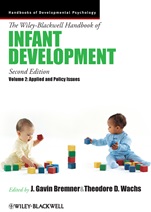
The Wiley–Blackwell Handbook of Infant Development, Volume 2: Applied and Policy Issues
ISBN 9781444332742
Autor: J. Gavin Bremner, Theodore D. Wachs
Wydawca: Wiley
Dostępność: 3-6 tygodni
Cena: 780,15 zł
Przed złożeniem zamówienia prosimy o kontakt mailowy celem potwierdzenia ceny.
ISBN13: |
9781444332742 |
ISBN10: |
1444332740 |
Autor: |
J. Gavin Bremner, Theodore D. Wachs |
Oprawa: |
Hardback |
Rok Wydania: |
2010-09-03 |
Numer Wydania: |
2nd Edition |
Ilość stron: |
456 |
Wymiary: |
258x181 |
Tematy: |
JC |
The second edition of The Wiley–Blackwell Handbook of Infant Development reflects the breadth of new topics and vast empirical knowledge relating to infancy research that has emerged in recent years.
Fully revised and updated, Volume 2, Applied and Policy Issues, covers the main issues related to childhood development in four sections. The first section focuses on biological risk in infancy and addresses such crucial topics as pre–natal development, nutrition and sensory–motor disorders. The second section emphasizes psychosocial risk and covers domains such as poverty, child abuse and maternal depression. The third section addresses a variety of developmental disorders characteristic of the infancy period including autism and intellectual disability. The final section deals with intervention and policy issues relating to childcare, assessment and public policy.
Edited by two leaders in the field with contributions from international researchers and practitioners, The Wiley–Blackwell Handbook of Infant Development offers the most comprehensive coverage available of this dynamic and rapidly growing field.
Spis treści:
Part I: Bioecological risks.
Chapter 1: Fetal development (Raye–Ann deRegnier and Shivani Desai, Northwestern University Feinberg School of Medicine).
Chapter 2: Infant nutrition (Maureen M. Black and Kristen M. Hurley, University of Maryland School of Medicine).
Chapter 3: Health (Robert J. Karp, SUNY–Downstate Medical Center).
Chapter 4: Development of communication in children with sensory functional disabilities (Gunilla Preisler, University of Stockholm).
Part II: Psychosocial risks.
Chapter 5: Growing up in poverty in developed countries (Jondou J. Chen, Nina Philipsen Hetzner, and Jeanne Brooks–Gunn, Columbia University).
Chapter 6: Infant Development in the Developing World (Patrice
Engle, California Polytechnic State University).
Chapter 7: Child abuse and neglect (Kelli Connell–Carrick, University of Houston).
Chapter 8: Effects of postnatal depression on mother–infant interactions, and child development (Lynne Murray, Sarah Halligan and Peter Cooper, University of Reading).
Part III: Developmental disorders.
Chapter 9: Infant assessment (Susan P. Berger, Children′s Memorial Hospital & Northwestern University, Feinberg School of Medicine, Joyce Hopkins, Illinois Institute of Technology, Hyo Bae, Illinois Institute of Technology, Bryce Hella, Illinois Institute of Technology, and Jennifer Strickland, Illinois Institute of Technology).
Chapter 10: The Early Development of Autism Spectrum Disorders (Gregory S. Young and Sally Ozonoff, University of California, Davis).
Chapter 11: Infant Psychosocial Disorders (Melissa R. Johnson, WakeMed Health and Hospitals & University of North Carolina – Chapel Hill, Karen Appleyard, Duke University).
Chapter 12: Genetic Disorders Associated with Intellectual Disability: An Early Development Perspective (Deborah J. Fidler, Colorado State University, Lisa Daunhauer, Colorado State University, David E. Most, Colorado State University, and Harvey Switzky, Northern Illinois University).
Part IV: Intervention and policy issues.
Chapter 13: Early intervention (Douglas R. Powell, Purdue University).
Chapter 14: Childcare Research at the Dawn of a New Millennium: An update (Sarah L. Friedman, CNA, Edward Melhuish, Birkbeck, University of London, and Candace Hill, CNA).
Chapter 15: Infancy research, policy, and practice (Marguerite Barratt and Erica Fener, The George Washington University).
Nota biograficzna:
Gavin Bremner is Professor of Developmental Psychology at Lancaster University. He has investigated perception and cognition in infancy
for more than 30 years, and has published numerous papers and books relating to this topic. His current research interests include infants’ perception of object trajectories and infants’ intersensory perception.
Theodore D. Wachs is Professor of Psychological Sciences at Purdue University. He is a member of the editorial boards of the International Journal of Behavioral Development and the Journal of Applied Developmental Psychology. His current research focuses on chaotic family environments and infant development; micro–nutrient deficiencies in infancy and cognitive and social–emotional development; and temperament in infancy and childhood.
Okładka tylna:
The second edition of The Wiley–Blackwell Handbook of Infant Development reflects the breadth of new topics and vast empirical knowledge relating to infancy research that has emerged in recent years.
Fully revised and updated, Volume 2, Applied and Policy Issues, covers the main issues related to childhood development in four sections. The first section focuses on biological risk in infancy and addresses such crucial topics as pre–natal development, nutrition and sensory–motor disorders. The second section emphasizes psychosocial risk and covers domains such as poverty, child abuse and maternal depression. The third section addresses a variety of developmental disorders characteristic of the infancy period including autism and intellectual disability. The final section deals with intervention and policy issues relating to childcare, assessment and public policy.
Edited by two leaders in the field with contributions from international researchers and practitioners, The Wiley–Blackwell Handbook of Infant Development offers the most comprehensive coverage available of this dynamic and rapidly growing field.
Koszyk
Książek w koszyku: 0 szt.
Wartość zakupów: 0,00 zł
Informacje


Kontakt
Gambit
Centrum Oprogramowania
i Szkoleń Sp. z o.o.
Al. Pokoju 29b/22-24
31-564 Kraków
Siedziba Księgarni
ul. Kordylewskiego 1
31-542 Kraków
+48 12 410 5991
+48 12 410 5987
+48 12 410 5989
Subskrypcje
Administratorem danych osobowych jest firma Gambit COiS Sp. z o.o. Na podany adres będzie wysyłany wyłącznie biuletyn informacyjny.
Autoryzacja płatności

Informacje na temat autoryzacji płatności poprzez PayU.

© Copyright 2012: GAMBIT COiS Sp. z o.o. Wszelkie prawa zastrzeżone.
Projekt i wykonanie: Alchemia Studio Reklamy