


Wydawcy
Katalog tematyczny
- Archeologia (109)
- Ekonomia, finanse, business (13704)
- Filozofia (1445)
- Historia (3040)
- Języki i językoznawstwo (2356)
- Lifestyle, hobby i rozrywka (475)
- Medycyna (9704)
- Nauki humanistyczne (4)
- Nauki o Ziemi i środowisku (2638)
- Nauki ścisłe (20412)
- Nauki społeczne (8486)
- Nauki techniczne (13450)
- Prawo (1696)
- Publikacje informacyjne i interdyscyplinarne (1288)
- Religia i wierzenia (917)
- Technika komputerowa (4067)
- Zdrowie, relacje międzyludzkie i rozwój osobisty (657)





Informacje szczegółowe o książce
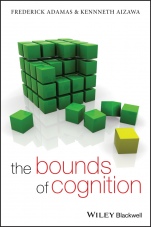
The Bounds of Cognition
ISBN 9781444332704
Autor: Frederick Adams, Kenneth Aizawa
Wydawca: Wiley
Dostępność: 3-6 tygodni
Cena: 192,15 zł
Przed złożeniem zamówienia prosimy o kontakt mailowy celem potwierdzenia ceny.
ISBN13: |
9781444332704 |
ISBN10: |
1444332708 |
Autor: |
Frederick Adams, Kenneth Aizawa |
Oprawa: |
Paperback |
Rok Wydania: |
2010-01-22 |
Ilość stron: |
216 |
Wymiary: |
229x152 |
Tematy: |
HP |
One is naturally inclined to say the tools that surround us—everything from paper and pencils to computers, clothing, and keys—complement our cognitive processing. That is common sense. The Bounds of Cognition articulates and defends a theory of "the mark of the cognitive," a common sense approach to cognitive science that differentiates between cognitive and non–cognitive processes. Addressing the limits of the embodied mind, the mark of the cognitive is a refreshing alternative approach to "extended cognition" whose advocates—including a growing number of leading philosophers and psychologists—argue that cognitive processing is not "brain bound," and the mind extends beyond the boundary of the brain and body. Putting their theory of the cognitive into practice, the authors analyze and expose some of the fallacies and shortcomings of extended cognition literature. The Bounds of Cognition is a timely and relevant text that exposes the need to develop a more sophisticated theory of cognition while allowing flexibility in exploring the nature of cognition.
Preface. Acknowledgments. 1 Introduction. 2 Refining the Issues. 2.1 What are the Boundaries? 2.2 What is Cognition? 2.3 The Possibility of Extended Cognition. 2.4 Conclusion. 3 Original Content. 3.1 Part of the Mark of the Cognitive: Non–Derived Content. 3.2 The Basics on Derived and Underived Content. 3.3 Dennett’s Critique of Original Content. 3.4 Clark’s Critique of Original Content. 3.5 Anti–Representationalism in Dynamical Systems and Mobile Robotics. 3.6 Conclusion. 4 Cognitive Processes. 4.1 Individuating Process Types in Science. 4.2 Individuating Processes in Cognitive Psychology. 4.3 A Broader Category of Cognition. 4.4 Conclusion. 5 The Mark of the Cognitive, Extended Cognition Style. 5.1 Cognition as Information Processing, as Computation, and as Abiding in the Meaningful. 5.2 Operationalism. 5.3 Is This Merely a Terminological Issue? 5.4 Conclusion. 6 The Coupling–Constitution Fallacy. 6.1 Some Examples of the Coupling–Constitution Fallacy. 6.2 Replies to the Coupling–Constitution Fallacy. 6.3 Conclusion. 7 Extended Cognitive Systems and Extended Cognitive Processes. 7.1 Dynamical Systems Theory and Coupling. 7.2 Haugeland’s Theory of Systems and the Coupling of Components. 7.3 Clark’s Theories of Systems and Coupling. 7.4 Conclusion. 8 Cognitive Equivalence, Complementarity, and Evolution. 8.1 Cognitive Equivalence. 8.2 The Complementarity Argument. 8.3 Evolutionary Arguments. 8.4 Conclusion: The Importance of the Mark of the Cognitive. 9 Inference to the Best Explanation and Extended Cognition. 9.1 What is the Theory of Enactive Perception? 9.2 Noë’s Evidence for Enactive Perception. 9.3 The Case against Enactive Perception: Paralysis. 9.4 Conclusion. 10 Future Directions. Bibliography. Index.
Frederick Adams is Professor of Cognitive Science & Philosophy and Chair of Linguistics and Cognitive Science at the University of Delaware. He is also director of the Delaware Program in Cognitive Science. He publishes in epistemology, philosophy of language, philosophy of mind, and philosophy of science. Kenneth Aizawa is Charles T. Beaird Professor of Philosophy in the Department of Philosophy at Centenary College of Louisiana and is the author of The Systematicity Arguments (2003).
"Where is human cognition located? Is human cognitive processing literally constituted (at least partly) by non–neural portions of the environment? The contemporary debate about extended cognition and the extended mind focuses on these questions, among others. Frederick Adams and Kenneth Aizawa′s new book, The Bounds of Cognition (BC), contributes wonderfully to this debate. The book is critical of the extended approach; but Adams and Aizawa (A&A) also work toward a positive view, one that allows, in principle, for extended cognition, while yielding very little of it when fed the empirical facts."( Philosophical Psychology, November 2010) “ The Bounds of Cognition is the most thorough–going, forceful, and compelling critique of EMH so far.” ( Erkenntnis , September 2009) "[This book] is without question a worthy and timely challenge to extended cognition, as well as to areas in related enterprises such as embodied cognition, situated cognition, dynamical systems theory and artificial life.... I recommend the book highly to anyone interested in these issues." ( Phenomenology and the Cognitive Sciences , June 2009) "This is a well written, well argued book. Written by philosophers mainly for philosophers.... It makes a serious contribution to the extended cognition debate that anyone with a serious interest in the issue needs to study." ( Journal of Consciousness Studies , January 2009) "Advocates of EMT must undoubtedly examine the arguments and criticisms that Adams and Aizawa offer in careful detail, because The Bounds of Cognition is the most forceful and most convincing criticism of their position so far." ( Metapsychology , October 2008) “The [authors] wrote this book as a reasoned challenge … .[It] offers an excellent overview of the promise, limits, and problems of bounded cognition. Recommended.” ( Choice)
Koszyk
Książek w koszyku: 0 szt.
Wartość zakupów: 0,00 zł
Informacje


Kontakt
Gambit
Centrum Oprogramowania
i Szkoleń Sp. z o.o.
Al. Pokoju 29b/22-24
31-564 Kraków
Siedziba Księgarni
ul. Kordylewskiego 1
31-542 Kraków
+48 12 410 5991
+48 12 410 5987
+48 12 410 5989
Subskrypcje
Administratorem danych osobowych jest firma Gambit COiS Sp. z o.o. Na podany adres będzie wysyłany wyłącznie biuletyn informacyjny.
Autoryzacja płatności

Informacje na temat autoryzacji płatności poprzez PayU.

© Copyright 2012: GAMBIT COiS Sp. z o.o. Wszelkie prawa zastrzeżone.
Projekt i wykonanie: Alchemia Studio Reklamy