


Wydawcy
Katalog tematyczny
- Archeologia (109)
- Ekonomia, finanse, business (13704)
- Filozofia (1445)
- Historia (3040)
- Języki i językoznawstwo (2356)
- Lifestyle, hobby i rozrywka (475)
- Medycyna (9704)
- Nauki humanistyczne (4)
- Nauki o Ziemi i środowisku (2638)
- Nauki ścisłe (20412)
- Nauki społeczne (8486)
- Nauki techniczne (13450)
- Prawo (1696)
- Publikacje informacyjne i interdyscyplinarne (1288)
- Religia i wierzenia (917)
- Technika komputerowa (4067)
- Zdrowie, relacje międzyludzkie i rozwój osobisty (657)





Informacje szczegółowe o książce
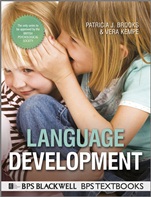
Language Development
ISBN 9781444331462
Autor: Patricia J. Brooks, Vera Kempe
Wydawca: Wiley
Dostępność: 3-6 tygodni
Cena: 313,95 zł
Przed złożeniem zamówienia prosimy o kontakt mailowy celem potwierdzenia ceny.
ISBN13: |
9781444331462 |
ISBN10: |
1444331469 |
Autor: |
Patricia J. Brooks, Vera Kempe |
Oprawa: |
Paperback |
Rok Wydania: |
2012-04-13 |
Ilość stron: |
400 |
Wymiary: |
245x192 |
Tematy: |
CF |
This is an outstanding book, based on an incrediblyimpressive range of detailed and thorough scholarship...The bookwill be invaluable to students encountering the field of childlanguage for the first time, and it will also be a vital resourcefor anyone wishing to update their knowledge about the latestfindings and current understandings in the field. The authors areto be congratulated on their remarkable achievement.
Professor Martyn Barrett, University of Surrey, UK
A well–written introduction to the field of languagedevelopment.As a textbook, it stands out by highlighting the socialand communicative aspects of language from the very beginning andtouching on them throughout. Covering everything from decoding thespeech signal to language use and from brain development to signlanguage acquisition, it will surely attract many new students tothe study of language development. Professor Morten H. Christiansen , Cornell University,USA
"This is an excellent discussion of the most importantresearch in language development. The authors write clearly andconcisely and cover an exceptionally wide range of topics, as wellas providing up–to–date coverage of the most recent research insyntax, semantics and phonology. This authoritative text willimmediately be placed on our undergraduate readinglist. Dr Julia M. Carroll, Associate Professor in DevelopmentalPsychology, University of Warwick, UK
From the first moment of life, language development occurs inthe context of social activities. This book emphasises how languagedevelopment interacts with social and cognitive development, andshows how these abilities work together to turn children intosophisticated language users a process that continues wellbeyond the early years. Covering the breadth of contemporaryresearch on language development, Brooks and Kempe illustrate themethodological variety and multi–disciplinary character of thefield, presenting recent findings with reference to majortheoretical discussions. Through their clear and accessible style,readers are given an authentic flavour of the complexities oflanguage development research.
With such research advancing at a rapid pace, LanguageDevelopment uncovers new insights into a variety of areas suchas the neurophysiological underpinnings of language, the languageprocessing capabilities of newborns, and the role of genes inregulating this amazing human ability.
Key features include:
A state–of–the–art overview of recent advances in the field
A wide breadth of topics, including how infants discoverlanguage through interaction with others and how children learn toread and write
Detailed coverage of how language development unfolds inspecial populations such as bilinguals, deaf children, and childrenwith language impairments.
A comprehensive summary of each chapter with a carefullyconstructed list of further readings that encompass keystudies
Methodology boxes describing crucial research methods for agiven topic
Additional resource materials to accompany this text areavailable at
www.wiley.com/college/brooks
Acknowledgements xv
Chapter 1 What Enables Infants to Acquire Language? 1
Chapter 2 What do Infants Learn Before they Speak their First Word? 19
Chapter 3 How does Social and Cognitive Development Support
Language Development? 43
Chapter 4 How do Children Learn Words? 63
Chapter 5 How do Children Learn to Combine and Modify Words? 89
Chapter 6 What Kind of Language do Children Encounter? 117
Chapter 7 How do Children Learn to Use Language? 141
Chapter 8 How does Language Development Aff ect Cognition? 163
Chapter 9 What is the Role of Literacy in Language Development? 189
Chapter 10 What Causes Language Impairments? 213
Chapter 11 How do Deaf Children Acquire Language? 239
Chapter 12 How does Language Development Aff ect the Brain? 263
Glossary 287
References 303
Name Index 367
Subject Index 379
Patricia Brooks is a Professor at the College of Staten Island. She conducts research in the areas of language development in children, second language learning in adults, and speech production and comprehension. On–going research projects explore (1) speech perception in children with Autism, (2) lexical access in children with Specific Language Impairment, (3) individual differences in adult second language learning, and (4) comprehension errors in sentence processing. Dr. Brooks joined the CSI faculty in 1997 after completing post–doctoral fellowships at Carnegie Mellon University and Emory University. She was appointed to the CUNY Graduate Center faculty in 1999, and is active in the Ph.D. programs in Developmental Psychology and Cognition, Brain & Behavior.
Vera Kempe is a Professor and Chair in Psychology of Language Learning at the University of Abertay, Dundee. She has held posts at Carnege Mellon University, the University of Toledo, SUNY Oswego, and the University of Stirling. She has published extensively within her research areas, which include: the role of child–directed speech in language acquisition; crosslinguistic research and neural network modeling of language learning and processing; first and second language vocabulary acquisition and learning of inflectional morphology; Individual differences in language learning and in child–directed speech; emotion and communication.
Koszyk
Książek w koszyku: 0 szt.
Wartość zakupów: 0,00 zł
Informacje


Kontakt
Gambit
Centrum Oprogramowania
i Szkoleń Sp. z o.o.
Al. Pokoju 29b/22-24
31-564 Kraków
Siedziba Księgarni
ul. Kordylewskiego 1
31-542 Kraków
+48 12 410 5991
+48 12 410 5987
+48 12 410 5989
Subskrypcje
Administratorem danych osobowych jest firma Gambit COiS Sp. z o.o. Na podany adres będzie wysyłany wyłącznie biuletyn informacyjny.
Autoryzacja płatności

Informacje na temat autoryzacji płatności poprzez PayU.

© Copyright 2012: GAMBIT COiS Sp. z o.o. Wszelkie prawa zastrzeżone.
Projekt i wykonanie: Alchemia Studio Reklamy