


Wydawcy
Katalog tematyczny
- Archeologia (109)
- Ekonomia, finanse, business (13704)
- Filozofia (1445)
- Historia (3040)
- Języki i językoznawstwo (2356)
- Lifestyle, hobby i rozrywka (475)
- Medycyna (9704)
- Nauki humanistyczne (4)
- Nauki o Ziemi i środowisku (2638)
- Nauki ścisłe (20412)
- Nauki społeczne (8486)
- Edukacja (229)
- Kryminologia, opieka spełeczna (284)
- Obronność (10)
- Polityka (1389)
- Psychologia (777)
- Socjologia (410)
- Społeczeństwo i kultura (187)
- Nauki techniczne (13450)
- Prawo (1696)
- Publikacje informacyjne i interdyscyplinarne (1288)
- Religia i wierzenia (917)
- Technika komputerowa (4067)
- Zdrowie, relacje międzyludzkie i rozwój osobisty (657)





Informacje szczegółowe o książce
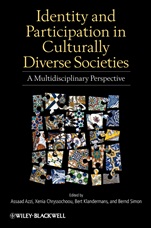
Identity and Participation in Culturally Diverse Societies: A Multidisciplinary Perspective
ISBN 9781405199476
Autor: Assaad E. Azzi, Xenia Chryssochoou, Bert Klandermans, Bernd Simon
Wydawca: Wiley
Dostępność: 3-6 tygodni
Cena: 556,50 zł
Przed złożeniem zamówienia prosimy o kontakt mailowy celem potwierdzenia ceny.
ISBN13: |
9781405199476 |
ISBN10: |
1405199474 |
Autor: |
Assaad E. Azzi, Xenia Chryssochoou, Bert Klandermans, Bernd Simon |
Oprawa: |
Hardback |
Rok Wydania: |
2010-10-08 |
Ilość stron: |
400 |
Wymiary: |
234x156 |
Tematy: |
JC |
In Identity and Participation in Culturally Diverse Societies, the contributors present an original discussion of how the links between identity, political participation, radicalization, and integration can provide a scientific understanding of the complex issue of coexistence between groups in culturally diverse societies.
Using state–of–the–art theory and the latest research findings, the book raises and answers a variety of questions, including: what identity dynamics are activated in culturally diverse societies, especially in societies with migrants? How do migrants and national citizens conceive of their identities and how does this impact intergroup relations? What is political participation and how does identity influence its probability and direction? When and why does radicalization occur?
Starting with an investigation of multiple identities at the individual level, and diverse identities at the societal level, the book examines the effect of identity dynamics on political participation. It then discusses the factors that lead from identity dynamics and political participation to the two alternative paths of radicalization or integration. These important and timely issues are examined through unique perspectives from both social psychology and the social sciences.
Spis treści:
Introduction (Xenia Chryssochoou, Assaad Azzi, Bert Klandermans & Bernd Simon).
Part I.
Development, (Re)Construction and Expression of Collective Identities (Xenia Chryssochoou).
Chapter 1: The role of nationalism, ethnicity and class in shaping Greek–American identity (1890–1927): a historical analysis (Yannis G.S. Papadopoulos).
Chapter 2: Religious identity and socio–political participation: Muslim minorities in Western Europe (Maykel Verkuyten).
Chapter 3: The Bicultural Identity Performance of Immigrants (Shaun Wiley and Kay D
eaux).
Chapter 4: Perceptions of (In)compatibility between identities and participation in the national polity of people belonging to ethnic minorities (Xenia Chryssochoou and Evanthia Lyons).
Part II.
Collective Identity and Political Participation (Bernd Simon).
Chapter 5: Winners and Losers in the Europeanisation of Public Policy Debates: Empowering the Already Powerful? (Ruud Koopmans and Paul Statham).
Chapter 6: New Ways of Understanding Migrant Integration in Europe (Patrick Ireland).
Chapter 7: Collective identity and political engagement (Bernd Simon).
Chapter 8: Collective identity, political participation and the making of the social self (Steve Reicher and John Drury).Part III.
Radicalisation (Bert Klandermans).
Chapter 9: Radicalization (Jacquelien van Stekelenburg and Bert Klandermans).
Chapter 10: Citizenship regimes and identity strategies among young Muslims in Europe (Catarina Kinvall and Paul Nesbitt–Larking).
Chapter 11: Going all the way: Politicization and radicalization of the Hofstad network in the Netherlands (Martijn de Koning and Roel Meijer).
Chapter 12: Trajectories of Ideologies and Action in U.S. Organized Racism (Kathleen M. Blee).
Chapter 13: No Radicalization without Identification: How ethnic Dutch and Dutch Muslim web forums radicalize over time (Jacquelien van Stekelenburg , Dirk Oegema and Bert Klandermans).
Part IV.
Integration (Assaad E. Azzi).
Chapter 14: Immigrant acculturation: Psychological and social adaptations (John W. Berry).
Chapter 15: Ethnic social networks, social capital and political participation of immigrants (Dirk Jacobs and Jean Tillie).
Chapter 16: Naturalization as boundary crossing: Evidence from labor migrants in Germany (Claudia Diehl and Michael Blohm).
Chapter 17: Confronting the past to create a b
etter future: The antecedents and benefits of intergroup forgiveness (Nyla R. Branscombe and Tracey Cronin).
Concluding chapter.
From identity and participation to integration or radicalization: A critical appraisal (Assaad E. Azzi).
Nota biograficzna:
Assaad Azzi is Professor of Psychology and Director of the Social Psychology unit at the Université Libre de Bruxelles. His research focuses on identity, resource–distribution, and the perception of justice and injustice in majority–minority relations.
Xenia Chryssochoou is Associate Professor at Panteion University, Athens. She currently works on mobility, migration and justice and on perceptions of globalization and political participation.
Bert Klandermans is Professor in Applied Social Psychology at the VU–University, Amsterdam, The Netherlands. He is co–editor (with Suzanne Staggenborg, 2002) of Social Movements, Protest, and Contention and co–author, most recently, of the Handbook of Social Movements Across Disciplines (with Conny Roggeband, 2007).
Bernd Simon is Professor of Social and Political Psychology and one of the Directors of the Institute of Psychology at the Christian–Albrechts–University in Kiel, Germany. His research investigates inter– and intragroup processes.
Okładka tylna:
In Identity and Participation in Culturally Diverse Societies, the contributors present an original discussion of how the links between identity, political participation, radicalization, and integration can provide a scientific understanding of the complex issue of coexistence between groups in culturally diverse societies.
Using state–of–the–art theory and the latest research findings, the book raises and answers a variety of questions, including: what identity dynamics are activated in culturally diverse societies, especia
lly in societies with migrants? How do migrants and national citizens conceive of their identities and how does this impact intergroup relations? What is political participation and how does identity influence its probability and direction? When and why does radicalization occur?
Starting with an investigation of multiple identities at the individual level, and diverse identities at the societal level, the book examines the effect of identity dynamics on political participation. It then discusses the factors that lead from identity dynamics and political participation to the two alternative paths of radicalization or integration. These important and timely issues are examined through unique perspectives from both social psychology and the social sciences.
Koszyk
Książek w koszyku: 0 szt.
Wartość zakupów: 0,00 zł
Informacje


Kontakt
Gambit
Centrum Oprogramowania
i Szkoleń Sp. z o.o.
Al. Pokoju 29b/22-24
31-564 Kraków
Siedziba Księgarni
ul. Kordylewskiego 1
31-542 Kraków
+48 12 410 5991
+48 12 410 5987
+48 12 410 5989
Subskrypcje
Administratorem danych osobowych jest firma Gambit COiS Sp. z o.o. Na podany adres będzie wysyłany wyłącznie biuletyn informacyjny.
Autoryzacja płatności

Informacje na temat autoryzacji płatności poprzez PayU.

© Copyright 2012: GAMBIT COiS Sp. z o.o. Wszelkie prawa zastrzeżone.
Projekt i wykonanie: Alchemia Studio Reklamy