


Wydawcy
Katalog tematyczny
- Archeologia (109)
- Ekonomia, finanse, business (13704)
- Filozofia (1445)
- Historia (3040)
- Języki i językoznawstwo (2356)
- Lifestyle, hobby i rozrywka (475)
- Medycyna (9704)
- Nauki humanistyczne (4)
- Nauki o Ziemi i środowisku (2638)
- Nauki ścisłe (20412)
- Astronomia (294)
- Biologia (5119)
- Biochemia (575)
- Biologia człowieka (14)
- Biologia komórkowa (377)
- Biologia molekularna (398)
- Biologia rozwoju (130)
- Biologia, ogólnie (1277)
- Botanika (280)
- Hydrobiologia (92)
- Mikrobiologia (363)
- Mykologia (22)
- Zoologia (303)
- Chemia (6540)
- Fizyka (3309)
- Matematyka (4574)
- Nauki ścisłe, ogólnie (503)
- Nauki społeczne (8486)
- Nauki techniczne (13450)
- Prawo (1696)
- Publikacje informacyjne i interdyscyplinarne (1288)
- Religia i wierzenia (917)
- Technika komputerowa (4067)
- Zdrowie, relacje międzyludzkie i rozwój osobisty (657)





Informacje szczegółowe o książce
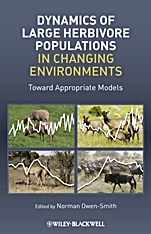
Dynamics of Large Herbivore Populations in Changing Environments: Towards Appropriate Models
ISBN 9781405198943
Autor: Norman Owen–Smith
Wydawca: Wiley
Dostępność: 3-6 tygodni
Cena: 751,80 zł
Przed złożeniem zamówienia prosimy o kontakt mailowy celem potwierdzenia ceny.
ISBN13: |
9781405198943 |
ISBN10: |
140519894X |
Autor: |
Norman Owen–Smith |
Oprawa: |
Hardback |
Rok Wydania: |
2010-02-05 |
Ilość stron: |
216 |
Wymiary: |
242x162 |
Tematy: |
PS |
This book aims to reconcile theoretical models of population dynamics with what is currently known about the population dynamics of large mammalian herbivores. It arose from a working group established at the National Center for Ecological Analysis and Synthesis at the University of California, Santa Barbara, to address the need for models that better accommodate environmental variability, especially for herbivores dependent on changing vegetation resources. The initial chapter reviews findings from definitive long–term studies of certain other ungulate populations, many based on individually identifiable animals. Other chapters cover climatic influences, emphasising temperate versus tropical contrasts, and demographic processes underlying population dynamics, more generally. There are new assessments of irruptive population dynamics, and of the consequences of landscape heterogeneity for herbivore populations. An initial review of candidate population models is followed up by a final chapter outlining how these models might be modified to better accommodate environmental variability. The contents provide a foundation for resolving problems of diminishing large mammal populations in Africa, over–abundant ungulate populations elsewhere, and general consequences of global change for biodiversity conservation. This book will serve as a definitive outline of what is currently known about the population dynamics of large herbivores.
Spis treści:
Contributors
Preface
1 Definitive case studies
Norman Owen–Smith and Jason P. Marshal
1.1 Red deer on Rum
1.2 Soay sheep on Hirta
1.3 Roe deer in France
1.4 Bighorn sheep in Alberta
1.5 Kudu in Kruger
1.6 Wildebeest in Serengeti
1.7 Moose on Isle Royale
1.8 Elk in North Yellowstone
1.9 Overview
Acknowledgments
References
2 The suite of population models
Norman Owen–Smith
2.1 Models of density dependence
2.2 Autoregressive time–series models
2.3 Age– or stage–structured models
2.4 Trophic interaction models
2.5 Physiological or metaphysiological models
2.6 Models accommodating spatial structure
2.7 Individual–based models
2.8 Overview
Acknowledgments
References
3 Climatic influences: temperate–tropical contrasts
Norman Owen–Smith
3.1 Temperate environments
3.2 Tropical and subtropical environments
3.3 Effects of predation and hunting
3.4 Overall assessment
Acknowledgments
References
4 Demographic processes: lessons from long–term, individual–based studies
Jean–Michel Gaillard, Tim Coulson and Marco Festa–Bianchet
4.1 Life history of large herbivores: a brief review
4.2 Differential contributions of demographic parameters to population growth
4.3 Climatic variation, density–dependence,andindividual variability
4.4 Conclusions:howcanfutureanalysesof largeherbivoredemography deal with complex demographic processes?
Acknowledgments
References
5 Irruptive dynamics and vegetation interactions
John E. Gross, Iain J. Gordon and Norman Owen–Smith
5.1 Models of herbivore–vegetation interactions
5.2 Examples of irruptive dynamics
5.3 Effects of irruptions on vegetation
5.4 Changing perspectives
5.5 Synthesis
5.6 Implications for conservation and management
Acknowledgments
References
6 How does landscape heterogeneity shape dynamics of large herbivore populations?
N. Thompson Hobbs and Iain J. Gordon
6.1 What is spatial heterogeneity?
6.2 How does spatial heterogeneity influence ungulate population dynamics?
6.3 Mechanisms explaining the influence of spatial heterogeneity on population dynamics
6.4 Influences from high–quality resources
6.5 Influences from buffer resources
6.6 Global change and access to heterogene
ity by large herbivores
6.7 Conclusions: the importance of spatial context for population dynamics
Acknowledgments
References
7 Towards an ecology of population dynamics
Norman Owen–Smith
7.1 Phenomenological descriptors
7.2 Time series elaborations
7.3 Environmental structure
7.4 Population structure
7.5 Adaptive responses and environmental contexts
7.6 Summary and conclusions
Acknowledgments
References
Index
Nota biograficzna:
Norman Owen–Smith has a special interest in the behavioural and population ecology of large mammalian herbivores. After obtaining his PhD for a study of white rhinos through the University of Wisconsin, he held appointments at the universities of Pretoria and Zimbabwe before settling into a position at the University of the Witwatersrand, where he headed the Centre for African Ecology.
Okładka tylna:
This book aims to reconcile theoretical models of population dynamics with what is currently known about the population dynamics of large mammalian herbivores. It arose from a working group established at the National Center for Ecological Analysis and Synthesis at the University of California, Santa Barbara, to address the need for models that better accommodate environmental variability, especially for herbivores dependent on changing vegetation resources. The initial chapter reviews findings from definitive long–term studies of certain other ungulate populations, many based on individually identifiable animals. Other chapters cover climatic influences, emphasising temperate versus tropical contrasts, and demographic processes underlying population dynamics, more generally. There are new assessments of irruptive population dynamics, and of the consequences of landscape heterogeneity for herbivore populations. An initial review of candidate population models is followed up by a final chapter outlining how these models might be modif
ied to better accommodate environmental variability. The contents provide a foundation for resolving problems of diminishing large mammal populations in Africa, over–abundant ungulate populations elsewhere, and general consequences of global change for biodiversity conservation. This book will serve as a definitive outline of what is currently known about the population dynamics of large herbivores.
Koszyk
Książek w koszyku: 0 szt.
Wartość zakupów: 0,00 zł
Informacje


Kontakt
Gambit
Centrum Oprogramowania
i Szkoleń Sp. z o.o.
Al. Pokoju 29b/22-24
31-564 Kraków
Siedziba Księgarni
ul. Kordylewskiego 1
31-542 Kraków
+48 12 410 5991
+48 12 410 5987
+48 12 410 5989
Subskrypcje
Administratorem danych osobowych jest firma Gambit COiS Sp. z o.o. Na podany adres będzie wysyłany wyłącznie biuletyn informacyjny.
Autoryzacja płatności

Informacje na temat autoryzacji płatności poprzez PayU.

© Copyright 2012: GAMBIT COiS Sp. z o.o. Wszelkie prawa zastrzeżone.
Projekt i wykonanie: Alchemia Studio Reklamy