


Wydawcy
Katalog tematyczny
- Archeologia (109)
- Ekonomia, finanse, business (13704)
- Filozofia (1445)
- Historia (3040)
- Języki i językoznawstwo (2356)
- Lifestyle, hobby i rozrywka (475)
- Medycyna (9704)
- Nauki humanistyczne (4)
- Nauki o Ziemi i środowisku (2638)
- Nauki ścisłe (20412)
- Nauki społeczne (8486)
- Nauki techniczne (13450)
- Prawo (1696)
- Publikacje informacyjne i interdyscyplinarne (1288)
- Religia i wierzenia (917)
- Technika komputerowa (4067)
- Zdrowie, relacje międzyludzkie i rozwój osobisty (657)





Informacje szczegółowe o książce
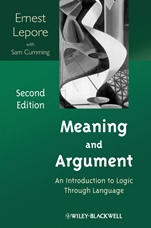
Meaning and Argument: An Introduction to Logic Through Language
ISBN 9781405196734
Autor: Ernest Lepore, Sam Cumming
Wydawca: Wiley
Dostępność: 3-6 tygodni
Cena: 186,90 zł
Przed złożeniem zamówienia prosimy o kontakt mailowy celem potwierdzenia ceny.
ISBN13: |
9781405196734 |
ISBN10: |
1405196734 |
Autor: |
Ernest Lepore, Sam Cumming |
Oprawa: |
Paperback |
Rok Wydania: |
2009-08-07 |
Numer Wydania: |
2nd Edition |
Ilość stron: |
448 |
Wymiary: |
226x155 |
Tematy: |
HPGL |
Meaning and Argument shifts introductory logic from the traditional emphasis on proofs to the symbolization of arguments. Another of its distinctive features is that it shows how the need for expressive power and for drawing distinctions forces formal language development. This volume is ideal as an introduction to formal logic, philosophical logic, and philosophy of language. At each stage of system elaboration and development, the book answers meta–logical questions. Why is a particular formalism needed? What must go into such a formalism and why? These questions engage students in a collective inquiry which allows them to see logical studies as a human enterprise aimed at achieving well–understood goals – clarity and good reasoning. This second edition extends and systematizes the account of anaphora, including “donkey” anaphora, plural anaphora, and cross–sentential anaphora. It also has additional sections on counter–models and semantics, and contains additional exercises and an updated bibliography.
Preface to Second Edition. Preface to Revised Edition. Acknowledgments. Introduction. 1. A Brief Introduction to Key Terms. 1.1 Arguments. 1.2 Putting Arguments into a Standard Format. 1.3 Multiple Conclusions. 1.4 Deductive Validity. 1.5 Soundness. 1.6 Missing Premises and Conclusions. 2. Argument Forms and Propositional Logic. 2.1 Formal Validity. 2.2 Quotation Marks. 2.3 Metalinguistic Variables. 2.4 Non–formal Validity. 2.5 The Need for Propositional Logic. 2.6 The Type/Token Distinction. 3. Conjunction. 3.1 Logical Conjunction. 3.2 Distinguishing Deductive from Non–deductive Aspects of Conjunction. 3.3 Phrasal Logical Conjunctions. 3.4 Series Decompounding. 3.5 Using ′Respectively′. 3.6 Symbolizing Logical Conjunctions. 4. Negation. 4.1 Logical Negation. 4.2 Some Other Negative Expressions. 4.3 A Point about Methodology. 4.4 A Point on Ambiguity. 4.5 Symbolizing Logical Negations. 4.6 Ambiguity and the Need for Groupers. 4.7 Review of Symbols. 4.8 Using ′Without′. 4.9 Argument Forms Continued. 4.10 Symbolizing Logical Negations Continued. 5. Truth Tables. 5.1 Well–formed Formulas. 5.2 Scope. 5.3 Main Connective. 5.4 Truth Tables. 6. Disjunction. 6.1 Logical Disjunction. 6.2 Disjunction and Negation. 6.3 Iterations and Groupers. 6.4 Inclusive versus Exclusive ′Or′. 6.5 Symbolizing Logical Disjunctions Continued. 7. Conditionals. 7.1 Conditionals with Constituent Statements. 7.2 Conditionals without Constituent Statements. 7.3 Logical Conditionals. 7.4 Symbolizing Conditionals in PL. 7.5 Necessary and Sufficient Conditions. 7.6 Only If. 7.7 Unless. 7.8 Since, Because. 7.9 Conditionals and Groupers. 7.10 If and Only If. 7.11 A Revised Grammar for Well–formedness in PL. 7.12 Summarizing Truth Tables. 8. Truth Trees. 8.1 Reviewing Validity. 8.2 Tree Trunks and Compound and Atomic Statements. 8.3 Truth Tree Rules. 8.4 Strategies. 8.5 Truth Trees and Invalidity. 8.6 Propositional Logic and Counter–examples (Counter–models). 8.7 Logical Properties and Relations Revisited. 9. Property Predicate Logic. 9.1 Limits of Propositional Logic. 9.2 Singular Terms. 9.3 Property Predicates. 9.4 Quantifiers. 9.5 Complex Predicates. 9.6 Well–formedness in PPL. 9.7 Quantifiers Modifying General Terms. 10. Evaluating Arguments in Property Predicate Logic. 10.1 Quantifiers and Scope. 10.2 The Truth Tree Method Extended. 10.3 Super Strategy. 10.4 Property Predicate Logic and Counter–examples (Counter–models). 10.5 PPL Logical Equivalences and Non–equivalences. 10.6 Other Logical Properties and Relations. 11. Property Predicate Logic Refinements. 11.1 Literal Meaning. 11.2 ‘Any’ as an Existential. 11.3 Restrictive Relative Clauses. 11.4 Pronouns Revisited. 11.5 Only. 11.6 Restrictive Words in English. 11.7 Evaluating Symbolizations of English in Logical Notation. 12. Relational Predicate Logic. 12.1 Limits of Property Predicate Logic. 12.2 Convention 1: Number. 12.3 Convention 2: Order. 12.4 Convention 3: Active/Passive Voice. 12.5 Convention 4: Single Quantifiers. 12.6 Variables. 13. Relational Predicate Logic with Nested Quantifiers. 13.1 Multiply General Statements. 13.2 Universal Quantifier Procedure. 13.3 Existential Quantifier Procedure. 13.4 Double Binding Variables. 13.5 Systematic and Analytic Procedures. 13.6 A Grammar for Well–formedness in RPL. 13.7 Nested Quantifiers, Variables, and Scope. 13.8 Order and Scope Refinements. 13.9 Summary of the Overall Procedure for Symbolizing English Statements with Nested Quantifiers into RPL. 14. Extending the Truth Tree Method to RPL. 14.1 RPL Arguments without Quantifiers. 14.2 RPL Arguments without Nested Quantifiers. 14.3 RPL Arguments with Nested Quantifiers. 14.4 Choosing Singular Terms to Instantiate. 14.5 Infinite Truth Trees for RPL Arguments. 14.6 Summary of Truth Tree Strategies. 14.7 Relational Predicate Logic and Counter–Examples (Counter–Models). 15. Negation, Only, and Restrictive Relative Clauses. 15.1 Negation. 15.2 ′Only′ as a Quantifier. 15.3 Restrictive Relative Clauses. 15.4 Quantifiers and Anaphora. 15.5 Anaphora and Restrictive Relative Clauses. 15.6 Anaphora across sentences. 15.7 Quantification in English. 16. Relational Predicate Logic with Identity. 16.1 Limits of Relational Predicate Logic. 16.2 Extending the Truth Tree Method to RPL. 16.3 Sameness and Distinctness in English. 16.4 Numerical Adjectives. 16.5 Definite Descriptions. 17. Verbs and their Modifiers. 17.1 Prepositional Phrases. 17.2 The Event Approach. 17.3 Indirect Support of the Event Approach. 17.4 Adverbial Modification. 17.5 Problems with the Event Approach. Appendix. A1 Conjunction. A2 Negation and Disjunction. A3 Conditionals. A4 Property Predicate Logic. A5 Relational Predicate Logic. A6 Relational Predicate Logic with Identity. A7 Verbs and their Modifiers. Answers for Selected Exercises. Logical Symbols. Index.
Ernest Lepore is the Associate Director of the Center for Cognitive Science at Rutgers University and is the author of numerous articles in philosophy of language. He is co–author (with Herman Cappelen) of Insensitive Semantics (Blackwell, 2004) and co–author (with Jerry Fodor) of Holism (Blackwell, 1991). He is editor of Truth and Interpretation (Blackwell, 1989), co–editor (with Zenon Pylyshyn) of What is Cognitive Science ? (Blackwell, 1999), and general editor of the series Philosophers and Their Critics , published by Wiley–Blackwell. Sam Cumming is Assistant Professor of Philosophy at the University of California, Los Angeles.
Koszyk
Książek w koszyku: 0 szt.
Wartość zakupów: 0,00 zł
Informacje


Kontakt
Gambit
Centrum Oprogramowania
i Szkoleń Sp. z o.o.
Al. Pokoju 29b/22-24
31-564 Kraków
Siedziba Księgarni
ul. Kordylewskiego 1
31-542 Kraków
+48 12 410 5991
+48 12 410 5987
+48 12 410 5989
Subskrypcje
Administratorem danych osobowych jest firma Gambit COiS Sp. z o.o. Na podany adres będzie wysyłany wyłącznie biuletyn informacyjny.
Autoryzacja płatności

Informacje na temat autoryzacji płatności poprzez PayU.

© Copyright 2012: GAMBIT COiS Sp. z o.o. Wszelkie prawa zastrzeżone.
Projekt i wykonanie: Alchemia Studio Reklamy