


Wydawcy
Katalog tematyczny
- Archeologia (109)
- Ekonomia, finanse, business (13704)
- Filozofia (1445)
- Historia (3040)
- Języki i językoznawstwo (2356)
- Lifestyle, hobby i rozrywka (475)
- Medycyna (9704)
- Nauki humanistyczne (4)
- Nauki o Ziemi i środowisku (2638)
- Geografia (299)
- Nauki o Ziemi (1661)
- Geologia (414)
- Hydrologia (237)
- Meteorologia i klimatologia (114)
- Paleontologia (33)
- Wulkanologia i sejsmologia (44)
- Planowanie przestrzenne (53)
- Środowisko (607)
- Nauki ścisłe (20412)
- Nauki społeczne (8486)
- Nauki techniczne (13450)
- Prawo (1696)
- Publikacje informacyjne i interdyscyplinarne (1288)
- Religia i wierzenia (917)
- Technika komputerowa (4067)
- Zdrowie, relacje międzyludzkie i rozwój osobisty (657)





Informacje szczegółowe o książce
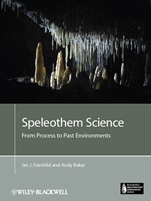
Speleothem Science: From Process to Past Environments
ISBN 9781405196208
Autor: Ian J. Fairchild, Andy Baker
Wydawca: Wiley
Dostępność: 3-6 tygodni
Cena: 408,45 zł
Przed złożeniem zamówienia prosimy o kontakt mailowy celem potwierdzenia ceny.
ISBN13: |
9781405196208 |
ISBN10: |
1405196203 |
Autor: |
Ian J. Fairchild, Andy Baker |
Oprawa: |
Hardback |
Rok Wydania: |
2012-04-10 |
Ilość stron: |
450 |
Wymiary: |
254x192 |
Tematy: |
RB |
Speleothems (mineral deposits that formed in caves) are currently giving us some of the most exciting insights into environments and climates during the Pleistocene ice ages and the subsequent Holocene rise of civilizations. The book applies system science to Quaternary environments in a new and rigorous way and gives holistic explanations the relations between the properties of speleothems and the climatic and cave setting in which they are found. It is designed as the ideal companion to someone embarking on speleothem research and, since the underlying science is very broad, it will also be invaluable to a wide variety of others. Students and professional scientists interested in carbonate rocks, karst hydrogeology, climatology, aqueous geochemistry, carbonate geochemistry and the calibration of climatic proxies will find up-to-date reviews of these topics here. The book will also be valuable to Quaternary scientists who, up to now, have lacked a thorough overview of these important archives.
Spis treści:
Preface, xi
Acknowledgements, xiii
I Scientifi c and geological context, 1
1 Introduction to speleothems and systems, 3
1.1 What is all the fuss about?, 3
1.2 How is this book organized?, 11
1.3 Concepts and approaches of system science, 13
1.4 The speleothem factory within the karst system, 18
2 Carbonate and karst cave geology, 28
2.1 Carbonates in the Earth system over geological time, 28
2.2 Lithologies of carbonate host rocks, 34
2.3 Carbonate diagenesis and eogenetic karst, 47
2.4 Speleogenesis in mesogenetic and telogenetic karst (with contributions from John Gunn and David J Lowe), 55
2.5 Cave infilling, 64
2.6 Conclusion, 71
3 Surface environments: climate, soil and vegetation, 73
3.1 The modern climate system, 73
3.2 Water isotopes in the atmosphere, 84
3.3 Soils of karst regions, 94
3.4 Vegetation of karst regions, 102
3.5 Synthesis: inputs to the incubator, 104
II Transfer processes in karst, 105
4 The speleothem incubator, 107
4.1 Introduction to speleophysiology, 107
4.2 Physical parameters and fl uid behaviour, 109
4.3 Water movement, 114
4.4 Air circulation, 122
4.5 Heat flux (authored by David Domínguez-Villar), 137
4.6 Synthesis: cave climatologies, 145
5 Inorganic water chemistry, 148
5.1 Sampling protocols for water chemistry, 148
5.2 The carbonate system, 152
5.3 Weathering, trace elements and isotopes, 156
5.4 Carbon isotopes, 173
5.5 Evolution of cave water chemistry: modelling sources and environmental signals, 180
6 Biogeochemistry of karstic environments, 187
6.1 Introduction, 187
6.2 Organic macromolecules, 188
6.3 Pollen and spores, 198
6.4 Cave faunal remains, 199
6.5 Synthesis and research gaps, 200
III Speleothem properties, 205
7 The architecture of speleothems, 207
7.1 Introduction, 207
7.2 Theoretical models of stalagmite growth and of stalagmite and stalactite shapes, 207
7.3 Geometrical classifi cation of speleothems, 213
7.4 Mineralogy and petrology, 223
7.5 Synthesis, 241
8 Geochemistry of speleothems, 245
8.1 Analysis and the sources of uncertainty, 245
8.2 The growth interface, 249
8.3 Trace element partitioning, 255
8.4 Oxygen and carbon isotope fractionation, 263
8.5 Evolution of dripwater and speleothem chemistry along water flowlines, 277
8.6 Process models of variability over time, 281
9 Dating of speleothems, 290
9.1 Introduction, 290
9.2 Dating techniques, 291
9.3 Age–distance models, 300
9.4 Conclusions, 301
IV Palaeoenvironments, 303
10 The instrumental era: calibration and validation of proxy-environment relationships, 305
10.1 Available instrumental and derived series, 306
10.2 Methodologies, 311
10.3 Case studies of calibrated speleothem proxies, 316
10.4 Questions raised and future directions, 323
11 The Holocene epoch: testing the climate and environmental proxies, 324
11.1 A brief overview of the Holocene, 325
11.2 The past millennium, 327
11.3 Holocene environmental changes: speleothem responses, 334
11.4 Questions raised and future directions, 351
12 The Pleistocene and beyond, 353
12.1 Pleistocene proxy records (ice-age climate fl uctuations defined and drawn), 353
12.2 Insights into pre-Quaternary palaeoenvironments, 361
12.3 Questions raised and looking to the future, 365
APPENDIX 1 Archiving speleothems and speleothem data, 368
References, 371
Index, 421
Koszyk
Książek w koszyku: 0 szt.
Wartość zakupów: 0,00 zł
Informacje


Kontakt
Gambit
Centrum Oprogramowania
i Szkoleń Sp. z o.o.
Al. Pokoju 29b/22-24
31-564 Kraków
Siedziba Księgarni
ul. Kordylewskiego 1
31-542 Kraków
+48 12 410 5991
+48 12 410 5987
+48 12 410 5989
Subskrypcje
Administratorem danych osobowych jest firma Gambit COiS Sp. z o.o. Na podany adres będzie wysyłany wyłącznie biuletyn informacyjny.
Autoryzacja płatności

Informacje na temat autoryzacji płatności poprzez PayU.

© Copyright 2012: GAMBIT COiS Sp. z o.o. Wszelkie prawa zastrzeżone.
Projekt i wykonanie: Alchemia Studio Reklamy