


Wydawcy
Katalog tematyczny
- Archeologia (109)
- Ekonomia, finanse, business (13704)
- Filozofia (1445)
- Historia (3040)
- Języki i językoznawstwo (2356)
- Lifestyle, hobby i rozrywka (475)
- Medycyna (9704)
- Nauki humanistyczne (4)
- Nauki o Ziemi i środowisku (2638)
- Geografia (299)
- Nauki o Ziemi (1661)
- Geologia (414)
- Hydrologia (237)
- Meteorologia i klimatologia (114)
- Paleontologia (33)
- Wulkanologia i sejsmologia (44)
- Planowanie przestrzenne (53)
- Środowisko (607)
- Nauki ścisłe (20412)
- Nauki społeczne (8486)
- Nauki techniczne (13450)
- Prawo (1696)
- Publikacje informacyjne i interdyscyplinarne (1288)
- Religia i wierzenia (917)
- Technika komputerowa (4067)
- Zdrowie, relacje międzyludzkie i rozwój osobisty (657)





Informacje szczegółowe o książce
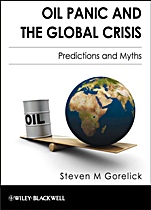
Oil Panic and the Global Crisis: Predictions and Myths
ISBN 9781405195485
Autor: Steven M. Gorelick
Wydawca: Wiley
Dostępność: 3-6 tygodni
Cena: 326,55 zł
Przed złożeniem zamówienia prosimy o kontakt mailowy celem potwierdzenia ceny.
ISBN13: |
9781405195485 |
ISBN10: |
1405195487 |
Autor: |
Steven M. Gorelick |
Oprawa: |
Hardback |
Rok Wydania: |
2009-11-06 |
Ilość stron: |
256 |
Wymiary: |
254x180 |
Tematy: |
RB |
Is the world running out of oil?" This book analyzes predictions of global oil depletion in the context of science, history, and economics. There has been continuing alarm about the imminent exhaustion of earth′s non–renewable resources. Yet, the world has never run out of any significant, globally traded, non–renewable resource. Is the world finally facing a non–renewable resource depletion catastrophe, or is the current concern just another one of a succession of panics? In this book, key assumptions underlying arguments in the global oil–depletion debate are first summarized and then challenged. Facts about oil supply, production, and consumption are made accessible using concise and simple graphics. Concepts of resource depletion, end–use needs, technology leap–frogging, efficiency, and substitution are used to evaluate historical patterns of exploitation of non–renewable resources and to explore what history suggests about our future dependence on oil. This book is aimed at a broad range of readers,from undergraduate students studying resource science and economics to anyone interested in understanding the context of the controversy over global oil depletion.
Spis treści:
Preface.
Acknowledgments.
About Units.
Getting Started: What Do You Think?
1 End of the Oil Era.
Cause for Concern.
Hubbert’s Curve.
The Appeal of Hubbert’s Curve.
Hubbert’s Success.
US Oil Dependence Since Peak Production.
Chapters Ahead.
Notes and References.
2 The Global Oil Landscape.
Introduction.
Definitions.
Petroleum Composition and Energy Density.
Why a Barrel Is a bbl.
The Oil Business.
OPEC.
How Much Oil Is There? The USGS Assessment.
From the USGS Assessment to 2009.
Reserves.
Where Is Oil Produced?
Where Is Oil Consumed?
Oil Imports.
After Oil Is Produced.
Oil Production Vers
us Consumption.
Oil Quality.
Oil Pricing by Quality.
Gasoline.
What Determines the Price of Gasoline at the Pump?
The Price of Gasoline.
Gasoline Price Elasticity: What Happens When the Price Goes Up (or Down)?
Gasoline Price Variability.
Points to Take Away.
Notes and References.
3 The Historical Resource Depletion Debate.
The Malthusian Doctrine.
The Limits to Growth.
The Oil Panics of 1916 and 1918.
Panic Revisited: The Oil Crisis of the 1970s.
Arguments Supporting Global Oil Depletion.
Declining Oil Production in Countries in Addition to That in the US.
Production Exceeds Discoveries.
Reserve and Endowment Estimates are Inflated.
Industry Exaggeration of Reserves.
Fewer Giant Fields Discovered and Production is Declining.
Decline in Discovery and Oil Drilling Suggests Onset of Production Decline.
Global Industrial Development and Oil Consumption.
The Price of Oil is Increasing: Does This Indicate Scarcity?
Forecasts Support a Decline in Global Production Using Extensions to Hubbert’s Approach.
Summary.
Notes and References.
4 Counter–Arguments to Imminent Global Oil Depletion.
Myth I: Hubbert’s Predicted Production Rates Were Accurate.
US Oil Production.
The Bell–Shaped Curve.
US Natural Gas Production.
Global Oil Production.
Myth II: A Decline in Production Necessarily Indicates Scarcity.
Commodity Scarcity.
Generalizing the Debate: Resource Economists versus Neo–Malthusians.
Back to Oil.
Scarcity Rent.
Myth III: Resource Assessments Provide Useful Endowment Estimates.
The Missing Mass Balance.
Counter–Argument to OPEC and Industry Exaggeration of Reserves.
Myth IV: After So Much Exploration, There Is Little Oil Left To Be Found.
US Oil: Reserves.
US Oil: Discoveries.
Global Oil: Reserves.
Global Oil: Discoveries.
Russian and Global Arctic Oil.
Myth V: The World Cannot Aff
ord Increases in Oil Use as Developing Nations Demand More Oil.
Future Demand of Developing Nations.
Oil Expenditures in the World Economy.
Myth VI: There Are No Substitutes for Oil.
The Gold Resource Pyramid.
The Oil Resource Pyramid.
The US and Global Oil Resource Pyramids.
Three Unconventional Oil Substitutes.
US heavy oil.
Global heavy oil.
US oil sands.
Global oil sands.
US oil shale.
Global oil shale.
Fossil Fuel Conversion: The Role of Gas and Coal.
The Importance of Diesel.
Synthetic Fuel from Coal and Natural Gas.
Natural Gas Resources.
Coal Resources.
Chapter Summary.
Notes and References.
5 Beyond Panic.
The Non–Renewable Resource Model.
Where Is an Effi ciency Gain Possible?
Will Increases in Effi ciency Indeed Reduce Demand?
Two scenarios for developing nations.
What Might Ultimately Substitute for Oil?
Consideration 1: Cost of dependence on imported oil.
Consideration 2: Gasoline and atmospheric carbon dioxide emissions.
Consideration 3: Alternatives.
Ethanol.
Biodiesel.
Leapfrogging to an ultimate substitute.
Effects of a US move to oil alternatives.
The State of Oil Resources.
Ending Thoughts.
Notes and References.
Index.
Nota biograficzna:
Steven M. Gorelick holds the Cyrus Fisher Tolman Professorship in the School of Earth Sciences at Stanford University, where he has been on the faculty for over 20 years. In 2005, he was named a Guggenheim Fellow for his study of global oil depletion. Professor Gorelick is a Fellow of both the American Geophysical Union and Geological Society of America, and he has been selected twice as a Fulbright Senior Scholar (1997 and 2008) for studies of water resources issues in Australia.
Okładka tylna:
Is the world running out of oil?" This book analyzes predictions of global oil depletion in the context of science, history, and economics. There
has been continuing alarm about the imminent exhaustion of earth′s non–renewable resources. Yet, the world has never run out of any significant, globally traded, non–renewable resource. Is the world finally facing a non–renewable resource depletion catastrophe, or is the current concern just another one of a succession of panics? In this book, key assumptions underlying arguments in the global oil–depletion debate are first summarized and then challenged. Facts about oil supply, production, and consumption are made accessible using concise and simple graphics. Concepts of resource depletion, end–use needs, technology leap–frogging, efficiency, and substitution are used to evaluate historical patterns of exploitation of non–renewable resources and to explore what history suggests about our future dependence on oil. This book is aimed at a broad range of readers,from undergraduate students studying resource science and economics to anyone interested in understanding the context of the controversy over global oil depletion.
Koszyk
Książek w koszyku: 0 szt.
Wartość zakupów: 0,00 zł
Informacje


Kontakt
Gambit
Centrum Oprogramowania
i Szkoleń Sp. z o.o.
Al. Pokoju 29b/22-24
31-564 Kraków
Siedziba Księgarni
ul. Kordylewskiego 1
31-542 Kraków
+48 12 410 5991
+48 12 410 5987
+48 12 410 5989
Subskrypcje
Administratorem danych osobowych jest firma Gambit COiS Sp. z o.o. Na podany adres będzie wysyłany wyłącznie biuletyn informacyjny.
Autoryzacja płatności

Informacje na temat autoryzacji płatności poprzez PayU.

© Copyright 2012: GAMBIT COiS Sp. z o.o. Wszelkie prawa zastrzeżone.
Projekt i wykonanie: Alchemia Studio Reklamy