


Wydawcy
Katalog tematyczny
- Archeologia (109)
- Ekonomia, finanse, business (13704)
- Filozofia (1445)
- Historia (3040)
- Języki i językoznawstwo (2356)
- Lifestyle, hobby i rozrywka (475)
- Medycyna (9704)
- Nauki humanistyczne (4)
- Nauki o Ziemi i środowisku (2638)
- Nauki ścisłe (20412)
- Nauki społeczne (8486)
- Nauki techniczne (13450)
- Prawo (1696)
- Publikacje informacyjne i interdyscyplinarne (1288)
- Religia i wierzenia (917)
- Technika komputerowa (4067)
- Zdrowie, relacje międzyludzkie i rozwój osobisty (657)





Informacje szczegółowe o książce
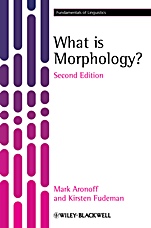
What is Morphology?
ISBN 9781405194679
Autor: Mark Aronoff, Kirsten Fudeman
Wydawca: Wiley
Dostępność: 3-6 tygodni
Cena: 184,80 zł
Przed złożeniem zamówienia prosimy o kontakt mailowy celem potwierdzenia ceny.
ISBN13: |
9781405194679 |
ISBN10: |
1405194677 |
Autor: |
Mark Aronoff, Kirsten Fudeman |
Oprawa: |
Paperback |
Rok Wydania: |
2010-11-05 |
Numer Wydania: |
2nd Edition |
Ilość stron: |
310 |
Wymiary: |
229x152 |
Tematy: |
CF |
Assuming only the most basic background in linguistics, What is Morphology? provides a concise, critical introduction to the central ideas and perennial problems of morphology. Designed to familiarize beginning students and specialists alike with the importance of morphology as a subject of research, this reader–friendly volume moves organically from the morphological “facts of everyday life” to important relationships with phonology, syntax, and semantics. This second edition builds on the previous one, expanding chapters on morphological productivity and the mental lexicon, and adding coverage of experimental and computational methods. Aronoff and Fudeman have revised and expanded the exercises and added suggestions for further reading to each chapter. Data from Kujamaat Joola, a West African language, is used throughout the book to explain and clarify new ideas presented. What is Morphology? equips readers with the skills to analyze a wealth of classic morphological issues through engaging narration and by direct example.
Preface. Acknowledgments. Abbreviations. Remarks on Transcription. The International Phonetic Alphabet. 1 Thinking about Morphology and Morphological Analysis. 1.1 What is Morphology? 1.2 Morphemes. 1.3 Morphology in Action. 1.4 Background and Beliefs. 1.5 Introduction to Morphological Analysis. 1.6 Summary. Introduction to Kujamaat Jóola. Further Reading. Exercises. 2 Words and Lexemes. 2.1 What is a Word? 2.2 Empirical Tests for Wordhood. 2.3 Types of Words. 2.4 Inflection vs. Derivation. 2.5 Two Approaches to Morphology: Item–and–Arrangement, Item–and–Process. 2.6 The Lexicon. 2.7 Summary. Kujamaat Jóola Noun Classes. Further Reading. Exercises. 3 Morphology and Phonology. 3.1 Allomorphs. 3.2 Prosodic Morphology. 3.3 Primary and Secondary Affixes. 3.4 Linguistic Exaptation, Leveling, and Analogy. 3.5 Morphophonology and Secret Languages. 3.6 Summary. Kujamaat Jóola Morphophonology. Further Reading. Exercises. 4 Derivation and the Lexicon. 4.1 The Saussurean Sign. 4.2 Motivation and Compositionality. 4.3 Derivation and Structure. 4.4 Summary. Derivation in Kujamaat Jóola. Further Reading. Exercises. 5 Derivation and Semantics. 5.1 The Polysemy Problem. 5.2 The Semantics of Derived Lexemes. 5.3 Summary. Derivation and Verbs in Kujamaat Jóola. Further Reading. Exercises. 6 Inflection. 6.1 What is Inflection? 6.2 Inflection vs. Derivation. 6.3 Inventory of Inflectional Morphology Types. 6.4 Syncretism. 6.5 Typology. 6.6 Summary. Agreement in Kujamaat Jóola. Further Reading. Exercises. 7 Morphology and Syntax. 7.1 Morphological vs. Syntactic Inflection. 7.2 Structural Constraints on Morphological Inflection. 7.3 Inflection and Universal Grammar. 7.4 Grammatical Function Change. 7.5 Summary. Kujamaat Jóola Verb Morphology. A Brief Survey of Kujamaat Jóola Syntax. Further Reading. Exercises. 8 Morphological Productivity and the Mental Lexicon. 8.1 What is Morphological Productivity? 8.2 Productivity and Structure: Negative Prefixes in English. 8.3 Degrees of Productivity. 8.4 Salience and Productivity. 8.5 Testing Productivity. 8.6 Conclusion. Further Reading. Exercises. Glossary. References. Index.
Mark Aronoff is Professor of Linguistics at Stony Brook University (SUNY). He is co–editor, with Janie Rees–Miller, of The Handbook of Linguistics (Wiley–Blackwell, 2001), and served as editor of the journal Language from 1995 to 2000. Kirsten Fudeman is Professor of French at the University of Pittsburgh. She is the author of Vernacular Voices: Language and Identity in Medieval French Jewish Communities (2010).
“This characteristic of the book particularly recommends it for teaching, as it is often the case that undergraduate students are reluctant to engage in argumentation and favor prescriptive contents. This book manages to lure the student into thinking and arguing rather than learning definitions.” ( Anglistik , 2 September 2012) "The intended audience is undergraduate students in linguistics but the text is accessible enough for a person from a general audience wanting to understand the basic concepts in morphological theory and practice in linguistics." (Linguist, 25 June 2011) “Aronoff and Fudeman have produced a clear and jargon–free introduction to contemporary morphological theory and practice. The book succeeds particularly in clarifying the empirical content, organizational principles and analytic techniques that distinguish morphology from other areas of linguistics.” — James P. Blevins , University of Cambridge
Koszyk
Książek w koszyku: 0 szt.
Wartość zakupów: 0,00 zł
Informacje


Kontakt
Gambit
Centrum Oprogramowania
i Szkoleń Sp. z o.o.
Al. Pokoju 29b/22-24
31-564 Kraków
Siedziba Księgarni
ul. Kordylewskiego 1
31-542 Kraków
+48 12 410 5991
+48 12 410 5987
+48 12 410 5989
Subskrypcje
Administratorem danych osobowych jest firma Gambit COiS Sp. z o.o. Na podany adres będzie wysyłany wyłącznie biuletyn informacyjny.
Autoryzacja płatności

Informacje na temat autoryzacji płatności poprzez PayU.

© Copyright 2012: GAMBIT COiS Sp. z o.o. Wszelkie prawa zastrzeżone.
Projekt i wykonanie: Alchemia Studio Reklamy