


Wydawcy
Katalog tematyczny
- Archeologia (109)
- Ekonomia, finanse, business (13704)
- Filozofia (1445)
- Historia (3040)
- Języki i językoznawstwo (2356)
- Lifestyle, hobby i rozrywka (475)
- Medycyna (9704)
- Nauki humanistyczne (4)
- Nauki o Ziemi i środowisku (2638)
- Nauki ścisłe (20412)
- Nauki społeczne (8486)
- Nauki techniczne (13450)
- Prawo (1696)
- Publikacje informacyjne i interdyscyplinarne (1288)
- Bibliotekoznawstwo, informacja naukowa i muzealnictwo (433)
- Encyklopedie i leksykony (181)
- Informacja naukowa (88)
- Zagadnienia interdyscyplinarne (391)
- Religia i wierzenia (917)
- Technika komputerowa (4067)
- Zdrowie, relacje międzyludzkie i rozwój osobisty (657)





Informacje szczegółowe o książce
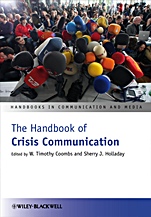
The Handbook of Crisis Communication
ISBN 9781405194419
Autor: W. Timothy Coombs, Sherry J. Holladay
Wydawca: Wiley
Dostępność: 3-6 tygodni
Cena: 887,25 zł
Przed złożeniem zamówienia prosimy o kontakt mailowy celem potwierdzenia ceny.
ISBN13: |
9781405194419 |
ISBN10: |
1405194413 |
Autor: |
W. Timothy Coombs, Sherry J. Holladay |
Oprawa: |
Hardback |
Rok Wydania: |
2009-12-11 |
Ilość stron: |
768 |
Wymiary: |
250x178 |
Tematy: |
GTS |
The Handbook of Crisis Communication is a comprehensive examination of the latest research and critical issues in crisis communication. Written as a tool for both researchers and communication managers, the Handbook includes a thorough discussion of the theory and method behind crisis communication, as well as the latest insight into practice in the field.
Incorporating the views and research of more than 50 top scholars, the book provides a starting point for developing crisis communication as a distinctive field research rather than as a sub–discipline of public relations or corporate communication. This cutting–edge collection includes in–depth analyses of well–known case studies in crisis communication, from terrorist attacks in London and Madrid to Hurricane Katrina. Going beyond traditional applications, the Handbook also explores the key emerging areas of new technology and global crisis communication.
Spis treści:
List of Contributors.
Preface.
Introduction: (Robert L. Heath, University of Houston).
Part I Crisis and Allied Fields.
1. Parameters for Crisis Communication: (W. Timothy Coombs, Eastern Illinois University).
2. Crisis Communication and Its Allied Fields: (W. Timothy Coombs, Eastern Illinois University).
3. Crisis Communication Research in Public Relations Journals: Tracking Research Trends Over Thirty Years (Seon–Kyoung An, University of Alabama and I–Huei Cheng, National Chengchi University).
Part II Methodological Variety.
Case Studies.
4. Organizational Networks in Disaster Response: An Examination of the US Government Network’s Efforts in Hurricane Katrina ( Gabriel L. Adkins, University of Oklahoma).
5. Regaining Altitude: A Case Analysis of the JetBlue Airways Valentine’s Day 2007 Crisis (Gregory G. Efthimiou, Duke Energy).
Textual Analysis.
6. The Press as Agent
of Cultural Repair: A Textual Analysis of News Coverage of the Virginia Tech Shootings (Mohamad H. Elmasry, University of Iowa and Vidhi Chaudhri, Purdue University).
Content Analysis.
7. Are They Practicing What We Are Preaching? An Investigation of Crisis Communication Strategies in the Media Coverage of Chemical Accidents (Sherry J. Holladay, Eastern Illinois University).
Experimental
8. Examining the Effects of Mutability and Framing on Perceptions of Human Error and Technical Error Crises : Implications for Situational Crisis Communication Theory (W. Timothy Coombs, Eastern Illinois University and Sherry J. Holladay, Eastern Illinois University).
9. How Do Past Crises Affect Publics’ Perceptions of Current Events? An Experiment Testing Corporate Reputation During an Adverse Event (J. Drew Elliot, Progress Energy).
10. Crisis Response Effectiveness: Methodological Considerations for Advancement in Empirical Investigation into Response Impact (Tomasz A. Fediuk, Illinois State University, Kristin M. Pace, Michigan State University, and Isabel C. Botero, Illinois State University).
Part III The Practice.
11. “We tell people. It’s up to them to be prepared.” Public Relations Practices of Local Emergency Managers (Robert Littlefield, Katherine Rowan, Shari R. Veil, Lorraine Kisselburgh, Kimberly Beauchamp, Kathleen Vidoloff, Marie L. Dick, Theresa Russell–Loretz, Induk Kim, Angelica Ruvarac, Quian Wang, Hyunyi Cho, Toni Siriko Hoang, Bonita Neff, Teri Toles–Patkin, Rod Troester, Shama Hyder, Steven Venette, and Timothy L. Sellnow, North Dakota State University).
12. Thirty Common Basic Elements of Crisis Management Plans :Guidelines for Handling the Acute Stage of “Hard” Emergencies at the Tactical Level (Alexander G. Nikolaev, Drexel University).
Part IV Specific Applications.
Organizational Contexts.
13. Oil Industry Crisis Communication (Michelle Maresh, Texas A&M Univers
ity–Corpus Christi and David E. Williams, Texas Tech University).
14. Educational Crisis Management Practices Tentatively Embrace the New Media (Barbara S. Gainey, Kennesaw State University).
15. FEMA and the Rhetoric of Redemption New Directions in Crisis Communication Models for Government Agencies (Elizabeth Johnson Avery, University of Tennessee and Ruthann W. Lariscy, University of Georgia).
Crisis Communication and Race.
16. Effective Public Relations in Racially Charged Crises: Not Black or White (Brooke Fisher Liu, University of Maryland).
17. Public Relations and Reputation Management in a Crisis Situation : How Denny’s Restaurants Reinvigorated the Firm’s Corporate Identity (Ali M. Kanso, University of Texas, Steven R. Levitt, University of Texas, and Richard Alan Nelson, Louisiana State University).
Part V Technology and Crisis Communication.
18. New Media for Crisis Communication: Opportunities for Technical Translation, Dialogue, and Stakeholder Responses (Keri K. Stephens, University of Texas and Patty Malone, California State University Fullerton).
19. Organizational and Media Use of Technology During Fraud Crises (Christopher Caldiero, Fairleigh Dickinson University, Maureen Taylor, University of Oklahoma, and Lia Ungureanu, Rutgers University).
20. Organizational Use of New Communication Technology in Product Recall Crises (Maureen Taylor, University of Oklahoma).
Part VI Global Crisis Communication.
21. Crisis Communication, Complexity, and the Cartoon Affair: A Case Study (Finn Frandsen, Åarhus University and Winni Johansen, Åarhus University).
22. Crisis Communication and Terrorist Attacks: Framing a Response to the 2004 Madrid Bombings and 2005 London Bombings (María José Canel, Madrid Complutense University and Karen Sanders, San Pablo University).
23. Negotiating Global Citizenship : Mattel’s 2007 Recall Crisis (Patricia A. Curtin, University of Oregon).
24.
Celebrating Expulsions? Crisis Communication in the Swedish Migration Board (Orla Vigsø, Örebro University).
Part VII Theory Development.
25. Crisis Communicators in Change: From Plans to Improvisations (Jesper Falkheimer, Lund University and Mats Heide, Lund University).
26. Contingency Theory of Strategic Conflict Management: Directions for the Practice of Crisis Communication from a Decade of Theory Development, Discovery, and Dialogue (Augustine Pang, Nanyang Technological University, Yan Jin, Virginia Commonwealth University, and Glen T. Cameron, University of Missouri–Columbia).
27. Crisis–Adaptive Public Information : A Model for Reliability in Chaos (Suzanne Horsley, University of Alabama).
28. Communicating Before a Crisis: An Exploration of Bolstering, CSR, and Inoculation Practices (Shelley Wigley, University of Texas and Michael Pfau (deceased).
29. Who Suffers? The Effect of Injured Party on Attributions of Crisis Responsibility (Sun–A Park and María E. Len–Ríos, University of Missouri–Columbia).
30. The Dialectics of Organizational Crisis Management (Charles Conrad, Texas A&M University, Jane Stuart Baker, Texas A&M University, Chris Cudahy, Texas A&M University, and Jennifer Willyard, Texas A&M University).
31. Exploring Crisis from a Receiver Perspective :Understanding Stakeholder Reactions During Crisis Events (Tomasz A. Fediuk, Illinois State University, W. Timothy Coombs, Eastern Illinois University, and Isabel C. Botero, Illinois State University).
32. Credibility Seeking through an Interorganizational Alliance : Instigating the Fen–Phen Confrontation Crisis (Timothy L. Sellnow, University of Kentucky, Shari R. Veil, University of Oklahoma, and Renae A. Streifel, (stay–at–home mother).
Part VIII Future Research Directions.
33. Future Directions of Crisis Communication Research : Emotions in Crisis – The Next
Frontier (Yan Jin, Virginia Commonwealth University and Augustine Pang, Nanyang Technological University).
34. Complexity and Crises: A New Paradigm (Dawn R. Gilpin, Arizona State University and Priscilla Murphy, Temple University).
35. Considering the Future of Crisis Communication Research: Understanding the Opportunities Inherent to Crisis Events through the Discourse of Renewal (Robert R. Ulmer, University of Arkansas, Timothy L. Sellnow, University of Kentucky, and Matthew W. Seeger, Wayne State University).
36. Toward a Holistic Organizational Approach to Understanding Crisis (Maureen Taylor, University of Oklahoma).
37. What is a Public Relations “Crisis”? Refocusing Crisis Research (Michael L. Kent, University of Oklahoma).
38. Crisis and Learning, Larsåke Larsson, Örebro University).
39. Pursuing Evidence–Based Crisis Communication (W. Timothy Coombs, Eastern Illinois University).
Afterword.
Name Index.
Subject Index.
Nota biograficzna:
W. Timothy Coombs is Professor of Corporate Communication at Eastern Illinois University, USA. He is the author of Code Red in the Boardroom (2006), and Today′s Public Relations (2006).
Sherry J. Holladay is Professor of Corporate Communication at Eastern Illinois University, USA. She is the author of numerous articles related to corporate communication.
Together, they have co–authored It′s Not Just PR (Wiley–Blackwell 2007), and PR Strategy and Application (Wiley–Blackwell 2010).
Okładka tylna:
The Handbook of Crisis Communication is a comprehensive examination of the latest research and critical issues in crisis communication. Written as a tool for both researchers and communication managers, the Handbook includes a thorough discussion of the theory and method behind crisis communication, as well as the latest insight into
practice in the field.
Incorporating the views and research of more than 50 top scholars, the book provides a starting point for developing crisis communication as a distinctive field research rather than as a sub–discipline of public relations or corporate communication. This cutting–edge collection includes in–depth analyses of well–known case studies in crisis communication, from terrorist attacks in London and Madrid to Hurricane Katrina. Going beyond traditional applications, the Handbook also explores the key emerging areas of new technology and global crisis communication.
Koszyk
Książek w koszyku: 0 szt.
Wartość zakupów: 0,00 zł
Informacje


Kontakt
Gambit
Centrum Oprogramowania
i Szkoleń Sp. z o.o.
Al. Pokoju 29b/22-24
31-564 Kraków
Siedziba Księgarni
ul. Kordylewskiego 1
31-542 Kraków
+48 12 410 5991
+48 12 410 5987
+48 12 410 5989
Subskrypcje
Administratorem danych osobowych jest firma Gambit COiS Sp. z o.o. Na podany adres będzie wysyłany wyłącznie biuletyn informacyjny.
Autoryzacja płatności

Informacje na temat autoryzacji płatności poprzez PayU.

© Copyright 2012: GAMBIT COiS Sp. z o.o. Wszelkie prawa zastrzeżone.
Projekt i wykonanie: Alchemia Studio Reklamy