


Wydawcy
Katalog tematyczny
- Archeologia (109)
- Ekonomia, finanse, business (13704)
- Filozofia (1445)
- Historia (3040)
- Języki i językoznawstwo (2356)
- Lifestyle, hobby i rozrywka (475)
- Medycyna (9704)
- Nauki humanistyczne (4)
- Nauki o Ziemi i środowisku (2638)
- Nauki ścisłe (20412)
- Nauki społeczne (8486)
- Nauki techniczne (13450)
- Prawo (1696)
- Publikacje informacyjne i interdyscyplinarne (1288)
- Religia i wierzenia (917)
- Technika komputerowa (4067)
- Zdrowie, relacje międzyludzkie i rozwój osobisty (657)





Informacje szczegółowe o książce
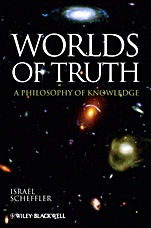
Worlds of Truth: A Philosophy of Knowledge
ISBN 9781405191708
Autor: Israel Scheffler
Wydawca: Wiley
Dostępność: 3-6 tygodni
Cena: 178,50 zł
Przed złożeniem zamówienia prosimy o kontakt mailowy celem potwierdzenia ceny.
ISBN13: |
9781405191708 |
ISBN10: |
1405191708 |
Autor: |
Israel Scheffler |
Oprawa: |
Hardback |
Rok Wydania: |
2009-03-27 |
Ilość stron: |
168 |
Wymiary: |
241x163 |
Tematy: |
HP |
Worlds of Truth: A Philosophy of Knowledge explicates and expands upon the formidable body of work by the author. Evincing a strong affinity for pragmatic philosophy as well as a dedication to analytical treatment of central problems, Israel Scheffler here provides an overview of his philosophy of knowledge, as developed in previous work and incorporating new views he has developed in recent thinking.
The inquiries here focus on truths: how truths are sought, what they express, and how they shape the worlds we inhabit. Consideration of these three topics highlights the interrelations of epistemology, symbolism, and metaphysics, all treated in a scientific spirit.
Scheffler s philosophy of knowledge incorporates several unfamiliar corollaries. Eschewing absolutism, the author nevertheless defends absolute truth; upholding systematic relativity, he also commends the ideal of objectivity; propounding his new doctrine of plurealism, he defends realism but rejects its usual concomitant monism, thus implying that we live not in one actual world but in many, all revealed by scientific investigation. Science itself, he holds, is not unitary in its motivation, but dual, spurred by two master impulses: the one to reduce, economize and systematize, the other to unsettle, explore and cultivate new areas for inquiry, an endless process belying the myth of a final theory of everything.
Preface viii
Acknowledgments x
Introduction 1
Part I: Inquiry 5
Chapter 1: Justification 7
1. Beliefs 7
2. Access to truth 8
3. Cogito ergo sum 9
4. Mathematical certainty 11
5. Classical logic 12
6. C. I. Lewis empiricism 14
7. Access as a metaphor 17
8. J. F. Fries and K. Popper 18
9. Voluntarism and linearity 19
10. One–way justification 20
11. Beginning in the middle 21
12. Justification, contextual and comparative 22
13. Justification in the empirical sciences 23
14. Circularity versus linearity 25
15. Democratic controls 25
16. Interactionism 27
Chapter 2: Truth 30
1. Allergy to absolute truth 31
2. Provisionality and truth 32
3. Truth versus verification 34
4. Truth and fixity 36
5. Transparency, Tarski, and Carnap 38
6. Truth and certainty 42
7. Sentences as truth candidates 44
8. Theoretical terms 44
9. Varieties of instrumentalism 45
10. Pragmatism and instrumentalism 45
11. Systems, simplicity, reduction 46
12. Crises in science 51
13. Reduction and expansion 52
Chapter 3: Worlds 55
1. Philosophies of truth 55
2. Operationism and truth 57
3. Version–dependence 59
4. Differences among scientifically oriented philosophers 61
5. Monism, pluralism, plurealism 62
6. Realism versus irrealism 66
7. A theory of everything 72
8. The status of ethics 75
9. Emotive theories; Ayer and Stevenson 75
10. Moore s ethical intuitionism 77
11. Dewey and ethical naturalism 79
12. Symbol, reference, and ritual 81
Part II: Related Pragmatic Themes 93
Chapter 4: Belief and Method 95
Introduction 95
1. Problems of pragmatism and pragmatic responses 98
2. Peirce s theory of belief, doubt, and inquiry 102
3. Peirce s comparison of methods 104
4. Difficulties in Peirce s treatment 106
5. An epistemological interpretation 108
6. The primacy of method 109
Chapter 5: Action and Commitment 114
Chapter 6: Emotion and Cognition 125
1. Emotions in the service of cognition 126
2. Cognitive emotions 132
Index 143
Israel Scheffler is Victor S. Thomas Professor of Education and Philosophy Emeritus at Harvard University and serves as Scholar–in–Residence at the Mandel Center at Brandeis University. He is a Fellow of the American Academy of Arts and Sciences, a founding member of the National Academy of Education and a past president of both the Philosophy of Science Association and the Charles S. Peirce Society. Among his various books are The Anatomy of Inquiry (1963), Science and Subjectivity (1967), Four Pragmatists (1974), Beyond the Letter (1979), and Symbolic Worlds: Art, Science, Language, Ritual (1997).
"The book will be of interest to philosophers working on pragmatism, pluralism, relativism, and justification". (International Studies In The Philosophy Of Science, 1 December 2010)
"This volume will be useful for specialists in pragmatism, but perhaps not sufficiently original for all collections." (CHOICE, October 2009)
Koszyk
Książek w koszyku: 0 szt.
Wartość zakupów: 0,00 zł
Informacje


Kontakt
Gambit
Centrum Oprogramowania
i Szkoleń Sp. z o.o.
Al. Pokoju 29b/22-24
31-564 Kraków
Siedziba Księgarni
ul. Kordylewskiego 1
31-542 Kraków
+48 12 410 5991
+48 12 410 5987
+48 12 410 5989
Subskrypcje
Administratorem danych osobowych jest firma Gambit COiS Sp. z o.o. Na podany adres będzie wysyłany wyłącznie biuletyn informacyjny.
Autoryzacja płatności

Informacje na temat autoryzacji płatności poprzez PayU.

© Copyright 2012: GAMBIT COiS Sp. z o.o. Wszelkie prawa zastrzeżone.
Projekt i wykonanie: Alchemia Studio Reklamy