


Wydawcy
Katalog tematyczny
- Archeologia (109)
- Ekonomia, finanse, business (13704)
- Filozofia (1445)
- Historia (3040)
- Języki i językoznawstwo (2356)
- Lifestyle, hobby i rozrywka (475)
- Medycyna (9704)
- Nauki humanistyczne (4)
- Nauki o Ziemi i środowisku (2638)
- Nauki ścisłe (20412)
- Nauki społeczne (8486)
- Edukacja (229)
- Kryminologia, opieka spełeczna (284)
- Obronność (10)
- Polityka (1389)
- Psychologia (777)
- Socjologia (410)
- Społeczeństwo i kultura (187)
- Nauki techniczne (13450)
- Prawo (1696)
- Publikacje informacyjne i interdyscyplinarne (1288)
- Religia i wierzenia (917)
- Technika komputerowa (4067)
- Zdrowie, relacje międzyludzkie i rozwój osobisty (657)





Informacje szczegółowe o książce
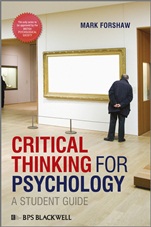
Critical Thinking For Psychology: A Student Guide
ISBN 9781405191173
Autor: Mark Forshaw
Wydawca: Wiley
Dostępność: 3-6 tygodni
Cena: 318,15 zł
Przed złożeniem zamówienia prosimy o kontakt mailowy celem potwierdzenia ceny.
ISBN13: |
9781405191173 |
ISBN10: |
1405191171 |
Autor: |
Mark Forshaw |
Oprawa: |
Paperback |
Rok Wydania: |
2012-04-03 |
Ilość stron: |
156 |
Wymiary: |
239x150 |
Tematy: |
JC |
There is a wealth of books on critical thinking, but very few of them apply specifically to psychology. Of those that do, these are beginning to seem dated, and in addition, it is my belief that the particular style of writing which I have demonstrated in my previous books (perhaps best described as relaxed, accessible and unpretentious) would be particularly apposite to tackle the subject of critical thinking, in the same way that I have aimed to lighten the learning of statistics.
Anecdotally, lecturers increasingly find themselves pointing out to students that they would gain better marks if they were more critical and analytical in their work. It seems that students are less prepared for this year on year, as the preparatory ‘A’ level system has focused less and less on critical thinking as applied to psychological theories and arguments. Students themselves, however, often complain that they are told to think and write more critically without really knowing what this means or entails.
The book could be sold to all undergraduate psychology students, especially those in their first two years, some ‘A’ level students, and possibly the lower end of postgraduates who still contest with feedback that they could better their work with more analysis. On the back of my first volume on student projects, and what I hope to be a successful second volume on psychological statistics, the impetus is there for this volume to achieve sales substantially over the minimum needed to pursue publication of the intended work with a view to more than a modest profit.
Spis treści:
Introduction.
What critical thinking is..
What lecturers expect from students and why. Interpreting feedback..
Constructing an argument..
Logical fallacies..
Arguing beyond the evidence: unreasonable extrapolation..
Errors of research: spotting design flaws. Fair and unfair criticism of research (for example, pointing out poorly meas
ured or operationalised variables versus standard criticisms such as claiming that ‘more’ participants equates to better research)..
The language of criticism; students often lack the vocabulary to make pertinent points or express their arguments properly. Here I will demonstrate common errors including non sequitur reasoning and incorrect application of ‘therefore’, ‘thus’, and other such terms..
Ethics, professional practice and conduct. How ethics committees show critical thinking, and how critical thinking pervades the life of a qualified psychologist..
Throughout, I hope to give examples of erroneous argument from genuine published work, and, unlike other books in the area, I will also supply examples from students’ writings which will illustrate common errors. This will include missed opportunities for critical thinking, good criticism and bad criticism.
Nota biograficzna:
Mark Forshaw is a Principal Lecturer in Psychology at Staffordshire University, having previously worked at Manchester University, Coventry University and Leeds Metropolitan University. He has been a guest lecturer for a number of years on MSc courses at the University of Surrey and at UCL, and is currently external examiner for MSc Health Psychology courses at University of Teesside and University of Surrey, and the D.Psych. in Health Psychology at City University. He is Chair of the BPS Division of Health Psychology Training Committee and Chief Supervisor and Registrar for the BPS Board of Assessors in Health Psychology. He also sits on the Registration Authority of the Science Council. His previous books are: Essential Health Psychology, Advanced Psychology: Health Psychology, Understanding Headaches and Migraines, Your Undergraduate Psychology Project: a BPS Guide, and Easy Statistics in Psychology: a BPS Guide. Health Psychology and Complementary Medicine (co–authored) is to be publish
ed in 2008.
Okładka tylna:
There is a wealth of books on critical thinking, but very few of them apply specifically to psychology. Of those that do, these are beginning to seem dated, and in addition, it is my belief that the particular style of writing which I have demonstrated in my previous books (perhaps best described as relaxed, accessible and unpretentious) would be particularly apposite to tackle the subject of critical thinking, in the same way that I have aimed to lighten the learning of statistics.
Anecdotally, lecturers increasingly find themselves pointing out to students that they would gain better marks if they were more critical and analytical in their work. It seems that students are less prepared for this year on year, as the preparatory ‘A’ level system has focused less and less on critical thinking as applied to psychological theories and arguments. Students themselves, however, often complain that they are told to think and write more critically without really knowing what this means or entails.
The book could be sold to all undergraduate psychology students, especially those in their first two years, some ‘A’ level students, and possibly the lower end of postgraduates who still contest with feedback that they could better their work with more analysis. On the back of my first volume on student projects, and what I hope to be a successful second volume on psychological statistics, the impetus is there for this volume to achieve sales substantially over the minimum needed to pursue publication of the intended work with a view to more than a modest profit.
Koszyk
Książek w koszyku: 0 szt.
Wartość zakupów: 0,00 zł
Informacje


Kontakt
Gambit
Centrum Oprogramowania
i Szkoleń Sp. z o.o.
Al. Pokoju 29b/22-24
31-564 Kraków
Siedziba Księgarni
ul. Kordylewskiego 1
31-542 Kraków
+48 12 410 5991
+48 12 410 5987
+48 12 410 5989
Subskrypcje
Administratorem danych osobowych jest firma Gambit COiS Sp. z o.o. Na podany adres będzie wysyłany wyłącznie biuletyn informacyjny.
Autoryzacja płatności

Informacje na temat autoryzacji płatności poprzez PayU.

© Copyright 2012: GAMBIT COiS Sp. z o.o. Wszelkie prawa zastrzeżone.
Projekt i wykonanie: Alchemia Studio Reklamy