


Wydawcy
Katalog tematyczny
- Archeologia (109)
- Ekonomia, finanse, business (13704)
- Filozofia (1445)
- Historia (3040)
- Języki i językoznawstwo (2356)
- Lifestyle, hobby i rozrywka (475)
- Medycyna (9704)
- Nauki humanistyczne (4)
- Nauki o Ziemi i środowisku (2638)
- Nauki ścisłe (20412)
- Nauki społeczne (8486)
- Nauki techniczne (13450)
- Prawo (1696)
- Publikacje informacyjne i interdyscyplinarne (1288)
- Religia i wierzenia (917)
- Technika komputerowa (4067)
- Zdrowie, relacje międzyludzkie i rozwój osobisty (657)





Informacje szczegółowe o książce
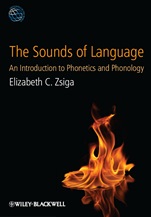
The Sounds of Language: An Introduction to Phonetics and Phonology
ISBN 9781405191036
Autor: Elizabeth C. Zsiga
Wydawca: Wiley
Dostępność: 3-6 tygodni
Cena: 195,30 zł
Przed złożeniem zamówienia prosimy o kontakt mailowy celem potwierdzenia ceny.
ISBN13: |
9781405191036 |
ISBN10: |
1405191031 |
Autor: |
Elizabeth C. Zsiga |
Oprawa: |
Paperback |
Rok Wydania: |
2013-01-11 |
Ilość stron: |
492 |
Wymiary: |
243x192 |
Tematy: |
CF |
The Sounds of Language is an introductory guide to the linguistic study of speech sounds, giving equal weight to both phonology and phonetics. Integrating these two disciplines allows students to appreciate the relationship of phonology and phonetics to each other, and to identify areas of overlap and mutual concern. Theoretically grounded, the book explores the range of data that any theory must account for, and discusses important concepts and constructs that emerge from the data, such as the interacting roles of biology and cognition in creating sound inventories, perception as distinct from hearing, contrast, alternation, and markedness. Zsiga presents a critical overview of different approaches that have been used in tackling these issues, with opportunities for students to practice data analysis and hypothesis testing. Data on sociolinguistic variation, first language acquisition, and second language learning are integrated throughout the text, along with valuable exercises, problem sets, and online data and sound files.
Preface xv 1 The Vocal Tract 1 1.1 Seeing the vocal tract: tools for speech research 2 1.2 Parts of the vocal tract 5 1.2.1 The sub–laryngeal vocal tract 5 1.2.2 The larynx 7 1.2.3 The supra–laryngeal vocal tract 9 Chapter summary 11 Further reading 11 Review exercises 12 Further analysis and discussion 13 Go online 13 References 13 2 Basics of Articulation: Manner and Place in English 14 2.1 The dance of the articulators 15 2.2 Phonetic transcription 16 2.3 The building blocks of speech 20 2.3.1 Airstream, larynx, and velum 20 2.3.2 Manner of articulation 21 2.3.3 Place of articulation for consonants 24 2.3.4 Vowels 26 Chapter summary 29 Further reading 29 Review exercises 30 Further analysis and discussion 32 Go online 32 3 A Tour of the Consonants 33 3.1 Exotic sounds and the phonetic environment 34 3.2 Pulmonic consonants 37 3.2.1 Stops, nasals, and fricatives 37 3.2.2 Laterals, trills, taps, and other approximants 42 3.2.3 Contour and complex segments 44 3.3 Non–pulmonic consonants 45 3.3.1 Implosives 45 3.3.2 Ejectives 46 3.3.3 Clicks 47 3.4 Positional variation in English 48 3.4.1 Change in laryngeal configuration 48 3.4.2 Change in place 49 3.4.3 Change in manner 50 3.4.4 Other changes 50 Chapter summary 51 Further reading 52 Review exercises 52 Further analysis and discussion 53 Go online 54 References 54 4 A Map of the Vowels 55 4.1 The landscape 56 4.2 Cardinal vowels 57 4.3 Building inventories: dimensions of vowel quality 59 4.3.1 Height and backness 59 4.3.2 Tense/lax 59 4.3.3 Rounding 61 4.3.4 Central vowels 62 4.3.5 Contrasts among the low vowels 64 4.4 Nasality and voice quality 66 4.5 Length and diphthongs 67 4.6 Tone 68 4.7 Positional variants of the vowels of English 70 Chapter summary 71 Further reading 71 Review exercises 72 Further analysis and discussion 73 Further research 74 References 74 5 Anatomy, Physiology, and Gestural Coordination 76 5.1 Anatomy and physiology of respiration 77 5.2 Anatomy and physiology of the larynx 79 5.3 Anatomy of the supralaryngeal vocal tract 85 5.3.1 The jaw 85 5.3.2 The tongue 86 5.3.3 The pharynx and velum 88 5.3.4 The lips 88 5.4 Coordination of gestures 89 5.5 Palatography 91 Chapter summary 94 Further reading 95 Review exercises 96 Further analysis and discussion 97 Go online 98 6 The Physics of Sound: Pendulums, Pebbles, and Waves 99 6.1 What is sound? 100 6.2 Simple harmonic motion: a pendulum and a tuning fork 102 6.3 Adding sinuosoids: complex waves 105 6.4 Sound propagation 108 6.5 Decibels 110 6.6 Resonance 111 6.7 The vocal tract as a sound–producing device: source–filter theory 114 Chapter summary 116 Further reading 116 Review exercises 117 Further analysis and discussion 118 Go online 118 7 Looking at Speech: Waveforms, Spectra, and Spectrograms 119 7.1 Pre–digital speech 120 7.2 Digitization 122 7.2.1 Sampling 122 7.2.2 Quantization 125 7.2.3 Digital recording 126 7.3 Looking at waveforms 129 7.4 Spectra 131 7.4.1 Spectrum of the glottal source 131 7.4.2 Spectrum of a noise source 134 7.4.3 Spectra of vowels 135 7.5 Spectrograms 137 Chapter summary 142 Further reading 143 Review exercises 144 Further analysis and discussion 144 Go online 148 References 148 8 Speech Analysis: Under the Hood 149 8.1 Building sounds up 150 8.1.1 Sinusoids as circular motion 150 8.1.2 Harmonics: standing waves in a string 153 8.1.3 Formants: resonances of a tube of air 156 8.1.4 Calculating resonances for other vocal tract configurations 159 8.2 Breaking sounds down 160 8.2.1 RMS amplitude 161 8.2.2 Autocorrelation pitch analysis 161 8.2.3 Fourier analysis 165 8.2.4 Linear predictive coding 167 Chapter summary 169 Further reading 170 Review exercises 170 Further analysis and discussion 171 Go online 172 References 172 9 Hearing and Speech Perception 173 9.1 Anatomy and physiology of the ear 174 9.2 Neuro–anatomy 181 9.2.1 Studying the brain 181 9.2.2 Primary auditory pathways 183 9.3 Speech perception 186 9.3.1 Non–linearity 186 9.3.2 Variability and invariance 187 9.3.3 Cue integration 190 9.3.4 Top–down processing 192 9.3.5 Units of perception 192 Chapter summary 194 Further reading 195 Review exercises 195 Further analysis and discussion 196 Go online 197 References 197 10 Phonology 1: Abstraction, Contrast, Predictability 198 10.1 The necessity of abstraction 199 10.2 Contrast and predictability: phonemes and allophones 203 10.2.1 Defining the phoneme 203 10.2.2 Phonemic analysis 207 10.3 Some complicating factors 211 10.3.1 Is one allophone always basic? 211 10.3.2 Phonetic similarity and complementary distribution 212 10.3.3 Free variation 213 10.3.4 Positional neutralization 214 10.4 Biuniqueness, Behaviorism, and the decline of phonemic analysis 214 Chapter summary 216 Further reading 216 Review exercises 216 Further analysis and discussion 217 Further research 219 Go online 219 References 219 11 Phonotactics and Alternations 221 11.1 Phonotactic constraints 222 11.1.1 Actual words and possible words 222 11.1.2 Absolute and statistical generalizations 223 11.1.3 Borrowings 224 11.2 Analyzing alternations 225 11.3 Alternations: what to expect 232 11.3.1 Local assimilation 232 11.3.2 Long–distance assimilation 236 11.3.3 Coalescence 238 11.3.4 Dissimilation 238 11.3.5 Lenition and fortition 240 11.3.6 Epenthesis 241 11.3.7 Deletion 243 11.3.8 Lengthening and shortening 244 11.3.9 Metathesis 244 11.3.10 Morphological interactions 245 Chapter summary 246 Further reading 246 Review exercises 246 Further analysis and discussion 248 Go online 250 References 250 12 What Is Possible Language?: Distinctive Features 253 12.1 Introduction 254 12.1.1 Phonological universals 254 12.1.2 Why bother with formalism? 255 12.1.3 Some hypotheses 256 12.2 Distinctive features 257 12.2.1 Background 257 12.2.2 Major class and manner features 258 12.2.3 Laryngeal features 262 12.2.4 Major place features 262 12.2.5 Subsidiary place distinctions 265 12.2.6 Features for vowels 267 12.3 How have our hypotheses fared? 270 Chapter summary 271 Further reading 272 Review exercises 272 Further analysis and discussion 272 Further research 274 Go online 274 References 274 13 Rules and Derivations in Generative Grammar 275 13.1 Generative grammars 276 13.2 Underlying representations 277 13.3 Writing rules 279 13.3.1 SPE notation 279 13.3.2 Derivations 280 13.3.3 Rule complexity 281 13.4 Autosegmental representations and feature geometry 284 13.4.1 Autosegmental representations for tone 284 13.4.2 Autosegmental representations for other features 289 13.4.3 Feature geometry 293 13.5 How have our hypotheses fared? 298 Chapter summary 299 Further reading 299 Review exercises 300 Further analysis and discussion 300 Further research 303 Go online 303 References 303 14 Constraint–based Phonology 304 14.1 Constraints and rules in linguistic theory 305 14.2 The basics of Optimality Theory 309 14.2.1 Con 309 14.2.2 Gen 312 14.2.3 Eval 312 14.3 Example problem solving in OT 314 14.3.1 Vowel sequences in three languages 314 14.3.2 Nasal place assimilation 316 14.3.3 Japanese /tu/ 319 14.4 Challenges and directions for future research 322 Chapter summary 324 Further reading 325 Review exercises 325 Further analysis and discussion 325 Further research 329 Go online 329 References 329 15 Syllables and Prosodic Domains 330 15.1 Syllables 331 15.1.1 Does phonology need syllables? 331 15.1.2 Syllables and sonority 333 15.1.3 Syllable structure constraints 1: onsets and codas 335 15.1.4 Syllables structure constraints 2: moras and syllable weight 339 15.2 The prosodic hierarchy 341 15.5.1 The phonological word 342 15.2.2 The phonological phrase 346 Chapter summary 348 Further reading 348 Review exercises 349 Further analysis and discussion 350 Further research 000 References 351 16 Stress 353 16.1 What is linguistic stress? 354 16.2 Cross–linguistic typology 356 16.3 A feature for stress? 360 16.4 Metrical structure 360 16.5 Stress in English 365 16.5.1 Overview 365 16.5.2 Nouns 366 16.5.3 Verbs and adjectives 367 16.5.4 Affixes and lexical phonology 368 Chapter summary 370 Further reading 371 Review exercises 371 Further analysis and discussion 372 Further research 374 Go online 374 References 374 17 Tone and Intonation 375 17.1 Tone 376 17.1.1 Tone contrasts 376 17.1.2 Tonal representations 380 17.1.3 Tone alternations: the evidence from Africa and the Americas 383 17.1.4 Tone alternations: the evidence from Asia 388 17.2 Intonation 392 17.2.1 What is intonation? 392 17.2.2 Intonational representations 393 Chapter summary 397 Further reading 397 Review exercises 398 Further analysis and discussion 399 Further research 399 Go online 400 References 400 18 Diachronic Change 401 18.1 Languages change 402 18.1.1 English in the last millennium 402 18.1.2 Types of sound change 405 18.1.3 Causes and effects 407 18.2 Historical reconstruction 408 18.2.1 Proto–Indo–European 408 18.2.2 Grimm’s Law, Verner’s Law and the Neo–grammarian hypothesis 411 18.2.3 Limits to the tree model 414 18.3 History of the sounds of English 415 18.3.1 Old English 415 18.3.2 Middle English 417 18.3.3 Modern English 419 Chapter summary 422 Further reading 422 Review exercises 423 Further analysis and discussion 423 Further research 423 Go online 425 References 425 19 Variation 426 19.1 Variation by place 428 19.1.1 What is a dialect? 428 19.1.2 Dialects of North American English 429 19.1.3 Dialects of British English 433 19.1.4 Australia, New Zealand, South Africa 434 19.1.5 World Englishes 435 19.1.6 Place and identity 437 19.2 Other sources of variation 437 19.2.1 Register 437 19.2.2 Socio–economic distinctions 438 19.2.3 Ethnicity 439 19.2.4 Gender, age, sexuality 440 19.2.5 Variation and identity 441 19.3 Formalizing variation 441 19.3.1 Traditional sociolinguistic analyses 442 19.3.2 Traditional phonological analyses 443 19.3.3 Stochastic grammars 443 Chapter summary 444 Further reading 445 Review exercises 445 Further analysis and discussion 446 Further research 446 Go online 446 References 446 20 Acquisition and Learning 447 20.1 Language Acquisition and Language Learning 448 20.2 Child language acquisition: the data 448 20.2.1 Tools 448 20.2.2 Perception in the first year 449 20.2.3 Child language production 452 20.3 Theories of L1 acquisition 454 20.3.1 Innateness vs. environmental effects 454 20.3.2 Acquiring language–specific contrasts 455 20.4 L2 Learning 457 20.4.1 Tools 457 20.4.2 L2 perception 458 20.4.3 L2 production 459 20.5 Acquisition, Learning, and Linguistic Theory 461 Chapter summary 462 Further reading 462 Review exercises 462 Further analysis and discussion 464 Further research 464 Go online 464 References 464 Index 465
Elizabeth C. Zsiga is Professor in the Department of Linguistics at Georgetown University, where she has been a faculty member since 1994, teaching phonology and phonetics to both graduate and undergraduate students, with concentrations in theoretical, applied, and socio–linguistics. She has been published in numerous linguistics journals and books. Her research describes the sound systems of diverse languages including English, Igbo, Korean, Russian, Setswana, Serbian, and Thai.
Koszyk
Książek w koszyku: 0 szt.
Wartość zakupów: 0,00 zł
Informacje


Kontakt
Gambit
Centrum Oprogramowania
i Szkoleń Sp. z o.o.
Al. Pokoju 29b/22-24
31-564 Kraków
Siedziba Księgarni
ul. Kordylewskiego 1
31-542 Kraków
+48 12 410 5991
+48 12 410 5987
+48 12 410 5989
Subskrypcje
Administratorem danych osobowych jest firma Gambit COiS Sp. z o.o. Na podany adres będzie wysyłany wyłącznie biuletyn informacyjny.
Autoryzacja płatności

Informacje na temat autoryzacji płatności poprzez PayU.

© Copyright 2012: GAMBIT COiS Sp. z o.o. Wszelkie prawa zastrzeżone.
Projekt i wykonanie: Alchemia Studio Reklamy