


Wydawcy
Katalog tematyczny
- Archeologia (109)
- Ekonomia, finanse, business (13704)
- Filozofia (1445)
- Historia (3040)
- Języki i językoznawstwo (2356)
- Lifestyle, hobby i rozrywka (475)
- Medycyna (9704)
- Nauki humanistyczne (4)
- Nauki o Ziemi i środowisku (2638)
- Nauki ścisłe (20412)
- Nauki społeczne (8486)
- Nauki techniczne (13450)
- Prawo (1696)
- Publikacje informacyjne i interdyscyplinarne (1288)
- Religia i wierzenia (917)
- Technika komputerowa (4067)
- Zdrowie, relacje międzyludzkie i rozwój osobisty (657)





Informacje szczegółowe o książce
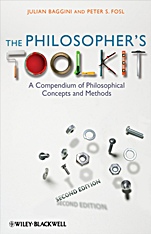
The Philosophers Toolkit: A Compendium of Philosophical Concepts and Methods
ISBN 9781405190183
Autor: Julian Baggini, Peter S. Fosl
Wydawca: Wiley
Dostępność: 3-6 tygodni
Cena: 124,95 zł
Przed złożeniem zamówienia prosimy o kontakt mailowy celem potwierdzenia ceny.
ISBN13: |
9781405190183 |
ISBN10: |
1405190183 |
Autor: |
Julian Baggini, Peter S. Fosl |
Oprawa: |
Paperback |
Rok Wydania: |
2010-04-09 |
Numer Wydania: |
2nd Edition |
Ilość stron: |
300 |
Wymiary: |
226x155 |
Tematy: |
HP |
Building a solid intellectual foundation is crucial if one wishes to engage effectively in the practice of philosophy. This second edition of The Philosopher′s Toolkit provides readers with the essential tools –– the intellectual equipment – necessary for participating in thoughtful philosophical argument, reading and reflection. The book begins with the basics of philosophical argumentation before moving on to address the important tools for assessment and criticism, the limits of argumentation and some of the radical critiques of standard philosophical methodology. Written in a highly accessible style, the entries are brought to life through the inclusion of vivid and colourful examples. For the second edition, many of the volume’s original 87 entries have been enhanced, extended and updated, an entirely new chapter has been added on methods drawn from the history of philosophy, and the suggestions for further reading have been expanded. This ingenious compendium of the methodologies and techniques of philosophy can be put to effective use in a variety of ways – as an introduction to the essentials of philosophical reflection, a comprehensive course on philosophical method or a quick reference for clear and concise accounts of key philosophical concepts and methods.
Preface. Acknowledgements. 1. Basic Tools for Argument. 1.1 Arguments, premises and conclusions. 1.2 Deduction. 1.3 Induction. 1.4 Validity and soundness. 1.5 Invalidity. 1.6 Consistency. 1.7 Fallacies. 1.8 Refutation. 1.9 Axioms. 1.10 Definitions. 1.11 Certainty and probability. 1.12 Tautologies, self–contradictions and the law of non–contradiction. 2. More Advanced Tools. 2.1 Abduction. 2.2 Hypothetico–deductive method. 2.3 Dialectic. 2.4 Analogies. 2.5 Anomalies and exceptions that prove the rule. 2.6 Intuition pumps. 2.7 Logical constructions. 2.8 Reduction. 2.9 Thought experiments. 2.10 Useful fictions. 3. Tools for Assessment. 3.1 Alternative explanations. 3.2 Ambiguity. 3.3 Bivalence and the excluded middle. 3.4 Category mistakes. 3.5 Ceteris paribus . 3.6 Circularity. 3.7 Conceptual incoherence. 3.8 Counterexamples. 3.9 Criteria. 3.10 Error theory. 3.11 False dichotomy. 3.12 False cause. 3.13 Genetic fallacy. 3.14 Horned dilemmas. 3.15 Is/ought gap. 3.16 Masked man fallacy. 3.17 Partners in guilt. 3.18 Principle of charity. 3.19 Question–begging. 3.20 Reductios. 3.21 Redundancy. 3.22 Regresses. 3.23 Saving the phenomena. 3.24 Self–defeating arguments. 3.25 Sufficient reason. 3.26 Testability. 4. Tools for Conceptual Distinctions. 4.1 A priori / a posteriori . 4.2 Absolute/relative. 4.3 Analytic/synthetic 4.4 Categorical/modal. 4.5 Conditional/biconditional. 4.6 De re/de dicto . 4.7 Defeasible/indefeasible. 4.8 Entailment/implication. 4.9 Essence/accident. 4.10 Internalism/externalism. 4.11 Knowledge by acquaintance/description. 4.12 Necessary/contingent. 4.13 Necessary/sufficient. 4.14 Objective/subjective. 4.15 Realist/non–realist. 4.16 Sense/reference. 4.17 Syntax/semantics. 4.18 Thick/thin concepts. 4.19 Types/tokens. 5. Tools of Historical Schools and Philosophers. 5.1 Aphorism, fragment, remark. 5.2 Categories and specific differences. 5.3 Elenchus and aporia . 5.4 Hume′s fork. 5.5 Indirect discourse. 5.6 Leibniz′s law of identity. 5.7 Ockham′s razor. 5.8 Phenomenological method(s). 5.9 Signs and signifiers. 5.10 Transcendental argument. 6. Tools for Radical Critique. 6.1 Class critique. 6.2 Deconstruction and the critique of presence. 6.3 Empiricist critique of metaphysics. 6.4 Feminist critique. 6.5 Foucaultian critique of power. 6.6 Heideggerian critique of metaphysics. 6.7 Lacanian critique. 6.8 Critiques of naturalism. 6.9 Nietzschean critique of Christian–Platonic culture. 6.10 Pragmatist critique. 6.11 Sartrean critique of ′bad faith′. 7. Tools at the Limit. 7.1 Basic beliefs. 7.2 Gödel and incompleteness. 7.3 Philosophy and/as art. 7.4 Mystical experience and revelation. 7.5 Paradoxes. 7.6 Possibility and impossibility. 7.7 Primitives. 7.8 Self–evident truths. 7.9 Scepticism. 7.10 Underdetermination. Internet Resources for Philosophers. Index.
Julian Baggini (www.julianbaggini.com) is a freelance writer and co–founding editor of The Philosophers’ Magazine . Peter S. Fosl is Professor of Philosophy at Transylvania University in Lexington, Kentucky.
" The Philosopher′s Toolkit is a very good book. It could be highly useful for both introductory courses in philosophy, or philosophical methodology, as well as independent study for anyone interested in the methods of argument, assessment and criticism used in contemporary analytic philosophy. It is unique in approach, and written in a pleasant and considerate tone. Its authors are both competent philosophers, and the book visibly reflects their deep sympathy to the discipline and their appreciation of its unique character. This book will help one to get going to do philosophy, but more advanced students might find this text helpful too. I wish I had had access to this book as an undergraduate." ( Teaching Philosophy ) "This book is ... an encyclopedia of philosophy. It should be of great use as a quick and accurate reference guide to the skill of philosophy, especially for beginners, but also for instructors ... highly recommended." ( Choice ) "Its choice of tools for basic argument ... is sound, while further tools for argument ... move through topics and examples concisely and wittily... Sources are well chosen and indicated step by step. Sections are cross–referenced (making it better than the Teach Youself "100 philosophical concepts") and supported by a useful index." ( Reference Reviews ) "...the average person who is interested in arguments and logic but who doesn′t have much background in philosophy would certainly find this book useful, as would anyone teaching a course on arguments, logic, and reasoning. Even introductory courses on philosophy in general might benefit because the book lays out so many of the conceptual "tools" which will prove necessary over students′ careers." ( About.com )
Koszyk
Książek w koszyku: 0 szt.
Wartość zakupów: 0,00 zł
Informacje


Kontakt
Gambit
Centrum Oprogramowania
i Szkoleń Sp. z o.o.
Al. Pokoju 29b/22-24
31-564 Kraków
Siedziba Księgarni
ul. Kordylewskiego 1
31-542 Kraków
+48 12 410 5991
+48 12 410 5987
+48 12 410 5989
Subskrypcje
Administratorem danych osobowych jest firma Gambit COiS Sp. z o.o. Na podany adres będzie wysyłany wyłącznie biuletyn informacyjny.
Autoryzacja płatności

Informacje na temat autoryzacji płatności poprzez PayU.

© Copyright 2012: GAMBIT COiS Sp. z o.o. Wszelkie prawa zastrzeżone.
Projekt i wykonanie: Alchemia Studio Reklamy