


Wydawcy
Katalog tematyczny
- Archeologia (109)
- Ekonomia, finanse, business (13704)
- Filozofia (1445)
- Historia (3040)
- Języki i językoznawstwo (2356)
- Lifestyle, hobby i rozrywka (475)
- Medycyna (9704)
- Nauki humanistyczne (4)
- Nauki o Ziemi i środowisku (2638)
- Geografia (299)
- Nauki o Ziemi (1661)
- Geologia (414)
- Hydrologia (237)
- Meteorologia i klimatologia (114)
- Paleontologia (33)
- Wulkanologia i sejsmologia (44)
- Planowanie przestrzenne (53)
- Środowisko (607)
- Nauki ścisłe (20412)
- Nauki społeczne (8486)
- Nauki techniczne (13450)
- Prawo (1696)
- Publikacje informacyjne i interdyscyplinarne (1288)
- Religia i wierzenia (917)
- Technika komputerowa (4067)
- Zdrowie, relacje międzyludzkie i rozwój osobisty (657)





Informacje szczegółowe o książce
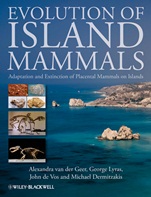
Evolution of Island Mammals: Adaptation and Extinction of Placental Mammals on Islands
ISBN 9781405190091
Autor: Alexandra van der Geer, George Lyras, John de Vos, Michael Dermitzakis
Wydawca: Wiley
Dostępność: 3-6 tygodni
Cena: 436,80 zł
Przed złożeniem zamówienia prosimy o kontakt mailowy celem potwierdzenia ceny.
ISBN13: |
9781405190091 |
ISBN10: |
1405190094 |
Autor: |
Alexandra van der Geer, George Lyras, John de Vos, Michael Dermitzakis |
Oprawa: |
Hardback |
Rok Wydania: |
2010-08-13 |
Ilość stron: |
496 |
Wymiary: |
246x182 |
Tematy: |
RB |
Evolution on islands differs in a number of important ways from evolution on mainland areas. Over millions of years of isolation, exceptional and sometimes bizarre mammals evolved on islands, such as pig–sized elephants and hippos, giant rats and gorilla–sized lemurs that would have been formidable to their mainland ancestors.
This timely and innovative book is the first to offer a much–needed synthesis of recent advances in the exciting field of the evolution and extinction of fossil insular placental mammals. It provides a comprehensive overview of current knowledge on fossil island mammals worldwide, ranging from the Oligocene to the onset of the Holocene.
The book addresses evolutionary processes and key aspects of insular mammal biology, exemplified by a variety of fossil species. The authors discuss the human factor in past extinction events and loss of insular biodiversity.
This accessible and richly illustrated textbook is written for graduate level students and professional researchers in evolutionary biology, palaeontology, biogeography, zoology, and ecology.
Spis treści:
Chapter Outline.
Our book on the Evolution of Island Mammals contains the following chapters, possibly organized under several Parts: Part I Theoretical framework, Part II Island Faunas and Island Mammals, overviews; Part III Trends, Patterns and the origin of island species; Appendices, index, glossary).
Introduction – Island faunas provide a special case of what evolution can do to a taxon. Once isolated from the rest of the world, species develop adaptations to new ecological niches. Clear patterns are, amongst others, dwarfism of large herbivores, gigantism of small mammals, hypsodonty of teeth in herbivores, shift in prey species in carnivores, fusion and shortening of limb bones, and change in body proportions. Patterns are not the same everywhere. Islands differ between each other, and so do their
faunas: balanced versus unbalanced, impoverished, endemic or mainland–like. Why this happens? How it happens? What will happen to the island mammals of today? These questions will be answered briefly in the Introduction..
Part I – Theoretical Framework.
Historical Background – This Chapter sketches the history of island studies until the early 20th century. We start with the first Island Book (Isolario), published in 1528, which is the first book to describe fossil findings on islands. The findings and explanations of early scholars (e.g. De Bruyn, 1698; Pococke, 1745; Cope, 1868; Bate, early 20th century) are discussed. Generally, the pony–sized elephants and rabbit–sized mice were explained as due to inbreeding or genetic degeneration. Mythology and folk–lore around fossils of island mammals is included in this chapter. Case–study: the Kyklops of Homer and the dwarf elephant skull, fact or fiction.
Island Rules – Roughly after WO II, several theories were developed to explain island faunas and their peculiarities and to predict the species diversity in a given isolated area. This Chapter gives an overview of these theories, such as Simpson’s land–bridge theory, Foster’s rule, and MacArthur and Wilson’s theory of island biogeography, and adaptations on these rules. Their context are discussed, and opposing models are given where relevant. The factors that are used in these island rules to explain / predict island faunas are briefly mentioned, e.g. area, distance, limited food, interspecies competition, decreased predation. Case study: Alfred Wallace on the orang–utan of Borneo.
Which factors influence an island fauna? In this Chapter, the factors are discussed in detail, along with related items such as dispersal types, geology, unbalanced and impoverished faunas and degree of endemism. They are interwoven, and as such
influence each other, e.g. the species composition of the earliest arrivals to a virgin island is dependent on dispersal type (distance), and so is the initial fauna of a gradually disconnecting area. The geology and climate put their stamp on island size (area). The degree of endemism is dependent on degree and length of isolation. Case study: Ibiza versus Mallorca (Balearics, Spain), similar islands, but with totally different faunas.
The candidate species – Just a few taxa appear to be successful islanders. This Chapter lists the candidate species either for island colonization or for surviving on a gradually disconnecting area. The characteristics and capacities of these taxa are given, based on living animals of today or historical reports. (Possibly this Chapter will be included in the previous chapter). Case study: reports of swimming elephants.
Fossil faunas as palaeogeographic tool – Fossil faunas from islands can inform about the geography of the area during a particular time. From the previous Chapters the reader might have get the impression that each island has its own particular fauna. The factor time is introduced in this Chapter. Islands change, and so do their faunas, resulting in different biozones. This implies that the fossil fauna informs about the geography of a certain period, and vice–versa, when the palaeogeography is known, the fossil fauna can be correlated. Case study: the Gargano promontory (Italy), an island in the remote past..
.
By now the reader has a general knowledge of the types of islands and island faunas, their characteristics, the various island theories and the factors used to formulate these theories or rules.
Part II – Island faunas and island taxa
Overview of island faunas – In this Chapter, island faunas are presented. Only those islands are discussed that yielded several fauna’s of different ages, and can thus info
rm about faunal turnovers with new invasions. Detailed discussed islands are Crete, Sicily–Malta, Sardinia, Gargano, Cyprus, Mallorca, Eivissa, Japan, Ryukyu Islands, Flores, Java, Channel Islands, West Indies, Madagascar. The biogeography of most of them includes not only insular stages but preceding or intermittent mainland stages as well; these are all described. Other islands are briefly discussed, such as Rhodes, Capri, Philippines, Sri Lanka, Canaries, Falklands. The Chapter might be split into smaller (geographical) units. The taxa will be mentioned but not described in detail. The whole idea behind this Chapter is to provide an overview of the history of each island and what faunal elements are found in which faunas, where and when. Case study: Wrangel Island, a refugee area with a mainland fauna or an isolated habitat with endemics
Overview of endemic taxa – In this Chapter, island taxa are presented. The known endemic taxa are described in detail here, and discussed. The taxa are deer (e.g. Candiacervus, Hoplitomeryx, present–day O. virginianus, R. tarandus, Cervus spp. on islands), bovids (e.g. Myotragus, Maremmia, Nesogoral), proboscideans (e.g. Elephas falconeri, E. tiliensis, Mammuthus creticus, M. exilis, Stegodon sondaari), hippopotamuses (e.g. H. creutzburgi, Phanourios, the Holocene H. lemerlei; incl. discussion Hippopotamus versus Hexaprotodon), pigs (e.g. Sus sondaari, S. nanus), mustelids (e.g. Sardolutra, Megalenhydris, Enhydrictis, Lutrogale robusta), carnivores (e.g. Cynotherium, and the recently extinct Dusicyon australis and Canis lupus hodophylax), micromammals ( e.g. Kritimys, Microtia, Deinogalerix, Nesiotites, Megalomys, Hypnomys, Heptaxodontidae, and the present–day Pentalagus, Phaulomys, and tenrecs), and primates (Oreopithecus, Macaca majori, Homo floresiensis (incl. discussion pathological versus erectine), palaeolithic Homo sapiens on islands, and the present–day Macaca spp., lemurs etc).
Case study: Phanourios minor from Cyprus with its terrestrial adaptations. .
After reading Part II, the reader has an good overview of all hitherto described island faunas and island taxa; he knows the endemic taxa and their context. Part II is so to say a database for island studies. The advantage of treating island taxa apart from island faunas is that by putting the taxa from different islands together, a more clear picture arises of the often convergent adaptations to island environments.
Part III – Trends, patterns and the origin of island species.
Common trends in insular taxa – Evolutionary changes in island mammals follow certain patterns. In this Chapter, observed anatomical and morphological patterns or trends are discussed, and the drive behind them explained. Well–known trends are a change in body size (size reduction in larger mammals, size increase in small mammals), the development of a stable and sure–footed but rather slow locomotion (short limbs, bone fusions) in artiodactyls and proboscideans, an increase in hypsodonty in herbivores. Much less known trends (because they are observed in fewer taxa) are the development of ever–growing rodent–like incisors in some goats, the loss of dental elements, the simplification of antler morphology, adaptive radiation (larger size and form variation than on the mainland), a more frontal view, and a change in dental eruption sequence. Case study: brain morphology in endemics.
Evolutionary processes in island environments – This Chapter gives an overview of the discussion regarding evolution of island species, or how island species evolve. Being a dwarf alone doesn’t make a taxon an island species, see e.g. Choeropsis; it is ancestry (phylogeny) that counts. Terms like sympatric and allopatric speciation, metapopulations, species flock are explained in this context and discussed with examples. Island arch
es and archipelagos are described in this Chapter, as well as the speed of evolution. Case study: Candiacervus with its eight morphotypes: species or not?
Global faunal turnover events – Global climatological changes have a profound impact on sea level, and this explains why some extinction and invasion events on several islands took place at the same time. The most clear events took place 700,000–800,000 years ago, 300,000–200,000 years ago and another one at 20,000 years ago. The effect is especially clear when humans form part of the invading party. The events are discussed in relation to global eustatic sea level and climate changes and anthropogenic factors. Case study: Java (Indonesia) with its dramatic faunal turnovers.
Habitat fragmentation – The relation between island studies and preservation biology especially clear in cases of habitat fragmentation. In this chapter, we discuss the ecological meltdown and faunal impoverishment after isolation of an area with a balanced fauna. Habitat fragmentation is caused by geological and climatological processes –the main cause in the past–, or by human activity –the main cause of today. The effects are, however, similar. Case study: Barro Colorado island.
Appendices etc.
Tables and diagrams – data on the discussed islands and taxa can be found here. These data are at present difficult to obtain, because they are scattered over many journals, most of which have a limited distribution or are in a language other than English.
Further reading.
At the end of the book, the reader will find an organized list of the literature on which the information of the book is based. These references provide the reader with more detailed information on the discussed topics.
Index and glossary.
Nota biograficzna:
Alexandra van der Geer is independent researcher, present
ly guest researcher at Naturalis, the National Museum of Natural History of the Netherlands and at the Department of Geology and Geoenvironment at the University of Athens, Greece. She publishes on various subjects, including insularity, primatology and the relation between humans and animals. Among her previous books are Animals in Stone and Hoe dieren op eilanden evolueren.
George Lyras is curator of the Museum of Geology and Palaeontology of the University of Athens, Greece. His research focuses primarily on the evolution of carnivores and of insular mammals. He currently specialises in evolutionary processes of the mammalian skull under strong selective forces.
John de Vos is curator of the Dubois Collection and the Collection of Pleistocene mammal fossils from the Netherlands and the North Sea at Naturalis, the National Museum of Natural History of the Netherlands. His expertise and field of research include the taxonomic, systematic, geographic and stratigraphic research of the Pleistocene mammals of Southeast Asia in relation to fossil humans and fossil island faunas.
Michael Dermitzakis is emeritus professor in the Department of Geology and Geoenvironment at the University of Athens, Greece, and former vice–rector of the same university. He is a recognized expert in the field of island biogeography of the Aegean Archipelago and the advocate of international research on the palaeo–ecology of Greek islands.
Okładka tylna:
Evolution on islands differs in a number of important ways from evolution on mainland areas. Over millions of years of isolation, exceptional and sometimes bizarre mammals evolved on islands, such as pig–sized elephants and hippos, giant rats and gorilla–sized lemurs that would have been formidable to their mainland ancestors.
This timely and innovative book is the first to offer a much–needed synthesis of recent advances in the exciting field of the evolution and
extinction of fossil insular placental mammals. It provides a comprehensive overview of current knowledge on fossil island mammals worldwide, ranging from the Oligocene to the onset of the Holocene.
The book addresses evolutionary processes and key aspects of insular mammal biology, exemplified by a variety of fossil species. The authors discuss the human factor in past extinction events and loss of insular biodiversity.
This accessible and richly illustrated textbook is written for graduate level students and professional researchers in evolutionary biology, palaeontology, biogeography, zoology, and ecology.
Koszyk
Książek w koszyku: 0 szt.
Wartość zakupów: 0,00 zł
Informacje


Kontakt
Gambit
Centrum Oprogramowania
i Szkoleń Sp. z o.o.
Al. Pokoju 29b/22-24
31-564 Kraków
Siedziba Księgarni
ul. Kordylewskiego 1
31-542 Kraków
+48 12 410 5991
+48 12 410 5987
+48 12 410 5989
Subskrypcje
Administratorem danych osobowych jest firma Gambit COiS Sp. z o.o. Na podany adres będzie wysyłany wyłącznie biuletyn informacyjny.
Autoryzacja płatności

Informacje na temat autoryzacji płatności poprzez PayU.

© Copyright 2012: GAMBIT COiS Sp. z o.o. Wszelkie prawa zastrzeżone.
Projekt i wykonanie: Alchemia Studio Reklamy