


Wydawcy
Katalog tematyczny
- Archeologia (109)
- Ekonomia, finanse, business (13704)
- Filozofia (1445)
- Historia (3040)
- Języki i językoznawstwo (2356)
- Lifestyle, hobby i rozrywka (475)
- Medycyna (9704)
- Nauki humanistyczne (4)
- Nauki o Ziemi i środowisku (2638)
- Nauki ścisłe (20412)
- Nauki społeczne (8486)
- Edukacja (229)
- Kryminologia, opieka spełeczna (284)
- Obronność (10)
- Polityka (1389)
- Psychologia (777)
- Socjologia (410)
- Społeczeństwo i kultura (187)
- Nauki techniczne (13450)
- Prawo (1696)
- Publikacje informacyjne i interdyscyplinarne (1288)
- Religia i wierzenia (917)
- Technika komputerowa (4067)
- Zdrowie, relacje międzyludzkie i rozwój osobisty (657)





Informacje szczegółowe o książce
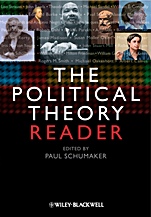
The Political Theory Reader
ISBN 9781405189972
Autor: Paul Schumaker
Wydawca: Wiley
Dostępność: 3-6 tygodni
Cena: 481,95 zł
Przed złożeniem zamówienia prosimy o kontakt mailowy celem potwierdzenia ceny.
ISBN13: |
9781405189972 |
ISBN10: |
1405189975 |
Autor: |
Paul Schumaker |
Oprawa: |
Hardback |
Rok Wydania: |
2010-02-05 |
Ilość stron: |
370 |
Wymiary: |
259x193 |
Tematy: |
JPA |
The Political Theory Reader is a collection of more than 80 important readings that address the contested philosophical assumptions and competing principles of politics. Included are key selections by canonical figures in the history of political thought, the founders of the major ideological perspectives of the nineteenth and twentieth centuries, and leading contemporary political theorists and philosophers. After opening chapters on the nature of political theory and selections introducing the major ideologies of the past 200 years, the readings are then arranged thematically, providing alternative perspectives on 11 great issues of politics, ranging from conceptions of human nature and the nature of political knowledge to questions of authority, citizenship, and justice. This structure not only helps to illustrate the diversity and evolution of political thinking, but also encourages the comparative evaluation of competing viewpoints.
Aimed at those coming new to the study of political theory, the Reader offers a carefully organized selection of unparalleled breadth, allowing students to see how different ideological voices express their beliefs about the great issues of politics and how political theory has evolved in its discussion of these issues.
Spis treści:
Preface
Acknowledgments
1. Political Theory, Public Philosophy, and Pluralism
Introduction
Leo Strauss, "What Is Political Philosophy?"
Judith Shklar, "Political Ideology"
Theodore J. Lowi, "America’s Old and New Public Philosophy"
Avigail Eisenberg, "Reconstructing Political Pluralism"
William E. Connolly, "Pluralism: A Prelude"
Part I: Ideological Voices
2. Nineteenth–Century Ideologies
Introduction
John Locke, "The Second Treatise of Government"
National Assembly of France, "The Declaration of the Rights of Man and of the Citizen"
Edmund Burke, "Reflections on the Revolution in France"
Karl Marx and Friedrich Engels, "The Communist Manifesto"
Emma Goldman, "Anarchism: What It Really Stands For"
3. Twentieth–Century Ideologies
Introduction
Vladimir I. Lenin, "State and Revolution"
Giovanni Gentile, "The Philosophic Basis of Fascism"
Paul Starr, "Why Liberalism Works"
John Kekes, "A Case for Conservatism"
4. Newer Quasi–Ideologies
Introduction
Michael J. Sandel, "America’s Search for a New Public Philosophy"
Richard John Neuhaus, "Public Religion and Public Reason"
Susan Moller Okin, "Justice, Gender, and the Family"
Arne Naess, "The Environmental Crisis and the Deep Ecological Movement"
Michael Hardt and Antonio Negri, "Globalization and Democracy"
Part II: Philosophical Assumptions
5. Ontological Conceptions
Introduction
Plato, "The Theory of Forms"
Walter Ullman, "Ascending and Descending Theses of Government"
Ken Wilber, "The Great Chain of Being"
Jean Jacques Rousseau, "On the General Will"
Friedrich Engels, "Marx’s Materialist Conception of History"
Charles Darwin, "Natural Selection"
T. H. Huxley, "Evolution and Ethics"
Judith Butler, "Contingent Foundations: Feminism and the Question of ‘Postmodernism’"
6. Conceptions of Human Nature
Introduction
Herbert Deane, "St. Augustine’s Conception of Fallen Man"
Thomas Hobbes, "The Natural Condition of Mankind"
C. B. Macpherson, "The Early Liberal Model of Man"
Karl Marx, "Estranged Labor"
Peter Kropotkin, "Mutual Aid"
John Rawls, "The Rationality and Motivations of Parties in the Original Position"
Michael Sandel, "The Procedural Republic and the Unencumbered Self"
Bhikhu Parekh, "Conceptualizing Human Beings"
7. Images of Society
Introduction
Aristotle, "The Natural Origins of Political Associations"
Thomas Hobbes, "The Contractual Origins of Society"
Edmund Burke, "The Great Primaeval Contract o
f Eternal Society"
Paul Schumaker, "Social Cleavages and Complex Equality"
8. Epistemological Orientations
Introduction
Benjamin Barber, "The Epistemological Frame: Cartesian Politics"
Jeremy Bentham, "Of the Principle of Utility"
Alasdair MacIntyre, "Narratives of the Good Life Guided by Living Traditions"
Richard Rorty, "America’s Civic Religion: A Hopeful Pragmatism"
Carol Gilligan, "In a Different Voice"
John Rawls, "Political Constructivism"
Part III: Political Principles
9. On Community
Introduction
James Madison, "The Federalist No. 10"
Rogers M. Smith, "Toward a Theory of Civic Identities"
David Held, "Towards a Global Covenant: Global Social Democracy"
Kirkpatrick Sale, "Human–Scale Democracy"
Robert Dahl, "The Chinese Boxes"
10. On Citizenship
Introduction
Michael Walzer, "The Distribution of Membership"
Joseph H. Carens, "Aliens and Citizens: The Case For Open Borders"
T. H. Marshall, "The Development of Citizen Rights"
Iris Marion Young, "Polity and Group Difference: A Critique of the Ideal of Universal Citizenship"
Amitai Etzioni et al., "The Responsive Communitarian Platform: Rights and Responsibilities"
Niccolo Machiavelli, "The Threat Posed by Corrupt Citizens"
11. On Structure
Introduction
John Stuart Mill, "On Liberty"
Adam Smith, "The Principles and Virtues of Free Markets"
Lawrence E. Harrison, "Progress and Poverty Without Marx"
Robert D. Putnam, "The Strange Disappearance of Civic America"
Anthony Giddens, "The Third Way and Government"
Imam Khomeini, "Islamic Government"
John Locke, "A Letter Concerning Toleration"
12. On Rulers
Introduction
Robert Dahl, "Guardianship"
Edmund Burke, "Speech to the Electors of Bristol"
Alexis de Tocqueville, "Unlimited Power of the Majority in the United States and Its Consequences"
Joseph Schumpeter, "A Realistic Alte
rnative to the Classical Doctrine of Democracy"
Benjamin Barber, "Strong Democracy: Politics in the Participatory Mode"
Amy Gutmann and Dennis Thompson, "What Deliberative Democracy Means"
William Riker, "Liberalism, Populism, and the Theory of Public Choice"
13. On Authority
Introduction
Robert Paul Wolff, "The Conflict Between Authority and Autonomy"
Milton Friedman, "The Role of Government in a Free Society"
Garrett Hardin, "The Tragedy of the Commons"
Benjamin I. Page and James R. Simmons, "What Should Government Do?"
William Galston, "Liberalism and Public Morality"
14. On Justice
Introduction
APSA Task Force on Inequality and American Democracy, "American Democracy in an Age of Rising Inequality"
John Rawls, "A Kantian Conception of Equality"
Irving Kristol, "A Capitalist Conception of Justice"
Robert Nozick, "The Entitlement Theory"
15. On Change
Introduction
Michael Oakeshott, "On Being Conservative"
Richard Rorty, "Movements and Campaigns"
Martin Luther King Jr., "Letter from a Birmingham Jail"
Abd Al–Salam Faraj, "The Neglected Duty"
Albert Camus, "Rebellion Beyond Nihilism"
Nota biograficzna:
Paul Schumaker is Professor of Political Science at the University of Kansas, where he has taught courses in political theory and community politics since 1972. Dr Schumaker has authored several books on political theory, including Critical Pluralism, Democratic Performance, and Community Power (1991). His most recent book is the political theory textbook From Ideologies to Public Philosophies (Wiley–Blackwell, 2008).
Okładka tylna:
The Political Theory Reader is a collection of more than 80 important readings that address the contested philosophical assumptions and competing principles of politics. Included are key selections by canonical figures in the history of political thought,
Koszyk
Książek w koszyku: 0 szt.
Wartość zakupów: 0,00 zł
Informacje


Kontakt
Gambit
Centrum Oprogramowania
i Szkoleń Sp. z o.o.
Al. Pokoju 29b/22-24
31-564 Kraków
Siedziba Księgarni
ul. Kordylewskiego 1
31-542 Kraków
+48 12 410 5991
+48 12 410 5987
+48 12 410 5989
Subskrypcje
Administratorem danych osobowych jest firma Gambit COiS Sp. z o.o. Na podany adres będzie wysyłany wyłącznie biuletyn informacyjny.
Autoryzacja płatności

Informacje na temat autoryzacji płatności poprzez PayU.

© Copyright 2012: GAMBIT COiS Sp. z o.o. Wszelkie prawa zastrzeżone.
Projekt i wykonanie: Alchemia Studio Reklamy