


Wydawcy
Katalog tematyczny
- Archeologia (109)
- Ekonomia, finanse, business (13704)
- Filozofia (1445)
- Historia (3040)
- Języki i językoznawstwo (2356)
- Lifestyle, hobby i rozrywka (475)
- Medycyna (9704)
- Nauki humanistyczne (4)
- Nauki o Ziemi i środowisku (2638)
- Nauki ścisłe (20412)
- Astronomia (294)
- Biologia (5119)
- Biochemia (575)
- Biologia człowieka (14)
- Biologia komórkowa (377)
- Biologia molekularna (398)
- Biologia rozwoju (130)
- Biologia, ogólnie (1277)
- Botanika (280)
- Hydrobiologia (92)
- Mikrobiologia (363)
- Mykologia (22)
- Zoologia (303)
- Chemia (6540)
- Fizyka (3309)
- Matematyka (4574)
- Nauki ścisłe, ogólnie (503)
- Nauki społeczne (8486)
- Nauki techniczne (13450)
- Prawo (1696)
- Publikacje informacyjne i interdyscyplinarne (1288)
- Religia i wierzenia (917)
- Technika komputerowa (4067)
- Zdrowie, relacje międzyludzkie i rozwój osobisty (657)





Informacje szczegółowe o książce
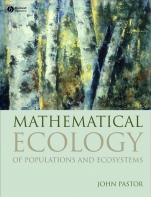
Mathematical Ecology of Populations and Ecosystems
ISBN 9781405188111
Autor: John Pastor
Wydawca: Wiley
Dostępność: 3-6 tygodni
Cena: 905,10 zł
Przed złożeniem zamówienia prosimy o kontakt mailowy celem potwierdzenia ceny.
ISBN13: |
9781405188111 |
ISBN10: |
1405188111 |
Autor: |
John Pastor |
Oprawa: |
Hardback |
Rok Wydania: |
2008-07-18 |
Ilość stron: |
344 |
Wymiary: |
249x195 |
Tematy: |
PS |
Population ecologists study how births and deaths affect the dynamics of populations and communities, while ecosystem ecologists study how species control the flux of energy and materials through food webs and ecosystems. Although all these processes occur simultaneously in nature, the mathematical frameworks bridging the two disciplines have developed independently. Consequently, this independent development of theory has impeded the cross–fertilization of population and ecosystem ecology. Using recent developments from dynamical systems theory, this advanced undergraduate/graduate level textbook shows how to bridge the two disciplines seamlessly. The book shows how bifurcations between the solutions of models can help understand regime shifts in natural populations and ecosystems once thresholds in rates of births, deaths, consumption, competition, nutrient inputs, and decay are crossed.
Mathematical Ecology is essential reading for students of ecology who have had a first course in calculus and linear algebra or students in mathematics wishing to learn how dynamical systems theory can be applied to ecological problems.
Spis treści:
Prologue.
Preface.
Acknowledgments.
Part I: Preliminaries.
1. What is Mathematical Ecology and Why Should We Do It?.
2. Mathematical Toolbox.
Part II: Populations.
3. Homogeneous Populations: Exponential and Geometric Growth and Decay.
4. Age– and Stage–structured Linear Models: Relaxing The Assumption Of Population Homogeneity.
5. Nonlinear Models of Single Populations: The Continuous Time Logistic Model.
6. Discrete Logistic Growth, Oscillations, and Chaos.
7. Harvesting and the Logistic Model.
8. Predators and their Prey.
9. Competition between Two Species, Mutualism, and Species Invasions.
10. Multispecies Community and Food Web Models.
Part III: Ecosystems.
11. Inorganic Resources, Mass Balance, Resource Uptake,
and Resource Use Efficiency.
12. Litter Return, Nutrient Cycling, and Ecosystem Stability.
13. Consumer Regulation of Nutrient Cycling.
14. Stoichiometry and Linked Element Cycles.
Part IV: Populations and Ecosystems in Space and Time.
15. Transitions between Populations and States in Landscapes.
16. Diffusion, Advection, the Spread of Populations and Resources, and the Emergence of Spatial Patterns.
Appendix: MatLab Commands for Equilibrium and Stability Analysis of Multi–compartment Models by Solving the Jacobian and its Eigenvalues.
References.
Index
Nota biograficzna:
John Pastor is Professor of Biology, at University of Minnesota Duluth, USA
Okładka tylna:
Population ecologists study how births and deaths affect the dynamics of populations and communities, while ecosystem ecologists study how species control the flux of energy and materials through food webs and ecosystems. Although all these processes occur simultaneously in nature, the mathematical frameworks bridging the two disciplines have developed independently. Consequently, this independent development of theory has impeded the cross–fertilization of population and ecosystem ecology. Using recent developments from dynamical systems theory, this advanced undergraduate/graduate level textbook shows how to bridge the two disciplines seamlessly. The book shows how bifurcations between the solutions of models can help understand regime shifts in natural populations and ecosystems once thresholds in rates of births, deaths, consumption, competition, nutrient inputs, and decay are crossed.
Mathematical Ecology is essential reading for students of ecology who have had a first course in calculus and linear algebra or students in mathematics wishing to learn how dynamical systems theory can be applied to ecological problems.
Koszyk
Książek w koszyku: 0 szt.
Wartość zakupów: 0,00 zł
Informacje


Kontakt
Gambit
Centrum Oprogramowania
i Szkoleń Sp. z o.o.
Al. Pokoju 29b/22-24
31-564 Kraków
Siedziba Księgarni
ul. Kordylewskiego 1
31-542 Kraków
+48 12 410 5991
+48 12 410 5987
+48 12 410 5989
Subskrypcje
Administratorem danych osobowych jest firma Gambit COiS Sp. z o.o. Na podany adres będzie wysyłany wyłącznie biuletyn informacyjny.
Autoryzacja płatności

Informacje na temat autoryzacji płatności poprzez PayU.

© Copyright 2012: GAMBIT COiS Sp. z o.o. Wszelkie prawa zastrzeżone.
Projekt i wykonanie: Alchemia Studio Reklamy