


Wydawcy
Katalog tematyczny
- Archeologia (109)
- Ekonomia, finanse, business (13704)
- Filozofia (1445)
- Historia (3040)
- Języki i językoznawstwo (2356)
- Lifestyle, hobby i rozrywka (475)
- Medycyna (9704)
- Nauki humanistyczne (4)
- Nauki o Ziemi i środowisku (2638)
- Nauki ścisłe (20412)
- Nauki społeczne (8486)
- Nauki techniczne (13450)
- Prawo (1696)
- Publikacje informacyjne i interdyscyplinarne (1288)
- Religia i wierzenia (917)
- Technika komputerowa (4067)
- Zdrowie, relacje międzyludzkie i rozwój osobisty (657)





Informacje szczegółowe o książce
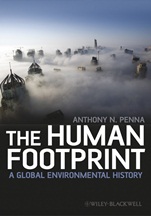
The Human Footprint: A Global Environmental History
ISBN 9781405187725
Autor: Anthony N. Penna
Wydawca: Wiley
Dostępność: 3-6 tygodni
Cena: 435,75 zł
Przed złożeniem zamówienia prosimy o kontakt mailowy celem potwierdzenia ceny.
ISBN13: |
9781405187725 |
ISBN10: |
1405187727 |
Autor: |
Anthony N. Penna |
Oprawa: |
Hardback |
Rok Wydania: |
2009-08-14 |
Ilość stron: |
378 |
Wymiary: |
236x162 |
Tematy: |
HB |
The Human Footprint is an innovative and accessible study of transnational environmental history, which uses broad themes to highlight the long and rich history of the earth.
Offering a coherent, comparative examination of the world′s past, Penna′s multidisciplinary approach draws on the most recent research in geology, climatology, archaeology, anthropology, and history. Flowing from the Paleolithic to the present era, each chapter contains a single theme, ranging from the global impact of agriculture and urbanization, to manufacturing, consumption, and industrialization.
In recognizing how humans have fit into this history of the earth, The Human Footprint brings harmony to human history and ecology, providing a fresh, much–needed narrative of world history.
List of Figures.
Acknowledgments.
Introduction.
The Nature of World History.
The Nature of World Environmental History.
Earth History and Human Origins.
Population Growth and the Rise of Cities.
Cities and the Rise of Manufacturing and Industry.
World Trade and New World Ecology.
Fossil Fuels and Climate Change.
1. An Evolving Earth.
Introduction.
The Origin of the Earth: From Hot to Cold Planet.
Icehouse Planet/Greenhouse Planet.
Plate Tectonics, Super–Continents, and Climate Change.
The Warming.
The Cooling.
The Elevation of the Tibetan Plateau and Its Effect on the Global Climate.
The Birth, Death, and Rebirth of the Mediterranean Sea and its Hemispheric Environmental Effects.
The Impact of the Isthmus of Panama on Global Climate Change.
The Mid–Pliocene, Glacial and Interglacial Cycles, and "Modern" Times.
2. Evolving Humanity.
Introduction.
Climatic Changes and Evolution.
Another Effect of the Closing of the Mediterranean Sea.
Human Ancestry.
The Birth of Human Intelligence.
Translating Human Intelligence into Action.
Population Migration and Expansion.
Homo neanderthalensis vs. Homo sapiens.
Early Diets and Their Nutritional Value.
The Broad Spectrum an Economic Revolution.
3. Foraging, Cultivating, and Food Production.
Introduction.
Early Farming and a Warming Climate.
Settlement and Domestication.
Early Agricultural Communities.
Early Agriculture in China.
Early Agriculture in Africa.
Early Agriculture in Mesoamerica.
Early Agriculture in Europe.
World Agriculture During the Age of Manufacture and Industry.
The Green Revolution.
4. Populating the Earth: Diet, Domestication, and Disease.
Introduction.
A Modern Demographic Scenario.
The Role of Disease in Calculating Population Size.
The Impact of Migration and Settlement on Global Population Growth.
The Role of Nutrition on Early population Growth.
The Role of Animal Domestication in the Spread of Infectious Disease.
Nutrition, Climate Change and Population.
A Population Bomb or Not?
5. The Making of an Urban World.
Introduction.
What Does Urban Mean?
Early Urbanization and Its Environmental Effects.
Ancient Urbanization.
The Origin of Writing.
The Impact of Changing Rivers on Environmental Quality.
Urbanization in the Indus Valley.
China s Early Cities.
Ancient Mesoamerican Cities.
Early European Cities.
6. Mining, Making, and Manufacturing.
Introduction.
The Age of Copper and Bronze.
The Effects of Ancient Mining on Human Health and the Environment.
Mining in the Roman World.
The Age of Iron.
Iron Making in China and India.
Iron Making in pre–Modern Europe.
Manufacturing in Colonial America.
7. Industrial Work.
Introduction.
China and India s Economy.
European Hegemony and British Industrialization.
Economic Development in China, Japan, and India.
Harnessing the Power of Water.
Disease, Death and a Public Health Response.
The Power of Steam.
The Role of Invention and Innovation.
Comparing Industrialization in the United States and in Britain.
Coal, Iron, and Steel.
Industrial Transformation and Global Auto Mobility.
8. Trade and Consumption.
Introduction.
Global Trading Networks.
Distancing Consumers from Producers.
Material Goods.
Luxury Foods Become Commodities.
Tobacco.
Sugar.
Coffee and Tea.
Environmental Effects of Increased Cultivation of Coffee.
Conspicuous Consumption.
Global Consumption.
The Automobile and Electronics in Emerging Markets.
9. Fossil Fuels, Wind, Water, Nuclear and Solar Energy.
Introduction.
The Eotechnic World: Waterwheels and Windmills.
The Paleotechnic World: Energy from Coal.
The Neotechnic World: Energy from Oil.
The Developing World s Demands for Energy.
The Case for Natural Gas: A Neotechnic Energy Solution.
The Case for Nuclear Energy: Another Neotechnic Solution.
The Case for Renewable Wind and Solar Power: A Return to the Eotechnic.
10. A Warming Climate.
Introduction.
The Rise and Fall of the Mayan Civilization.
The Medieval Warm Period (1000 1300 ce) and the Little Ice Age (1300 1850 ce).
Current Global Climate Conditions.
The Role of Solar Energy.
The Role of the Atlantic Circulation Energy Exchange.
The Role of Fossil Fuel Emissions.
What Is to be Done?
Epilogue.
Notes.
Index.
Anthony N. Penna has taught at Carnegie–Mellon University and Northeastern University, where he has been teaching North American and Global Environmental history courses since 1990. He is the author of Nature’s Bounty: Historical and Modern Environmental Perspectives (1999), and he is co–editor of Remaking Boston: An Environmental History of the City and Its Surroundings (2009).
"The Human Footprint adds to the growing literature combining environmental with world history, both of which are relatively recent and vibrant subfields of history . . . His topical approach does result in an interesting, readable, and accessible set of histories that addresses issues of concern not just to world and environmental historian, but to geologists and evolutionary biologists as well, making it quite suitable for use in a range of college and university courses." (Technology and Culture, 1 January 2011)
"I highly recommend this book as one that would work extremely well in an environmental history offering or as a supplementary work in any World survey." (World History Association, 1 October 2010)
"An increasing number of scholar–teachers are now able to teach global survey courses, giving students an improved context for heading into a future of daunting climate change. None of the recent survey volumes is better tailored for this audience (or for a wider and equally anxious public) than Penna′s Human Footprint, the fruit of two decades of teaching this subject at Northeastern University...One virtue of Penna′s approach is its integration of hard sciences (archeology, climatology, epidemiology, etc.) with social and historical concepts...Penna makes clear how natural settings shaped early human cultures; this enables readers then to watch the long human effort to turn the tables on Nature, reshaping it to this species′ innovative priorities." (Environmental History, 2011)
Koszyk
Książek w koszyku: 0 szt.
Wartość zakupów: 0,00 zł
Informacje


Kontakt
Gambit
Centrum Oprogramowania
i Szkoleń Sp. z o.o.
Al. Pokoju 29b/22-24
31-564 Kraków
Siedziba Księgarni
ul. Kordylewskiego 1
31-542 Kraków
+48 12 410 5991
+48 12 410 5987
+48 12 410 5989
Subskrypcje
Administratorem danych osobowych jest firma Gambit COiS Sp. z o.o. Na podany adres będzie wysyłany wyłącznie biuletyn informacyjny.
Autoryzacja płatności

Informacje na temat autoryzacji płatności poprzez PayU.

© Copyright 2012: GAMBIT COiS Sp. z o.o. Wszelkie prawa zastrzeżone.
Projekt i wykonanie: Alchemia Studio Reklamy