


Wydawcy
Katalog tematyczny
- Archeologia (109)
- Ekonomia, finanse, business (13704)
- Filozofia (1445)
- Historia (3040)
- Języki i językoznawstwo (2356)
- Lifestyle, hobby i rozrywka (475)
- Medycyna (9704)
- Nauki humanistyczne (4)
- Nauki o Ziemi i środowisku (2638)
- Nauki ścisłe (20412)
- Nauki społeczne (8486)
- Nauki techniczne (13450)
- Prawo (1696)
- Publikacje informacyjne i interdyscyplinarne (1288)
- Religia i wierzenia (917)
- Technika komputerowa (4067)
- Zdrowie, relacje międzyludzkie i rozwój osobisty (657)





Informacje szczegółowe o książce
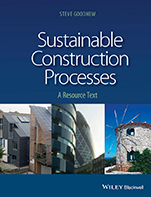
Sustainable Construction Processes: A Resource Text
ISBN 9781405187596
Autor: Steve Goodhew
Wydawca: Wiley
Dostępność: 3-6 tygodni
Cena: 348,60 zł
Przed złożeniem zamówienia prosimy o kontakt mailowy celem potwierdzenia ceny.
ISBN13: |
9781405187596 |
ISBN10: |
140518759X |
Autor: |
Steve Goodhew |
Oprawa: |
Paperback |
Rok Wydania: |
2016-05-27 |
Ilość stron: |
392 |
Wymiary: |
242x188 |
Tematy: |
AM |
This book explores the concepts and practicalities that lead to sustainable construction. It breaks new ground by providing the reader with the underlying principles of how to build sustainably and then assesses many of the tools required for the task. From energy to materials and from procurement to operation, all aspects play their part in turning a theoretically sustainable building project into a reality. There are many guidelines for the designer on how to maximise the sustainability of buildings but this resource text supplements these by focusing on the construction and operational aspects of sustainable buildings, as well as some of the more fundamental design–related considerations.
Offers an excellent text for those learning to construct, design and operate sustainable buildings.
Covers the drivers for sustainable construction, definitions, historical impacts, climate change and global, regional and individual responses.
enables the construction professional to achieve optimum solutions, both in design, process and the aftercare of buildings.
evaluates the effectiveness of different renewable technologies and provides guidance on the practicalities of their use.
Alerts the reader to future trends in this field.
CHAP 1: INTRODUCTION. Informs the reader of the wider rationale for this work; environmental, social, economic and governmental drivers for sustainable construction.. CHAP 2: THE PROBLEM. A more technical insight into the potential problems we are encountering including due reference to IPCC 2006/7 report, Stern Review and other appropriate materials.. A possible further exploration of the wider benefits of the efficiencies that sustainable practices can offer, including the highly regarded and more traditional attributes such as; High quality work (long lasting with few defects at handover and through out the building s life). To budget, or negotiated alterations to allow for longer term benefits To time, giving the client the fullest opportunities offered by prompt occupation Low running costs within the context of toleration of longer pay–back periods Environmental Effectiveness of buildings including producing healthier buildings. This will include discussions of the well known harm caused by certain materials and extrapolating forwards using well established research undertaken upon other materials that are likely to be a problem in the future. This aspect will be linked to Post Occupancy Evaluation of buildings with case studies where possible. . CHAP 3: THE ROLE OF CARBON. Exploring the links between sustainability and a low carbon economy. The impact of other greenhouse gases, energy v carbon? Exploring the doctrine of carbon neutrality, sequestration, carbon trading, Development globally, and carbon. Leading to the major questions of energy and its inextricable link to carbon.. CHAP 4: ENERGY and MATERIALS. Where does all this come from? Macro planting, fuel types, distribution systems, losses, micro plants is small really beautiful? Storing micro (near point of use = good?) Renewables types, pro s/cons, barriers to use, implementation and construction of stand alone systems for buildings, inc. micro CHP, bio, renewables.. The great embodied energy versus energy in use debate, including a range of suitable case studies and theoretical examples. These will explore the energy payback periods and contrast those with monetary payback periods.. Construction materials, how natural is natural? is this really an asset? The debate concerning the lifetime use of a materials and its maintenance/reuse/ recycling cradle to grave? grave to grave? The skills issues with building with new sustainable materials, offsite production, can this reduce carbon footprints?. CHAP 5: The CONNECTION to CONSTRUCTION How construction has changed and its current position as far as technology part of the built environment (see fig 1) Quantities of materials, waste, energy etc The part that the professionals play at the present time and their roles. The questions arising from the previous chapters leading to the next chapter . CHAP 6: THE DESIGN AND PLANNING FOR SUSTAINABLE CONSTRUCTION. 1. The big picture of planning, communities, the where, what and how of urban and rural development. Best practice, case studies. Do you need to build a new building at all? See Fig 2. 2. The design of dwellings, philosophies, inclusive/exclusive homes, passive/active homes, massive/lightweight, low tech/high tech. Case studies/best practice. 3. The design of commercial/industrial buildings needs of the client, what technologies are feeding through from domestic dwellings? What drivers will plot the course of building design s direction. . CHAP 7: BENCHMARKING/TOOLS. Design and process related benchmarking systems will be introduced as an aid to satisfying the good practice shown in the process section.. CEQUAL, BREEAM, LEAD, Ecopoints, Code for Sustainable Housing etc etc.. Use of more commonly accepted general tools as to an aid to decision making including the Natural Step, with the inclusion of a range of case studies (possibly overlapping with the case studies in chapter 8).. . CHAP 8: THE CONSTRUCTION PROCESS. This chapter will be focused upon providing the reader a case study based diet of oh now I see where XXXX comes in . It will be logically split up into the separate stages of. Domestic construction Commercial construction Industrial construction Civil Engineering example . A series of practical case studies will include some/most of the following (assuming a contract type is decided). Planning Procurement and pre design Design/costings/technical design Tendency/solicitation Site set up Ground work Up to ground level Superstructure to topping out 1st then 2nd fix External works Commissioning and the production of the buildings Handbook. . At each stage the three E s (Economic, Environmental and Equity) elements will be used to pick apart the issues and best practice. Each theoretical example will use a range of other real knowledge bites from other projects to give the reader an idea of how the issues connect to real sites and situations.. CHAP 9: THE FUTURE. This chapter will highlight the new and up–and–coming technologies and techniques that are filtering into the construction industry from reaserch institutes and geographically new practices. These will include, new and promising technologies, new processes, new mindsets, new social orders, new economic powers, new potential constraints, new climates .
Professor Steve Goodhew is Professor of Environmental Building and Discipline Leader School of Architecture, Design and Environment at Plymouth University. He has been teaching and researching in the area of sustainable construction for over 20 years.
Steve’s main focus has been the assessment and monitoring of existing buildings specialising in the in situ measurement of the thermal properties of building materials, particularly the use of thermal imaging. Steve is the Associate Head for Research and a fellow of the RICS and the CIOB. Steve studied at Bristol Polytechnic, London University and Cranfield Institute of Technology, gaining his PhD from Plymouth University.
Koszyk
Książek w koszyku: 0 szt.
Wartość zakupów: 0,00 zł
Informacje


Kontakt
Gambit
Centrum Oprogramowania
i Szkoleń Sp. z o.o.
Al. Pokoju 29b/22-24
31-564 Kraków
Siedziba Księgarni
ul. Kordylewskiego 1
31-542 Kraków
+48 12 410 5991
+48 12 410 5987
+48 12 410 5989
Subskrypcje
Administratorem danych osobowych jest firma Gambit COiS Sp. z o.o. Na podany adres będzie wysyłany wyłącznie biuletyn informacyjny.
Autoryzacja płatności

Informacje na temat autoryzacji płatności poprzez PayU.

© Copyright 2012: GAMBIT COiS Sp. z o.o. Wszelkie prawa zastrzeżone.
Projekt i wykonanie: Alchemia Studio Reklamy