


Wydawcy
Katalog tematyczny
- Archeologia (109)
- Ekonomia, finanse, business (13704)
- Filozofia (1445)
- Historia (3040)
- Języki i językoznawstwo (2356)
- Lifestyle, hobby i rozrywka (475)
- Medycyna (9704)
- Nauki humanistyczne (4)
- Nauki o Ziemi i środowisku (2638)
- Geografia (299)
- Nauki o Ziemi (1661)
- Geologia (414)
- Hydrologia (237)
- Meteorologia i klimatologia (114)
- Paleontologia (33)
- Wulkanologia i sejsmologia (44)
- Planowanie przestrzenne (53)
- Środowisko (607)
- Nauki ścisłe (20412)
- Nauki społeczne (8486)
- Nauki techniczne (13450)
- Prawo (1696)
- Publikacje informacyjne i interdyscyplinarne (1288)
- Religia i wierzenia (917)
- Technika komputerowa (4067)
- Zdrowie, relacje międzyludzkie i rozwój osobisty (657)





Informacje szczegółowe o książce
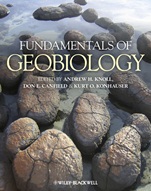
Fundamentals of Geobiology
ISBN 9781405187527
Autor: Andrew H. Knoll, Don E. Canfield, Kurt O. Konhauser
Wydawca: Wiley
Dostępność: 3-6 tygodni
Cena: 311,85 zł
Przed złożeniem zamówienia prosimy o kontakt mailowy celem potwierdzenia ceny.
ISBN13: |
9781405187527 |
ISBN10: |
1405187522 |
Autor: |
Andrew H. Knoll, Don E. Canfield, Kurt O. Konhauser |
Oprawa: |
Paperback |
Rok Wydania: |
2012-04-20 |
Ilość stron: |
456 |
Wymiary: |
275x214 |
Tematy: |
RB |
Spis treści:
1. Introduction.
General introduction to the emerging field of geobiology, including an explanation of the book’s major segments (process, tools and applications, historical geobiology), and a geobiological phylogeny of life –– much like the “geological periodic table” published recently.
Geobiological Processes:.
2. The carbon cycle: biological loops –.
–primary producers and controls on primary production.
–marine.
–global patterns.
–primary contributors.
–nutrient and trace element limitation.
–CO2 limitation and carbon compensation mechanisms.
–light and the deep chlorophyll maximum.
–the microbial loop and the viral loop.
–terrestrial.
–global patterns.
–water availability.
–nutrient availability and access.
–biological remineralization of organic molecules: respirers and other heterotrophs.
–trophic levels.
–export production.
–electron acceptors and carbon mineralization.
–secondary production and efficiency of energy utilization.
3. The carbon cycle: geological loops.
– inorganic carbon ions and molecules: production and preservation.
– controls on organic carbon preservation.
– regeneration of carbon dioxide.
–subduction, metamorphism.
–weathering (both IC and OC).
–ocean chemistry over Phanerozoic time.
–pH.
–calcite/aragonite oceans.
.
4. The N cycle.
–nitrogen as a biological molecule and nutrient.
–N2 fixation.
–biochemical aspects.
–phylogenic aspects.
–importance of and controls in the ocean.
–importance of and controls on land.
–Denitrification/Nitrate ammonification.
–biochemical aspects.
–phylogenetic aspects.
–importance of and controls in
the aquatic systems.
– Nitrification and Anammox.
–biochemical aspects.
–phylogenetic aspects.
–importance of and controls in aquatic systems.
–summary of N cycle in the oceans (and on land?).
5. The S cycle.
–S as a biological molecule and nutrient.
–sulfate reduction.
–biochemical aspects.
–phylogenic aspects.
–importance of and controls in aquatic systems.
–sulfide oxidation.
–nonphotosynthetic pathways.
–photosynthetic pathways.
–summary of S cycle in the oceans.
6. The Fe cycle.
–Fe as a biological molecule and nutrient.
–Fe reduction.
–biochemical aspects.
–phylogenic aspects.
–Fe availability.
–siderophores.
–Pili.
–importance of and controls in aquatic systems.
–Fe oxidation.
–non–phototrophic.
–phototrophic.
–A word about Mn.
7. The O cycle.
–O2 production: photosynthesis.
–coupled photosystems and function of the oxygen evolving apparatus –a few words on the evolution of oxygenic photosynthesis.
–review of photosynthetic rates in ocean and on land.
–distribution of O2 in the oceans.
–O2 consumption.
–oxygen respiration.
–biochemistry.
–phylogeny.
–kinetics.
–oxygen in marine sediments.
–distribution.
–importance in carbon mineralization.
–reduced species oxidation.
–weathering.
–reactions.
–kinetics.
–oxygen control over geologic time.
8. Geobiology of P and trace nutrients.
–Biological requirements for P, Mo, Cu, V, Zn and other trace nutrients.
–Availability in the oceans: sources and sinks.
–Phosphate remineralization under oxic and anoxic conditions.
–Availability in soils.
–
;Redox sensitivity of trace metals and its implications for bioavailability.
9. Bacterial biomineralization.
– cell surface reactivity.
– metal sorption, nucleation and crystal growth.
– induced vs controlled pathways.
– examples: Fe oxyhydroxides, carbonates, silica, pyrite.
10. Eukaryotic skeleton formation.
– the functional biology and phylogenetic distribution of mineralized skeletons.
– how organisms control mineralization.
– CaCO3 skeletons: illustrated by E. huxleyi, echinoderms, bivalves.
– Ca–phosphate skeletons: illustrated by humans.
– SiO2 skeletons: illustrated by diatoms and sponges.
– relevance to marine Si and Ca cycles. Link to C cycle?.
11. Plants and animals as geobiological agents.
– a discussion of how plants and animals function as geobiological agents, going beyond skeleton formation to include the geobiological effects of roots, burrowing, etc..
12. Weathering, erosion, and climate regulation: a geobiological view.
– role of microbes (production of organic acids and CO2, chelators, endoliths).
–carbonate–silicate weathering cycle and BLAG, including influence of plants on CO2.
–DMS and climate.
–methane and climate.
.
.
How do we know what we think we know: Geobiological tools and applications.
13. Microbial geobiology: identifying the players and their metabolisms.
– traditional methods of characterizing microorganisms.
– molecular methods of identifying microorganisms.
– SSU rRNA signatures.
– Direct investigation of field samples.
– Biases in amplification and ways of dealing with this.
– FISH.
– molecular phylogenies: construction, interpretation and caveats.
(lateral transfer, alternative gene phylogenies).
– bioenergetics (linking geochemistry to ATP generation; stable isot
ope probing).
14. Microbial geobiology; genomics and proteomics.
–Genomics and the structure of microbial populations.
–individual gene surveys.
–Fosmid libraries.
–environmental genomes.
–mRNA.
–environmental proteomics.
–other?.
–case studies.
15. Stable isotopes in geobiology.
–Carbon isotope systematics.
– carbon fixation (various pathways).
– carbon remineralization.
– methanogenesis.
–N isotope systematics.
– N fixation.
– denitrification and anammox.
– nitrification.
–Sulfur isotope systematics.
– sulfate reduction.
– disproportionation.
– sulfide oxidation.
– minor isotopes and a few words on their systematics.
–Oxygen isotopes.
– photosynthesis.
– respiration.
– minor isotopes and the Dole effect.
–Metal isotopes.
– Fe.
– Mo.
– others.
16. Biomarker molecules in geobiology.
– the biomarker principle.
– environments and probabilities of molecular preservation.
– ancient DNA.
– pigments.
– sterols.
– hopanes.
– isotopic abundances in individual biomarker compounds.
17. Microfossils and biotic sedimentary structures.
– microfossils: what gets preserved and how.
– environments and probabilities of morphological preservation.
– interpreting microfossils.
– stromatolites.
– formation.
– biological and physical information recorded by stromatolites.
– modern case studies: Shark Bay, Bahamas.
– are all laminated precipitates stromatolitic?.
– microbially induced sedimentary structures.
.
Historical Geobiology:.
18. Origin of Life.
– likely environments.
– surface metabolism and likely mineral interfa
Koszyk
Książek w koszyku: 0 szt.
Wartość zakupów: 0,00 zł
Informacje


Kontakt
Gambit
Centrum Oprogramowania
i Szkoleń Sp. z o.o.
Al. Pokoju 29b/22-24
31-564 Kraków
Siedziba Księgarni
ul. Kordylewskiego 1
31-542 Kraków
+48 12 410 5991
+48 12 410 5987
+48 12 410 5989
Subskrypcje
Administratorem danych osobowych jest firma Gambit COiS Sp. z o.o. Na podany adres będzie wysyłany wyłącznie biuletyn informacyjny.
Autoryzacja płatności

Informacje na temat autoryzacji płatności poprzez PayU.

© Copyright 2012: GAMBIT COiS Sp. z o.o. Wszelkie prawa zastrzeżone.
Projekt i wykonanie: Alchemia Studio Reklamy