


Wydawcy
Katalog tematyczny
- Archeologia (109)
- Ekonomia, finanse, business (13704)
- Filozofia (1445)
- Historia (3040)
- Języki i językoznawstwo (2356)
- Lifestyle, hobby i rozrywka (475)
- Medycyna (9704)
- Nauki humanistyczne (4)
- Nauki o Ziemi i środowisku (2638)
- Nauki ścisłe (20412)
- Nauki społeczne (8486)
- Nauki techniczne (13450)
- Budownictwo lądowe (1045)
- Budownictwo komunikacyjne (9)
- Hydraulika (33)
- Konstrukcje budowlane (95)
- Mechanika konstrukcji (182)
- Przemysł budowlany (7)
- Chemia przemysłowa (2258)
- Elektronika i telekomunikacja (3287)
- Energetyka (1122)
- Inne nauki stosowane (363)
- Inżynieria biochemiczna (507)
- Inżynieria transportu (232)
- Mechanika i materiały (3316)
- Nauka o środowisku (321)
- Rolnictwo (507)
- Technika, ogólnie (475)
- Prawo (1696)
- Publikacje informacyjne i interdyscyplinarne (1288)
- Religia i wierzenia (917)
- Technika komputerowa (4067)
- Zdrowie, relacje międzyludzkie i rozwój osobisty (657)





Informacje szczegółowe o książce
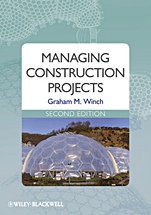
Managing Construction Projects
ISBN 9781405184571
Autor: Graham M. Winch
Wydawca: Wiley
Dostępność: 3-6 tygodni
Cena: 327,60 zł
Przed złożeniem zamówienia prosimy o kontakt mailowy celem potwierdzenia ceny.
ISBN13: |
9781405184571 |
ISBN10: |
1405184574 |
Autor: |
Graham M. Winch |
Oprawa: |
Paperback |
Rok Wydania: |
2009-12-11 |
Numer Wydania: |
2nd Edition |
Ilość stron: |
544 |
Wymiary: |
244x170 |
Tematy: |
TN |
Project management is of critical importance in construction, yet its execution poses major challenges. In order to keep a project on track, decisions often have to be made before all the necessary information is available.
Drawing on a wide range of research, Managing Construction Projects proposes new ways of thinking about projectmanagement in construction, exploring the skills requiredto manage uncertainty and offering techniques for thinkingabout the challenges involved. The second edition takes theinformation processing perspective introduced in the firstedition and develops it further. In particular, this approachdeepens the reader’s understanding of the dynamics in theconstruction project process – from the value propositioninherent in the project mission, to the functioning asset thatgenerates value for its owners and users.
Managing Construction Projects is a unique and indispensible contribution to the available literature on construction project management. It will be of particular benefi t to advanced students of construction and construction project management, as well as contractors and quantity surveyors.
Reviews of the First edition:
"A refreshing and unique study of information management and its impact upon international construction project management.... The book is well presented and written, logical and succinct and is flexible enough to allow readers to either read from start to finish or to dip into selected chapters. This book deserves to be an established text for any construction or civil engineering under– and/or postgraduate course."
—CNBR
Spis treści:
Preface to 1st Edition.
Preface to 2nd Edition.
Part I Introduction.
1 The Management of Construction Projects.
1.1 Introduction.
1.2 Projects as the creation of new value.
1.3 The project as an information processing system.
1.4 Project managem
ent and the management of projects.
1.5 Projects and resource bases.
1.6 The five generic project processes.
1.7 Critiques of the first edition.
1.8 A theoretical perspective on managing construction projects.
1.9 A practical contribution to managing construction projects.
1.10 The plan of the book.
1.11 Summary.
Case 1 The Channel Fixed Link.
2 The Context of Construction Project Management.
2.1 Introduction.
2.2 The industry recipe for construction.
2.3 National business systems in construction.
2.4 The regulatory context.
2.5 The construction cycle.
2.6 The development of concession contracting.
2.7 Summary.
Case 2 The UK Construction Business System.
Further reading.
Part II Defining the Project Mission.
3 Deciding What the Client Wants.
3.1 Introduction.
3.2 From artefact to asset: facilities as new value.
3.3 Understanding spatial quality and business processes.
3.4 Indoor environmental quality and business processes.
3.5 Symbolic quality: beyond peer review.
3.6 Justifying the investment.
3.7 Strategic misrepresentation in investment appraisal.
3.8 Defining the project mission: a conceptual framework for product integrity.
3.9 Summary.
Case 3 Defining the Mission at the University of York.
Further reading.
4 Managing Stakeholders.
4.1 Introduction.
4.2 Which are the project stakeholders?
4.3 Mapping stakeholders.
4.4 The regulatory context.
4.5 Managing consent.
4.6 Ethics in project mission definition.
4.7 The role of visualisation.
4.8 Summary.
Case 4 The Rebuilding of Beirut Central District.
Further reading.
Part III Mobilising the Resource Base.
5 Forming the Project Coalition.
5.1 Introduction.
5.2 The principal/agent problem in construction.
5.3 Procuring construction services.
5.4 The formation of project coalitions.
5.5 Selecting resour
ce bases.
5.6 Forming more effective project coalitions.
5.7 The development of e–procurement.
5.8 Probity in procurement.
5.9 Summary.
Case 5 Partnering Between Marks & Spencer and Bovis.
Further reading.
6 Motivating the Project Coalition.
6.1 Introduction.
6.2 The problem of moral hazard in construction projects.
6.3 The problem of switching costs.
6.4 Managing the problem of moral hazard.
6.5 Contractual uncertainty and risk allocation.
6.6 Governing the contract and the role of third parties.
6.7 The dynamic of adversarial relations.
6.8 Alliancing.
6.9 Summary.
Case 6 NHS ProCure 21.
Further reading.
7 Managing the Dynamics of the Supply Chain.
7.1 Introduction.
7.2 Horizontal and vertical governance.
7.3 Internal resource mobilisation.
7.4 Shirking.
7.5 The role of sequential spot contracting in construction employment.
7.6 Managing the supply chain.
7.7 Managing consortia and joint ventures.
7.8 The dynamics of supply chains.
7.9 Clustering the supply chain.
7.10 Summary.
Case 7 Building Down Barriers.
Further reading.
Part IV Riding the Project Life Cycle.
8 Minimising Client Surprise.
8.1 Introduction.
8.2 Projecting a perfect future.
8.3 Strategies for imagining the future: options thinking.
8.4 Moving from phase to phase: gating the process.
8.5 The gap analysis approach.
8.6 What do we mean by project success?
8.7 The nature of information flows in problem solving.
8.8 Process representation.
8.9 Knowledge management and learning from projects.
8.10 Summary.
Case 8 Riding the Life Cycle on the Glaxo Project.
Further reading.
9 Defining Problems and Generating Solutions.
9.1 Introduction.
9.2 Tame and wicked problems in the project process.
9.3 Solving the briefing problem.
9.4 Client organisation for briefing and design.
9.5 S
olving the design problem.
9.6 The cult of wickedness.
9.7 The management of design.
9.8 Summary.
Case 9 Designing the Sheffield Arena.
Further reading.
10 Managing the Budget.
10.1 Introduction.
10.2 Levels of accuracy in project budgets.
10.3 Developing a budgetary system.
10.4 Using the PBS to control the budget.
10.5 Value engineering and cost management.
10.6 Constructability.
10.7 Controlling the budget.
10.8 Earned value analysis.
10.9 Mitigating optimism bias.
10.10 Budget overruns and escalating commitments.
10.11 Summary.
Case 10 The Centuria Project Budget.
Further reading.
11 Managing the Schedule.
11.1 Introduction.
11.2 Critical path method.
11.3 Resourcing the project.
11.4 The limitations of the critical path method.
11.5 New approaches to project scheduling.
11.6 The dynamics of the project schedule.
11.7 Summary.
Case 11 Centuria Project Schedule.
Further reading.
12 Managing Conformance.
12.1 Introduction.
12.2 The principles of quality management systems.
12.3 Inspection.
12.4 Quality control.
12.5 Quality assurance.
12.6 Integrated management systems for quality, environment, safety and health.
12.7 Creating a culture of improvement.
12.8 Quality awards and self–assessment.
12.9 Conformance management in a project environment.
12.10 Standardisation and pre–assembly.
12.11 Summary.
Case 12 From Navvies to White Van Man: Managing Conformance at T5.
Further reading.
13 Managing Uncertainty and Risk on the Project.
13.1 Introduction.
13.2 Risk and uncertainty: a cognitive approach.
13.3 The elicitation of subjective probabilities.
13.4 Propensity for risk and uncertainty.
13.5 The practice of managing risk and uncertainty.
13.6 Managing opportunities and threats on projects.
13.7 The strategic management of project risk and uncerta
inty.
13.8 Summary.
Case 13 Managing Front–End Risks Through Networks: Boston Central Artery/Tunnel.
Further reading.
14 Managing the Project Information Flow.
14.1 Introduction.
14.2 The principles of integrated project information.
14.3 The development of information and communication technologies.
14.4 Engineering information management systems.
14.5 Enterprise resource management systems.
14.6 e–construction.
14.7 Project extranets.
14.8 The role of the project manager in managing project information.
14.9 Summary.
Case 14 Building Information Modelling at One Island East.
Further reading.
Part V Leading the Project Coalition.
15 Designing Effective Project Organisations.
15.1 Introduction.
15.2 The rise of the project management concept.
15.3 Projects, programmes and portfolios.
15.4 The responsibilities of the client.
15.5 Who is the project manager?
15.6 Organising the project through the life cycle.
15.7 Project organisation in construction.
15.8 Determining the organisation breakdown structure.
15.9 Project teamworking.
15.10 Constructing the team.
15.11 Summary: project organisation design.
Case 15 Glaxo Project Organisation.
Further reading.
16 Infusing the Project Mission.
16.1 Introduction.
16.2 Appropriate leadership.
16.3 Leadership style.
16.4 Construction project leadership.
16.5 Resolving conflict on the project.
16.6 The levers of power.
16.7 Project culture and leadership.
16.8 Leading the construction project.
16.9 Summary: infusing the project mission.
Case 16 Patrick Crotty: Project Director on the Waterloo International Project.
16.10 The project life cycle.
16.11 Keeping control.
Further reading.
17 Conclusions: Managing Construction Projects Consummately.
17.1 Revaluing construction.
17.2 Managing for product integrity.
17.3
Managing for process integrity.
17.4 Construction as a manufacturing process.
17.5 Systems thinking and managing projects.
17.6 Professionalism and managing construction projects.
17.7 Judgement in managing construction projects.
17.8 Summary of the book.
17.9 A concluding thought.
Case 17 Tinker Bell Theory in Practice.
Further reading.
References.
People Index.
Project Index.
Subject Index.
Nota biograficzna:
Graham Winch is Professor of Project Management, Director of the Centre for Research in the Management of Projects, Director of the BP Managing Projects executive education programme and Head of the Decision Sciences and Operations Management Subject Area Group at Manchester Business School, University of Manchester.
Okładka tylna:
Project management is of critical importance in construction, yet its execution poses major challenges. In order to keep a project on track, decisions often have to be made before all the necessary information is available.
Drawing on a wide range of research, Managing Construction Projects proposes new ways of thinking about projectmanagement in construction, exploring the skills requiredto manage uncertainty and offering techniques for thinkingabout the challenges involved. The second edition takes theinformation processing perspective introduced in the firstedition and develops it further. In particular, this approachdeepens the reader’s understanding of the dynamics in theconstruction project process – from the value propositioninherent in the project mission, to the functioning asset thatgenerates value for its owners and users.
Managing Construction Projects is a unique and indispensible contribution to the available literature on construction project management. It will be of particular benefi t to advanced students of construction and construction project management, as well
as contractors and quantity surveyors.
Reviews of the First edition:
"A refreshing and unique study of information management and its impact upon international construction project management.... The book is well presented and written, logical and succinct and is flexible enough to allow readers to either read from start to finish or to dip into selected chapters. This book deserves to be an established text for any construction or civil engineering under– and/or postgraduate course."
—CNBR
Koszyk
Książek w koszyku: 0 szt.
Wartość zakupów: 0,00 zł
Informacje


Kontakt
Gambit
Centrum Oprogramowania
i Szkoleń Sp. z o.o.
Al. Pokoju 29b/22-24
31-564 Kraków
Siedziba Księgarni
ul. Kordylewskiego 1
31-542 Kraków
+48 12 410 5991
+48 12 410 5987
+48 12 410 5989
Subskrypcje
Administratorem danych osobowych jest firma Gambit COiS Sp. z o.o. Na podany adres będzie wysyłany wyłącznie biuletyn informacyjny.
Autoryzacja płatności

Informacje na temat autoryzacji płatności poprzez PayU.

© Copyright 2012: GAMBIT COiS Sp. z o.o. Wszelkie prawa zastrzeżone.
Projekt i wykonanie: Alchemia Studio Reklamy