


Wydawcy
Katalog tematyczny
- Archeologia (109)
- Ekonomia, finanse, business (13704)
- Filozofia (1445)
- Historia (3040)
- Języki i językoznawstwo (2356)
- Lifestyle, hobby i rozrywka (475)
- Medycyna (9704)
- Nauki humanistyczne (4)
- Nauki o Ziemi i środowisku (2638)
- Nauki ścisłe (20412)
- Nauki społeczne (8486)
- Nauki techniczne (13450)
- Prawo (1696)
- Publikacje informacyjne i interdyscyplinarne (1288)
- Religia i wierzenia (917)
- Technika komputerowa (4067)
- Zdrowie, relacje międzyludzkie i rozwój osobisty (657)





Informacje szczegółowe o książce
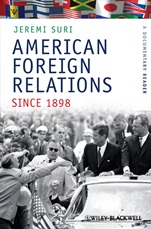
American Foreign Relations Since 1898: A Documentary Reader
ISBN 9781405184489
Autor: Jeremi Suri
Wydawca: Wiley
Dostępność: 3-6 tygodni
Cena: 457,80 zł
Przed złożeniem zamówienia prosimy o kontakt mailowy celem potwierdzenia ceny.
ISBN13: |
9781405184489 |
ISBN10: |
1405184485 |
Autor: |
Jeremi Suri |
Oprawa: |
Hardback |
Rok Wydania: |
2010-04-09 |
Ilość stron: |
272 |
Wymiary: |
252x153 |
Tematy: |
HB |
Bringing together more than 50 primary documents from the period, this volume offers a revealing picture of how Americans have interacted with the wider world since 1898. The documents capture the complexity of the issues at stake and give readers a first–hand look at the personalities, arguments, and events that shaped conflict and cooperation. Editor Jeremi Suri provides a clear and accessible framework for studying the period with a preliminary essay that introduces the reader to the key issues and debates, informative document headnotes which contextualize the materials, discussion questions, and a bibliography for further study. Discussing US foreign policy not only in terms of leaders and states but also in terms of social movements, cultural ideas, and images, this is a comprehensive examination of a subject which continues to play an important part in US history.
List of Illustrations. Series Editors′ Preface. Acknowledgments. Source Acknowledgments. Introduction. Chapter 1: War, Imperialism, Anti–Imperialism. 1 Secretary of State, John Hay, Open Door Notes, 1899–1900. 2 President William McKinley, Account of his Decision to Occupy the Philippines, 1898. 3 The Platt Amendment, 1901. 4 Jane Addams, Critique of American Militarism, 1902. 5 President Theodore Roosevelt, "Corollary" to the Monroe Doctrine, 1904. Chapter 2: The Great War and Its Aftermath. 1 George M. Cohan, "Over There," 1917. 2 President Woodrow Wilson, Fourteen Points Address, 1918. 3 Senator Robert LaFollette, Opposition to President Wilson’s War Message, 1917. 4 W. E. B. Dubois, Comments on the First World War, the Treaty of Versailles, and the Politics of Race, 1918. 5 Charles Lindbergh, Account of the First Solo Nonstop Airplane Flight Across the Atlantic Ocean, 1927. 6 The Kellogg–Briand Pact, 1928. Chapter 3: The Great Depression, Fascist Fears, and Social Change in America. 1 President Franklin D. Roosevelt, First Inaugural Address, 1933. 2 Hamilton Fish Armstrong, Meeting with Adolf Hitler, 1933. 3 Father Charles Coughlin, Radio attack on "Internationalism," 1931. 4 Charles Lindbergh, Speech to an America First Committee Meeting, 1941. 5 The Atlantic Charter, 1941. Chapter 4: The Second World War. 1 Lawrence T. Kagawa, the Internment of Japanese–Americans, 1942. 2 President Franklin Roosevelt and Soviet Marshal Josef Stalin at the Tehran Conference, 1943. 3 Dwight Eisenhower, the Liberation of Nazi Concentration Camps, 1945. 4 President Harry Truman, Diary Entries on the Potsdam Conference and his Decision to Drop the Atomic Bombs on Japan, 1945. 5 The Atomic Mushroom Cloud Over Nagasaki, 1945. Chapter 5: The Early Cold War. 1 George F. Kennan, "Long Telegram" on the Soviet Union, 1946. 2 The Truman Doctrine, 1947. 3 Assistant Secretary of State, Dean Rusk, the "Loss" of China, 1950. 4 Senator Joseph McCarthy, Speech in Wheeling, West Virginia, 1950. 5 NSC 68, 1950. 6 President Dwight Eisenhower, the "Falling Domino" Theory in Indochina, 1954. Chapter 6: Rebellions Against the Cold War. 1 Martin Luther King, Jr., "The Rising Tide of Racial Consciousness," 1960. 2 "Spy vs. Spy," 1961. 3 SANE, Public Petition, 1961. 4 Students for a Democratic Society, Port Huron Statement, 1962. 5 Women Strike for Peace, "What Every Woman Knows," 1962. 6 "Dr. Strangelove," 1964. 7 President Lyndon Johnson, "Peace Without Conquest," 1965. 8 Phil Ochs, "I ain′t marchin’ anymore," 1965. 9 Christian Appy, Oral Histories from the Vietnam War. 10 My Lai Massacre, 1968. Chapter 7: Detente, Human Rights, and the Continuation of the Cold War. 1 President Richard Nixon, "Opening" to China, 1972. 2 Agreement on Basic Principles between the United States and the Soviet Union, 1972. 3 American Complicity in Chilean Repression, 1973. 4 The Helsinki Final Act, 1975. 5 President Jimmy Carter, Address at the University of Notre Dame, 1977. 6 President Ronald Reagan, "Evil Empire" Speech, 1983. Chapter 8: The End of the Cold War. 1 President Ronald Reagan, Speech and Questionand–Answer Session at Moscow State University, 1988. 2 The New York Times, Mikhail Gorbachev′s Heroic Reception in the United States, 1988. 3 The New York Times, The Fall of the Berlin Wall, 1989. 4 President George H. W. Bush and Soviet Chairman Mikhail Gorbachev, the End of the Cold War, 1989. Chapter 9: After the Cold War. 1 President George H. W. Bush, the Iraqi Invasion of Kuwait, 1990. 2 Deputy Secretary of Defense, John Deutch, Genocide in Rwanda, 1994. 3 President Bill Clinton, the Kosovo Crisis, 1999. Chapter 10: The War on Terror. 1 The Terrorist Attacks of September 11, 2001. 2 The New York Times , the Public Horror of September 11, 2001. 3 President George W. Bush, the Bush Doctrine, 2002. 4 George Packer, the Iraq War, 2005. 5 Torture at Abu Ghraib Prison, 2004. Select Bibliography. Index.
Jeremi Suri is the E. Gordon Fox Professor of History at the University of Wisconsin – Madison. He is the author of Henry Kissinger and the American Century (2007), The Global Revolutions of 1968 (2006), and Power and Protest: Global Revolution and the Rise of Détente (2003).
Koszyk
Książek w koszyku: 0 szt.
Wartość zakupów: 0,00 zł
Informacje


Kontakt
Gambit
Centrum Oprogramowania
i Szkoleń Sp. z o.o.
Al. Pokoju 29b/22-24
31-564 Kraków
Siedziba Księgarni
ul. Kordylewskiego 1
31-542 Kraków
+48 12 410 5991
+48 12 410 5987
+48 12 410 5989
Subskrypcje
Administratorem danych osobowych jest firma Gambit COiS Sp. z o.o. Na podany adres będzie wysyłany wyłącznie biuletyn informacyjny.
Autoryzacja płatności

Informacje na temat autoryzacji płatności poprzez PayU.

© Copyright 2012: GAMBIT COiS Sp. z o.o. Wszelkie prawa zastrzeżone.
Projekt i wykonanie: Alchemia Studio Reklamy