


Wydawcy
Katalog tematyczny
- Archeologia (109)
- Ekonomia, finanse, business (13704)
- Filozofia (1445)
- Historia (3040)
- Języki i językoznawstwo (2356)
- Lifestyle, hobby i rozrywka (475)
- Medycyna (9704)
- Nauki humanistyczne (4)
- Nauki o Ziemi i środowisku (2638)
- Nauki ścisłe (20412)
- Nauki społeczne (8486)
- Nauki techniczne (13450)
- Prawo (1696)
- Publikacje informacyjne i interdyscyplinarne (1288)
- Religia i wierzenia (917)
- Technika komputerowa (4067)
- Zdrowie, relacje międzyludzkie i rozwój osobisty (657)





Informacje szczegółowe o książce
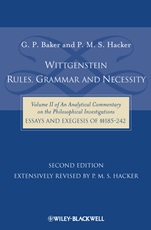
Wittgenstein: Rules, Grammar and Necessity: Volume 2 of an Analytical Commentary on the Philosophical Investigations, Essays and Exegesis §§185–242
ISBN 9781405184083
Autor: Gordon P. Baker, P. M. S. Hacker
Wydawca: Wiley
Dostępność: 3-6 tygodni
Cena: 694,05 zł
Przed złożeniem zamówienia prosimy o kontakt mailowy celem potwierdzenia ceny.
ISBN13: |
9781405184083 |
ISBN10: |
1405184086 |
Autor: |
Gordon P. Baker, P. M. S. Hacker |
Oprawa: |
Hardback |
Rok Wydania: |
2009-11-20 |
Numer Wydania: |
2nd Edition |
Ilość stron: |
400 |
Wymiary: |
239x162 |
Tematy: |
CFA |
This is an extensively revised second edition of Wittgenstein: Rules, Grammar and Necessity, the second volume of Baker and Hacker′s renowned analytical commentary on Wittgenstein′s Philosophical Investigations . Comprising both detailed exegesis and interpretative essays, this edition includes comprehensively revised coverage of some of the most important and widely discussed passages in Wittgenstein′s entire writings, namely his intricate and controversial remarks on following rules (§§189–242). The new edition draws on the full resources of the search engine of the electronic publication of the Nachlass and takes into account the extensive debates on the themes associated with these sections of Wittgenstein′s masterwork over the last quarter of a century. All the essays have been revised and one new essay on communitarian and individualist conceptions of rule–following has been added to the previous six. These deal with the relationship between the alternative continuations of the early draft of the Investigations ; with Wittgenstein′s conception of grammar and rules of grammar; with the relation between a rule and what accords with it; with the characterization of rule–following as mastery of a technique manifest in practice; with the notion of a form of life and agreements in definitions and judgements. The major essay ′Grammar and necessity′ has been greatly extended. It provides an overview of Wittgenstein′s revolutionary and little understood analysis of the propositions of logic, mathematics and metaphysics. Insightful and thought–provoking, the second edition of Wittgenstein: Rules, Grammar and Necessity constitutes a key contribution to the ongoing analysis of one of the most influential philosophical works of the 20th century.
Acknowledgements. Introduction to Volume 2. Abbreviations. ANALYTICALCOMMENTARY. I Two fruits upon one tree. 1. The continuation of the Early Draft into philosophy of mathematics. 2. Hidden isomorphism. 3. A common methodology. 4. The flatness of philosophical grammar. FOLLOWINGA RULE§§185–242. Introduction to the exegesis. II Rules and grammar. 1. The Tractatusand rules of logical syntax. 2. From logical syntax to philosophical grammar. 3. Rules and rule–formulations. 4. Philosophy and grammar. 5. The scope of grammar. 6. Some morals. Exegesis§§185–8. III Accord with a rule. 1. Initial compass bearings. 2. Accord and the harmony between language and reality. 3. Rules of inference and logical machinery. 4. Formulations and explanations of rules by examples. 5. Interpretations, fitting and grammar. 6. Further misunderstandings. Exegesis §§189–202. IV Following rules, mastery of techniques, and practices. 1. Following a rule. 2. Practices and techniques. 3. Doing the right thing and doing the same thing. 4. Privacy and the community view. 5. On not digging below bedrock. V Private linguists and ‘private linguists’ – Robinson Crusoe sails again. 1. Is a language necessarily shared with a community of speakers? 2. Innate knowledge of a language. 3. Robinson Crusoe sails again. 4. Solitary cavemen and monologuists. 5. Private languages and ‘private languages’. 6. Overview. Exegesis§§203–37. VI Agreement in definitions, judgements and forms of life. 1. The scaffolding of facts. 2. The role of our nature. 3. Forms of life. 4. Agreement: consensus of human beings and their actions. Exegesis§§238–42. VII Grammar and necessity. 1. Setting the stage. 2. Leitmotifs. 3. External guidelines. 4. Necessary propositions and norms of representation. 5. Concerning the truth and falsehood of necessary propositions. 6. What necessary truths are about. 7. Illusions of correspondence: ideal objects, kinds of reality and ultra–physics. 8. The psychology and epistemology of the a priori. (i) Knowledge. (ii) Belief. (iii) Certainty. (iv) Surprise. (v) Discoveries and conjectures. (vi) Compulsion. 9. Propositions of logic and laws of thought. 10. Alternative forms of representation. 11. The arbitrariness of grammar. 12. A kinship to the non–arbitrary. 13. Proof in mathematics. 14. Conventionalism. Index.
G. P. Baker was a Fellow of St John′s College, Oxford from 1967 until his death in 2002. He is the co–author with P.M.S. Hacker of the first two volumes of the four–volume Analytical Commentary on the Philosophical Investigations (Blackwell, 1980–96), author of Wittgenstein, Frege and the Vienna Circle (Blackwell, 1988) and, with Katherine Morris, of Descartes′ Dualism (1996). He also wrote numerous articles on Wittgenstein, Frege, Russell, Waismann and Descartes. P. M. S. Hacker is the leading authority on the philosophy of Wittgenstein. He is author of the four–volume Analytical Commentary on the Philosophical Investigations , the first two volumes co–authored with G.P. Baker (Blackwell, 1980–96) and of Wittgenstein′s Place in Twentieth–century Analytic Philosophy (Blackwell, 1996). His recent works include The Philosophical Foundations of Neuroscience (Blackwell, 2003) and History of Cognitive Neuroscience (Wiley–Blackwell, 2008), both co–authored with M. R. Bennett. Most recently he has published Human Nature: The Categorial Framework (Blackwell, 2007), the first volume of a trilogy on human nature. Together with Joachim Schulte, he has produced the 4 th edition and extensively revised translation of Wittgenstein′s Philosophical Investigations (Wiley–Blackwell, 2009).
Koszyk
Książek w koszyku: 0 szt.
Wartość zakupów: 0,00 zł
Informacje


Kontakt
Gambit
Centrum Oprogramowania
i Szkoleń Sp. z o.o.
Al. Pokoju 29b/22-24
31-564 Kraków
Siedziba Księgarni
ul. Kordylewskiego 1
31-542 Kraków
+48 12 410 5991
+48 12 410 5987
+48 12 410 5989
Subskrypcje
Administratorem danych osobowych jest firma Gambit COiS Sp. z o.o. Na podany adres będzie wysyłany wyłącznie biuletyn informacyjny.
Autoryzacja płatności

Informacje na temat autoryzacji płatności poprzez PayU.

© Copyright 2012: GAMBIT COiS Sp. z o.o. Wszelkie prawa zastrzeżone.
Projekt i wykonanie: Alchemia Studio Reklamy