


Wydawcy
Katalog tematyczny
- Archeologia (109)
- Ekonomia, finanse, business (13704)
- Filozofia (1445)
- Historia (3040)
- Języki i językoznawstwo (2356)
- Lifestyle, hobby i rozrywka (475)
- Medycyna (9704)
- Nauki humanistyczne (4)
- Nauki o Ziemi i środowisku (2638)
- Nauki ścisłe (20412)
- Nauki społeczne (8486)
- Nauki techniczne (13450)
- Prawo (1696)
- Publikacje informacyjne i interdyscyplinarne (1288)
- Religia i wierzenia (917)
- Technika komputerowa (4067)
- Zdrowie, relacje międzyludzkie i rozwój osobisty (657)





Informacje szczegółowe o książce
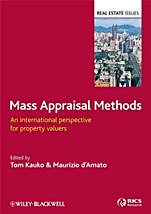
Mass Appraisal Methods: An International Perspective for Property Valuers
ISBN 9781405180979
Autor: Tom Kauko, Maurizio dAmato
Wydawca: Wiley
Dostępność: 3-6 tygodni
Cena: 672,00 zł
Przed złożeniem zamówienia prosimy o kontakt mailowy celem potwierdzenia ceny.
ISBN13: |
9781405180979 |
ISBN10: |
1405180978 |
Autor: |
Tom Kauko, Maurizio dAmato |
Oprawa: |
Hardback |
Rok Wydania: |
2008-08-29 |
Ilość stron: |
360 |
Wymiary: |
254x175 |
Tematy: |
KM |
This book takes a cross–disciplinary and cross–cultural look at mass appraisal expertise for property valuation in different market conditions, and offers some cutting– edge approaches.
The editors establish an international platform and present the scientific debate as well as practical feasibility considerations. Heretic and orthodox valuation methods are assessed based on specific criteria, partly technical and partly institutional. Methodological evaluation is approached using two types of criteria: operational concerns about how to determine property value differentials between spatial and functional units of real estate in a valid and reliable way (technical criteria); and the kind of market circumstances being operated in (institutional criteria). While technical criteria are relatively well–researched, there is little theoretically informed work on the connection between country context and selection of property appraisal methods.
The book starts with an examination of current mass property appraisal practices, presenting case studies from widely differing markets – from the American and Dutch, where regression–based methods have been used successfully for some time; to the Eastern European and other emerging economies, where limitations have to be compensated by focusing on the modelling assumptions.
The second part of the book looks at sophisticated modelling approaches, some of which represent combinations of elements from two or more techniques. Whatever the exact modelling approach, the requirements are always high for the quality of the data and suitability of the method. In the final section, methods are evaluated and compared according to technical criteria and against institutional contexts.
With its exceptionally wide coverage of valuation issues, Mass Appraisal Methods: an international perspective for property valuers addresses property valuation problems common to different countries and approac
hes applicable in both developed and emerging economies.
Spis treści:
Contributors.
Foreword.
Preface.
Abbreviations.
1 Introduction: Suitability Issues in Mass Appraisal Methodology (Tom Kauko and Maurizio d’Amato).
PART I MASS APPRAISAL PRACTICE AND RECOMMENDATIONS.
2 Data Issues Involved with the Application of Automated Valuation Methods: A Case Study (John F. Thompson, Jr).
3 The Modified Comparable Sales Method as the Basis for a Property Tax Valuations System and its Relationship and Comparison to Spatially Autoregressive Valuation Models (Richard A. Borst and William J. McCluskey).
4 Automated Valuation in the Dutch Housing Market: The Web–Application ′MarktPositie′ Used by NVM–Realtors (Dree Op ’t Veld, Emma Bijlsma and Paulien van de Hoef).
5 Using Fuzzy Numbers in Mass Appraisal: The Case of the Belarusian Property Market (Maurizio d’Amato and Nikolai Siniak).
PART II CURRENT ADVANCED METHODS.
6 Mass Appraisal, Hedonic Price Modelling and Urban Externalities: Understanding Property Value Shaping Processes (François Des Rosiers and Marius Thériault).
7 Residuals Analysis for Constructing ‘More Real’ Property Value (Małgorzata Renigier).
8 The Hierarchical Trend Model (Marc K. Francke).
PART III EMERGING METHODS.
9 Developing Mass Appraisal Models with Fuzzy Systems (Marco Aurélio Stumpf González).
10 Utterly Unorthodox Modelling for the Purposes of Mass Appraisal: An Approach Based on Patterns and Judgments (Tom Kauko).
11 Rough Set Theory as Property Valuation Methodology: The Whole Story (Maurizio d’Amato).
PART IV COMPARISON OF TOOLS USING A SET OF SPECIFIC CRITERIA.
12 Technical Comparison of the Methods Including Formal Testing of Accuracy and Other Modelling Performance Using Own Data Sets and Multiple Regression Analysis (Richard A. Borst, François Des Ro
siers, Małgorzata Renigier, Marco Aurélio Stumpf González, Tom Kauko and Maurizio d’Amato).
13 Property Market Classification and Mass Appraisal Methodology (Maurizio d’Amato and Tom Kauko).
PART V CONCLUSION.
14 Automated Valuation Methods, Empirical Modelling of Value, and Systems for Market Analysis (Tom Kauko).
Glossary.
Index.
Nota biograficzna:
Tom Kauko, Norwegian University of Science and Technology, and Delft University of Technology, The Netherlands.
Maurizio d′Amato, Technical Univerisity Politecnico di Bari, Italy.
Okładka tylna:
This book takes a cross–disciplinary and cross–cultural look at mass appraisal expertise for property valuation in different market conditions, and offers some cutting– edge approaches.
The editors establish an international platform and present the scientific debate as well as practical feasibility considerations. Heretic and orthodox valuation methods are assessed based on specific criteria, partly technical and partly institutional. Methodological evaluation is approached using two types of criteria: operational concerns about how to determine property value differentials between spatial and functional units of real estate in a valid and reliable way (technical criteria); and the kind of market circumstances being operated in (institutional criteria). While technical criteria are relatively well–researched, there is little theoretically informed work on the connection between country context and selection of property appraisal methods.
The book starts with an examination of current mass property appraisal practices, presenting case studies from widely differing markets – from the American and Dutch, where regression–based methods have been used successfully for some time; to the Eastern European and other emerging economies, where limitations have to be compensated by focus
ing on the modelling assumptions.
The second part of the book looks at sophisticated modelling approaches, some of which represent combinations of elements from two or more techniques. Whatever the exact modelling approach, the requirements are always high for the quality of the data and suitability of the method. In the final section, methods are evaluated and compared according to technical criteria and against institutional contexts.
With its exceptionally wide coverage of valuation issues, Mass Appraisal Methods: an international perspective for property valuers addresses property valuation problems common to different countries and approaches applicable in both developed and emerging economies.
Koszyk
Książek w koszyku: 0 szt.
Wartość zakupów: 0,00 zł
Informacje


Kontakt
Gambit
Centrum Oprogramowania
i Szkoleń Sp. z o.o.
Al. Pokoju 29b/22-24
31-564 Kraków
Siedziba Księgarni
ul. Kordylewskiego 1
31-542 Kraków
+48 12 410 5991
+48 12 410 5987
+48 12 410 5989
Subskrypcje
Administratorem danych osobowych jest firma Gambit COiS Sp. z o.o. Na podany adres będzie wysyłany wyłącznie biuletyn informacyjny.
Autoryzacja płatności

Informacje na temat autoryzacji płatności poprzez PayU.

© Copyright 2012: GAMBIT COiS Sp. z o.o. Wszelkie prawa zastrzeżone.
Projekt i wykonanie: Alchemia Studio Reklamy