


Wydawcy
Katalog tematyczny
- Archeologia (109)
- Ekonomia, finanse, business (13704)
- Filozofia (1445)
- Historia (3040)
- Języki i językoznawstwo (2356)
- Lifestyle, hobby i rozrywka (475)
- Medycyna (9704)
- Nauki humanistyczne (4)
- Nauki o Ziemi i środowisku (2638)
- Nauki ścisłe (20412)
- Nauki społeczne (8486)
- Nauki techniczne (13450)
- Prawo (1696)
- Publikacje informacyjne i interdyscyplinarne (1288)
- Religia i wierzenia (917)
- Technika komputerowa (4067)
- Zdrowie, relacje międzyludzkie i rozwój osobisty (657)





Informacje szczegółowe o książce
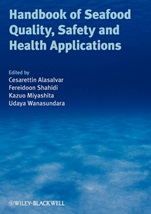
Handbook of Seafood Quality, Safety and Health Applications
ISBN 9781405180702
Autor: Cesarettin Alasalvar, Kazuo Miyashita, Fereidoon Shahidi, Udaya Wanasundara
Wydawca: Wiley
Dostępność: 3-6 tygodni
Cena: 1 061,55 zł
Przed złożeniem zamówienia prosimy o kontakt mailowy celem potwierdzenia ceny.
ISBN13: |
9781405180702 |
ISBN10: |
1405180706 |
Autor: |
Cesarettin Alasalvar, Kazuo Miyashita, Fereidoon Shahidi, Udaya Wanasundara |
Oprawa: |
Hardback |
Rok Wydania: |
2010-10-15 |
Ilość stron: |
576 |
Wymiary: |
245x178 |
Tematy: |
KNAF |
The global market for seafood products continues to increase year by year. Food safety considerations are as crucial as ever in this sector, and higher standards of quality are demanded even as products are shipped greater distances around the world. The current global focus on the connection between diet and health drives growth in the industry and offers commercial opportunities on a number of fronts. There is great interest in the beneficial effects of marine functional compounds such as omega–3 polyunsaturated fatty acids. Seafoods are well–known as low calorie foods, and research continues into the nutritional effects on, for example, obesity and heart disease. In addition, by–products of marine food processing can be used in nutraceutical applications.
This book will be a resource for those interested in the latest advances in the science and technology of seafood quality and safety as well as new developments in the nutritional effects and applications of marine foods. It will include chapters on the practical evaluation of seafood quality; novel approaches in preservation techniques; flavour chemistry and analysis; textural quality and measurement; packaging; the control of food–borne pathogens and seafood toxins. New research on the health–related aspects of marine food intake will be covered, as well as the use of seafoods as sources of bioactives and nutraceuticals. The book is directed at scientists and technologists in academia, government laboratories and the seafood industries, including quality managers, processors and sensory scientists.
Spis treści:
1. Introduction.
Cesarettin Alasalvar, TUBITAK Marmara Research Centre, Gebze, Kocaeli, Turkey.
.
Part I: Seafood Quality.
2. Practical evaluation of seafood quality.
Cesarettin Alasalvar, TUBITAK Marmara Research Centre, Gebze, Kocaeli, Turkey.
3. Quality of freshwater products.
Msaki Kaneniwa, National Research Institute
of Fisheries Science, Yokohama, Japan.
4. Lipid oxidation, odor and color.
Jeong–Ho Sohn and Toshiaki Ohshima, Department of Food Science and Technology,Tokyo University of Marine Science and Technology, Japan.
5. Blackspot development in crustaceans during storage – mechanism and prevention.
Takashi Hirata, Graduate School of Agriculture, Kyoto University, Japan.
6. Novel approaches in seafood preservation techniques.
Fatih Ozogul, Cukurova University, Faculty of Aquatic Sciences, Adana, Turkey.
7. Flavour chemistry and analysis of seafood and its products.
Keith Cadwallader, University of Illinos, USA.
8. Textural quality and measurement of seafoods.
Paul Nesvadba, Consultant, UK.
9. Packaging in the seafood industry.
Author TBA.
.
Part II: Seafood safety.
10. Foodborne pathogens in seafood and their control.
Bagenda D. Kasujja and Koji Yamazaki, Faculty of Fisheries Science, Hokkaido University, Japan.
11. Natural antimicrobials for fish preservation.
Barakat S.M. Mahmoud, Department of Food Science, Purdue University, West Lafayette, USA.
12. Transgenic/genetically modified fish.
Author TBA.
13. Seafood toxins.
Author from Endonesia.
14. Molecular detection of pathogens.
Author TBA.
.
Part III: Health Applications of Seafood.
15. Functional improvement of fish meat proteins.
Hiroki Saeki, Faculty of Fisheries Science, Hokkaido University, Hakodate, Japan.
16. Adding value to fish processing by–products.
Sachindra M. Nakkarike, Central Food Research Institute, Mysore, India.
17. The suppressive effect of marine foods intake on obesity and lifestyle–related diseases.
Shigeru Nakajima, Bunkyo University Women’s College, Kanagawa, Japan.
18. Microencapsulation, edible film and coatings applications in seafood processing.
Subramaniam Sathivel, University of Alaska Fairbanks, Kodiak, USA and Don Kramer, Marine Advisory Program, Anchorag
e, Canada.
19. Fish oil extraction, purification, and properties.
Subramaniam Sathivel, University of Alaska Fairbanks, Kodiak, USA.
20. Nutraceutical quality of shellfish.
Bonnie Sun Pam, Taiwan.
21. Marine food intake and heart disease.
Robert Ackman, Canadian Institute of Fisheries Technology, Dalhousie University, Halifax, Canada.
22. Marine seaweed as a source of bioactives and nutraceuticals.
Author TBA.
References
Nota biograficzna:
Professor Cesarettin Alasalvar, Chief Research Scientist, Food Institute, TÜBİTAK Marmara Research Centre, Gebze, Turkey
Professor Kazuo Miyashita, Laboratory of Bio–functional Material Chemistry, Graduate School of Fisheries Science, Hokkaido University, Hakodate, Japan
Professor Fereidoon Shahidi, University Research Professor, Department of Biochemistry, Memorial University of Newfoundland, St. John’s, Newfoundland, Canada
Okładka tylna:
The global market for seafood products continues to increase year by year. Food safety considerations are as crucial as ever in this sector, and higher standards of quality are demanded even as products are shipped greater distances around the world. The current global focus on the connection between diet and health drives growth in the industry and offers commercial opportunities on a number of fronts. There is great interest in the beneficial effects of marine functional compounds such as omega–3 polyunsaturated fatty acids. Seafoods are well–known as low calorie foods, and research continues into the nutritional effects on, for example, obesity and heart disease. In addition, by–products of marine food processing can be used in nutraceutical applications.
This book will be a resource for those interested in the latest advances in the science and technology of seafood quality and safety as well as new developments in the nutritional effects and applications of marine foods.
It will include chapters on the practical evaluation of seafood quality; novel approaches in preservation techniques; flavour chemistry and analysis; textural quality and measurement; packaging; the control of food–borne pathogens and seafood toxins. New research on the health–related aspects of marine food intake will be covered, as well as the use of seafoods as sources of bioactives and nutraceuticals. The book is directed at scientists and technologists in academia, government laboratories and the seafood industries, including quality managers, processors and sensory scientists.
Koszyk
Książek w koszyku: 0 szt.
Wartość zakupów: 0,00 zł
Informacje


Kontakt
Gambit
Centrum Oprogramowania
i Szkoleń Sp. z o.o.
Al. Pokoju 29b/22-24
31-564 Kraków
Siedziba Księgarni
ul. Kordylewskiego 1
31-542 Kraków
+48 12 410 5991
+48 12 410 5987
+48 12 410 5989
Subskrypcje
Administratorem danych osobowych jest firma Gambit COiS Sp. z o.o. Na podany adres będzie wysyłany wyłącznie biuletyn informacyjny.
Autoryzacja płatności

Informacje na temat autoryzacji płatności poprzez PayU.

© Copyright 2012: GAMBIT COiS Sp. z o.o. Wszelkie prawa zastrzeżone.
Projekt i wykonanie: Alchemia Studio Reklamy