


Wydawcy
Katalog tematyczny
- Archeologia (109)
- Ekonomia, finanse, business (13704)
- Filozofia (1445)
- Historia (3040)
- Języki i językoznawstwo (2356)
- Lifestyle, hobby i rozrywka (475)
- Medycyna (9704)
- Nauki humanistyczne (4)
- Nauki o Ziemi i środowisku (2638)
- Nauki ścisłe (20412)
- Nauki społeczne (8486)
- Edukacja (229)
- Kryminologia, opieka spełeczna (284)
- Obronność (10)
- Polityka (1389)
- Psychologia (777)
- Socjologia (410)
- Społeczeństwo i kultura (187)
- Nauki techniczne (13450)
- Prawo (1696)
- Publikacje informacyjne i interdyscyplinarne (1288)
- Religia i wierzenia (917)
- Technika komputerowa (4067)
- Zdrowie, relacje międzyludzkie i rozwój osobisty (657)





Informacje szczegółowe o książce
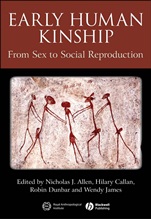
Early Human Kinship: From Sex to Social Reproduction
ISBN 9781405179010
Autor: Nicholas J. Allen, Hilary Callan, Robin Dunbar, Wendy James
Wydawca: Wiley
Dostępność: 3-6 tygodni
Cena: 500,85 zł
Przed złożeniem zamówienia prosimy o kontakt mailowy celem potwierdzenia ceny.
ISBN13: |
9781405179010 |
ISBN10: |
1405179015 |
Autor: |
Nicholas J. Allen, Hilary Callan, Robin Dunbar, Wendy James |
Oprawa: |
Hardback |
Rok Wydania: |
2008-06-06 |
Ilość stron: |
336 |
Wymiary: |
256x183 |
Tematy: |
JBK |
Questions of ‘kinship’ have always been at the centre of anthropology. Was there a connection between the beginnings of language and the beginnings of organized ‘kinship and marriage’? How far did evolutionary selection favour gender and generation as abstract principles for regulating social relations within and between ancient bands of our early ancestors? This book debates these and other fundamental questions about the emergence of human society.
Early Human Kinship brings together original studies from leading figures in the biological sciences, social anthropology, archaeology and linguistics. The volume takes as its starting point the evolutionary link between enlarged brain capacity and the ability of human ancestors to support increasingly large population groups. It then moves beyond traditional Darwinian questions to ask how far early humans might have organized these groups according to rules about mating and social reproduction of a kind that we would recognize today.
Sponsored by the Royal Anthropological Institute, in conjunction with the British Academy, Early Human Kinship provides a major breakthrough in the debate over human evolution and the nature of society.
Spis treści:
List of Tables.
List of Figures.
List of Illustrations.
Preface.
Acknowledgements.
Notes on Contributors.
INTRODUCTION AND BACKGROUND.
Why ′Kinship′? New Questions on an Old Topic (Wendy James).
A Brief Overview of Human Evolution (John A. J. Gowlett and Robin Dunbar).
PART I Where and When: The Archaeological Evidence for Early Social Life in Africa.
1 Kinship and Material Culture: Archaeological Implications of the Human Global Diaspora (Clive Gamble).
2 Deep Roots of Kin: Developing the Evolutionary Perspective from Prehistory (John A. J. Gowlett).
PART II Women, Children, Men – and the Puzzles of Comparative So
cial Structure.
3 Early Human Kinship Was Matrilineal (Chris Knight).
4 Alternating Birth Classes: A Note from Eastern Africa (Wendy James).
5 Tetradic Theory and the Origin of Human Kinship Systems (Nicholas J. Allen).
6 What Can Ethnography Tell Us about Human Social Evolution? (Robert Layton).
PART III Other Primates and the Biological Approach.
7 Kinship in Biological Perspective (Robin Dunbar).
8 The Importance of Kinship in Monkey Society (Amanda H. Korstjens).
9 Meaning and Relevance of Kinship in Great Apes (Julia Lehmann).
10 Grandmothering and Female Coalitions: A Basis for Matrilineal Priority? (Kit Opie and Camilla Power).
PART IV Reconstructions: Evidence from Cultural Practice and Language.
11 A Phylogenetic Approach to the History of Cultural Practices (Laura Fortunato).
12 Reconstructing Ancient Kinship in Africa (Christopher Ehret).
13 The Co–evolution of Language and Kinship (Alan Barnard).
EPILOGUE.
Reaching across the Gaps (Hilary Callan).
Appendices to Chapter 12.
Bibliography.
Index.
Nota biograficzna:
Nicholas J. Allen is Emeritus Fellow of Wolfson College, University of Oxford. He has published on the Himalayas, kinship theory, the Durkheimian School and Indo–European Comparativism. His books include Categories and Classifications (2000) and Marcel Mauss: A Centenary Tribute (1998).
Hilary Callan has been Director of the Royal Anthropological Institute of Great Britain and Ireland since 2000. Her research and publications include work on biological and social anthropology, occupational cultures, and gender, including Ethology and Society (1970)and The Incorporated Wife (edited with Shirley Ardener, 1984).
Wendy James was until recently Professor of Social Anthropology at the University of Oxford, an
d is now Emeritus Fellow of St Cross College, Oxford. She has carried out ethnographic research in North East Africa, and her books include War and Survival in Sudan’s Frontierlands: Voices from the Blue Nile (2007) and The Ceremonial Animal: A New Portrait of Anthropology (2003).
Robin Dunbar is Professor of Evolutionary Anthropology, University of Oxford, and specializes in primate behaviour. He is co–director of the British Academy’s Centenary Research Project (′From Lucy to Language: The Archaeology of the Social Brain′). He is the author or co–author of numerous books, including The Human Story (2004) and Evolutionary Psychology: A Beginner’s Guide (2005).
Okładka tylna:
Questions of ‘kinship’ have always been at the centre of anthropology. Was there a connection between the beginnings of language and the beginnings of organized ‘kinship and marriage’? How far did evolutionary selection favour gender and generation as abstract principles for regulating social relations within and between ancient bands of our early ancestors? This book debates these and other fundamental questions about the emergence of human society.
Early Human Kinship brings together original studies from leading figures in the biological sciences, social anthropology, archaeology and linguistics. The volume takes as its starting point the evolutionary link between enlarged brain capacity and the ability of human ancestors to support increasingly large population groups. It then moves beyond traditional Darwinian questions to ask how far early humans might have organized these groups according to rules about mating and social reproduction of a kind that we would recognize today.
Sponsored by the Royal Anthropological Institute, in conjunction with the British Academy, Early Human Kinship provides a major breakthrough in the debate over human
evolution and the nature of society.
Koszyk
Książek w koszyku: 0 szt.
Wartość zakupów: 0,00 zł
Informacje


Kontakt
Gambit
Centrum Oprogramowania
i Szkoleń Sp. z o.o.
Al. Pokoju 29b/22-24
31-564 Kraków
Siedziba Księgarni
ul. Kordylewskiego 1
31-542 Kraków
+48 12 410 5991
+48 12 410 5987
+48 12 410 5989
Subskrypcje
Administratorem danych osobowych jest firma Gambit COiS Sp. z o.o. Na podany adres będzie wysyłany wyłącznie biuletyn informacyjny.
Autoryzacja płatności

Informacje na temat autoryzacji płatności poprzez PayU.

© Copyright 2012: GAMBIT COiS Sp. z o.o. Wszelkie prawa zastrzeżone.
Projekt i wykonanie: Alchemia Studio Reklamy