


Wydawcy
Katalog tematyczny
- Archeologia (109)
- Ekonomia, finanse, business (13704)
- Filozofia (1445)
- Historia (3040)
- Języki i językoznawstwo (2356)
- Lifestyle, hobby i rozrywka (475)
- Medycyna (9704)
- Nauki humanistyczne (4)
- Nauki o Ziemi i środowisku (2638)
- Nauki ścisłe (20412)
- Nauki społeczne (8486)
- Nauki techniczne (13450)
- Budownictwo lądowe (1045)
- Budownictwo komunikacyjne (9)
- Hydraulika (33)
- Konstrukcje budowlane (95)
- Mechanika konstrukcji (182)
- Przemysł budowlany (7)
- Chemia przemysłowa (2258)
- Elektronika i telekomunikacja (3287)
- Energetyka (1122)
- Inne nauki stosowane (363)
- Inżynieria biochemiczna (507)
- Inżynieria transportu (232)
- Mechanika i materiały (3316)
- Nauka o środowisku (321)
- Rolnictwo (507)
- Technika, ogólnie (475)
- Prawo (1696)
- Publikacje informacyjne i interdyscyplinarne (1288)
- Religia i wierzenia (917)
- Technika komputerowa (4067)
- Zdrowie, relacje międzyludzkie i rozwój osobisty (657)





Informacje szczegółowe o książce
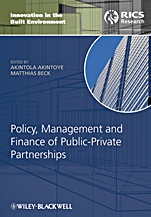
Policy, Management and Finance of Public–Private Partnerships
ISBN 9781405177917
Autor: Akintola Akintoye, Matthias Beck
Wydawca: Wiley
Dostępność: 3-6 tygodni
Cena: 605,85 zł
Przed złożeniem zamówienia prosimy o kontakt mailowy celem potwierdzenia ceny.
ISBN13: |
9781405177917 |
ISBN10: |
1405177918 |
Autor: |
Akintola Akintoye, Matthias Beck |
Oprawa: |
Hardback |
Rok Wydania: |
2008-10-10 |
Ilość stron: |
504 |
Wymiary: |
253x181 |
Tematy: |
TN |
This book examines some of the key policy, financial and managerial aspects of public–private partnerships within the context of the global spread of this form of procurement.
The chapters investigate political and institutional issues surrounding PPPs, together with the financial and managerial strategies employed by the private sector. Adopting a cross–disciplinary perspective, the book highlights the often politically sensitive nature of these projects and identifies a need for the private sector to investigate a broad set of parameters which relate to the particular political economy of individual partnerships.
Policy, Finance & Management for Public–Private Partnerships covers a range of specific issues, including: partnerships in developing countries; innovation in partnership–based procurement; government and business interaction; institutional and organisational approaches to facilitating partnership; project and corporate financing; risk and value management; market analysis, modelling and forecasting; capital structure decisions and management; investment theory and practice; pricing and cost evaluation; statutory regulations and their financial implications; option pricing; financial monitoring; syndicate funding; new roles for the financial and insurance sectors; institutional and multilateral funding; payment mechanisms; concession period determination; risk analysis and management; whole life value methodology; cost comparators and best value; team building, team work and skill development.
Contributions from Australia, Europe, the Far East, South Africa and the United States together present the current thinking and state–of–the–art approaches to public–private partnerships.
Spis treści:
Foreword.
Contributors.
Introduction.
Part One: PPP Policy.
1 Private Finance Initiative in Use.
Ezekiel Chinyio and Rod Games
on.
1.1Introduction.
1.2The private finance initiative.
1.3UK government’s influence on the use of PFI.
1.4Private sector tasks in PFI.
1.5Establishing PFI contracts.
1.6Forms of finance used in PFI.
1.7Performance of PFI schemes –– a theoretical perspective.
1.8Improving the performance of PFI.
1.9Performance of PFI schemes –– an empirical review.
1.10A generic overview of PFI schemes.
1.11Comparative studies.
1.12Conclusion.
2 Using the Private Sector to Finance Capital Expenditure.
Jean Shaoul.
2.1Introduction.
2.2The control of PFI.
2.3Post–implementation evaluation of PFI.
2.4Conclusion.
3 Obstacles to Accountability in PFI Projects.
Darinka Asenova and Matthias Beck.
3.1Introduction.
3.2Finance capital and institutional decision making.
3.3Conclusion.
4 Refinancing and the Profitability of UK PFI Projects.
Steven Toms, Darinka Asenova and Matthias Beck.
4.1Introduction.
4.2PFI finance and value for money.
4.3Mechanisms and policies of refinancing.
4.4PFI profits and refinancing.
4.5Conclusion.
5 The Dedicated PPP Unit of the South African National Treasury.
Philippe Burger.
5.1Introduction.
5.2The rationale for PPPs.
5.3The rationale for a dedicated PPP unit.
5.4A brief history of PPPs and the PPP unit in South Africa.
5.5The role of the South African dedicated PPP Unit.
5.6Future challenges.
5.7Conclusion.
6 PPP in Greenfield Airport Development.
Thillai Rajan A., Sheetal Sharad and Sinha Sidharth.
6.1Introduction.
6.2Private participation in new airport development.
6.3Indian aviation sector.
6.4The Cochin International Airport project.
6.5Performance of CIAL.
6.6Summary and lessons.
7 PPPs for Physical Infrastructure in Developing Countries.
Akintola Akintoye.
7.1Introduction.
7.2An overview of public––private par
tnerships.
7.3PPP: developed economies.
7.4PPP: Developing economies.
7.5PPP: Analysis of private sector participation.
7.6Discussion.
7.7Conclusions.
8 Team building for PPPs.
Mohan M. Kumaraswamy, Florence Y.Y. Ling and Aaron M. Anvuur.
8.1Introduction.
8.2Integrating and sustaining PPP teams.
8.3Hong Kong perspectives of PPP teams.
8.4Singapore perspectives of PPP teams.
8.5Intergrating PPP project teams.
8.6Selecting project consortium teams.
8.7Concluding observations.
Part Two: PPP Finance.
9 PPP Infrastructure Investments.
Demos C. Angelides and Yiannis Xenidis.
9.1Introduction.
9.2Critical issues in financing PPP projects.
9.3Prospects for PPP infrastructure development.
9.4Conclusion.
10 Patterns of Financing PPP Projects.
Sudong Ye.
10.1Introduction.
10.2General patterns of financing PPP projects.
10.3Choice of financing patterns.
10.4Summary.
.
11 PPP Financing in the USA.
Arthur L. Smith.
11.1Introduction.
11.2PPP financing models in the US.
11.3Case studies.
11.4Conclusions.
12 Financial Modelling of PPP Projects.
Ammar Kaka and Faisal Alsharif.
12.1Introduction.
12.2Research in PPP financial modelling.
12.3Cost models.
12.4Occupancy cost.
12.5Cash flow models.
12.6PFI financial modelling in practice.
12.7An example of a PFI financial model for schools.
12.8Conclusion.
13 Application of Real Options in PPP Infrastructure Projects.
Charles Y.J. Cheah and Michael J. Garvin.
13.1Introduction.
13.2Infrastructure project flexibility as real options.
13.3Real options literature related to architecture, engineering, construction and infrastructure projects.
13.4Modelling issues and concerns.
13.5An integrated real options––risk management process for PPP infrastructure projects.
13.6Summary.
14 Financial Implications of Power Purchase Agree
ment Clauses in Revenue Stream of Independent Power Producers in Nepal.
Raju B. Shrestha, Stephen Ogunlana.
14.1Introduction.
14.2Financial analysis.
14.3Analyses of clauses.
14.4Summary.
15 Government Policy on PPP Financial Issues.
S. Ping Ho.
15.1Introduction.
15.2Game theory.
15.3Is bid compensation effective in PPP tendering?.
15.4Financial renegotiation problems and the implied administration policies.
15.5Financial renegotiation game and its equilibrium.
15.6Propositions and rules.
15.7Governing principles and policy implications for project procurement and management.
15.8Conclusion.
Part Three: PPP Management.
16 Innovation in PPP.
David Eaton and Rıfat Akbiyikli.
16.1Introduction.
16.2Innovation and competitive advantage in PPP.
16.3Stimulants and impediments to innovation in PFI/PPP projects.
16.4Innovation and financial issues in PFI/PPP projects.
16.5Conclusion.
17 Combining Finance and Design Innovation to Develop Winning Proposals.
Colin F. Duffield and Chris J. Clifton.
17.1Introduction.
17.2The drivers of PFI/PPP projects in different jurisdictions.
17.3Design innovation: the issues.
17.4Financing arrangements for PFI/PPP projects.
17.5The theory and practice of winning proposals.
18 The Application of a Whole Life Value Methodology to PPP/PFI Projects.
John Kelly.
18.1Introduction.
18.2Projects.
18.3Client value system.
18.4Whole–life costing.
18.5The application of whole–life value to the PPP/PFI process.
18.6Discussion.
19 Best Value Procurement in Build Operate Transfer Projects.
Irem Dikmen, M. Talat Birgonul and Guzide Atasoy.
19.1Introduction.
19.2Bid evaluation in BOT projects.
19.3Case studies.
19.4Best value procurement in BOT projects.
19.5An application of the proposed methodology.
19.6Concluding remarks.
20 Application of Risk Analy
Koszyk
Książek w koszyku: 0 szt.
Wartość zakupów: 0,00 zł
Informacje


Kontakt
Gambit
Centrum Oprogramowania
i Szkoleń Sp. z o.o.
Al. Pokoju 29b/22-24
31-564 Kraków
Siedziba Księgarni
ul. Kordylewskiego 1
31-542 Kraków
+48 12 410 5991
+48 12 410 5987
+48 12 410 5989
Subskrypcje
Administratorem danych osobowych jest firma Gambit COiS Sp. z o.o. Na podany adres będzie wysyłany wyłącznie biuletyn informacyjny.
Autoryzacja płatności

Informacje na temat autoryzacji płatności poprzez PayU.

© Copyright 2012: GAMBIT COiS Sp. z o.o. Wszelkie prawa zastrzeżone.
Projekt i wykonanie: Alchemia Studio Reklamy